Stencil library
Dog tattoo stencil
The golden retriever below is real Stencify output from an ordinary phone photo, which is exactly how pet portrait requests arrive: a client opens their camera roll and picks a favourite. Dog portraits have the same rules as human portraits, with fur instead of hair and a wet nose that catches light. The stencil keeps the eyes, nose and mouth placed exactly, draws the fur as directional strokes, and leaves the fill to the artist.
- Real Stencify output
- Line work for thermal or hand transfer
- Prints on A4 or letter
- Updated Oct 4, 2026
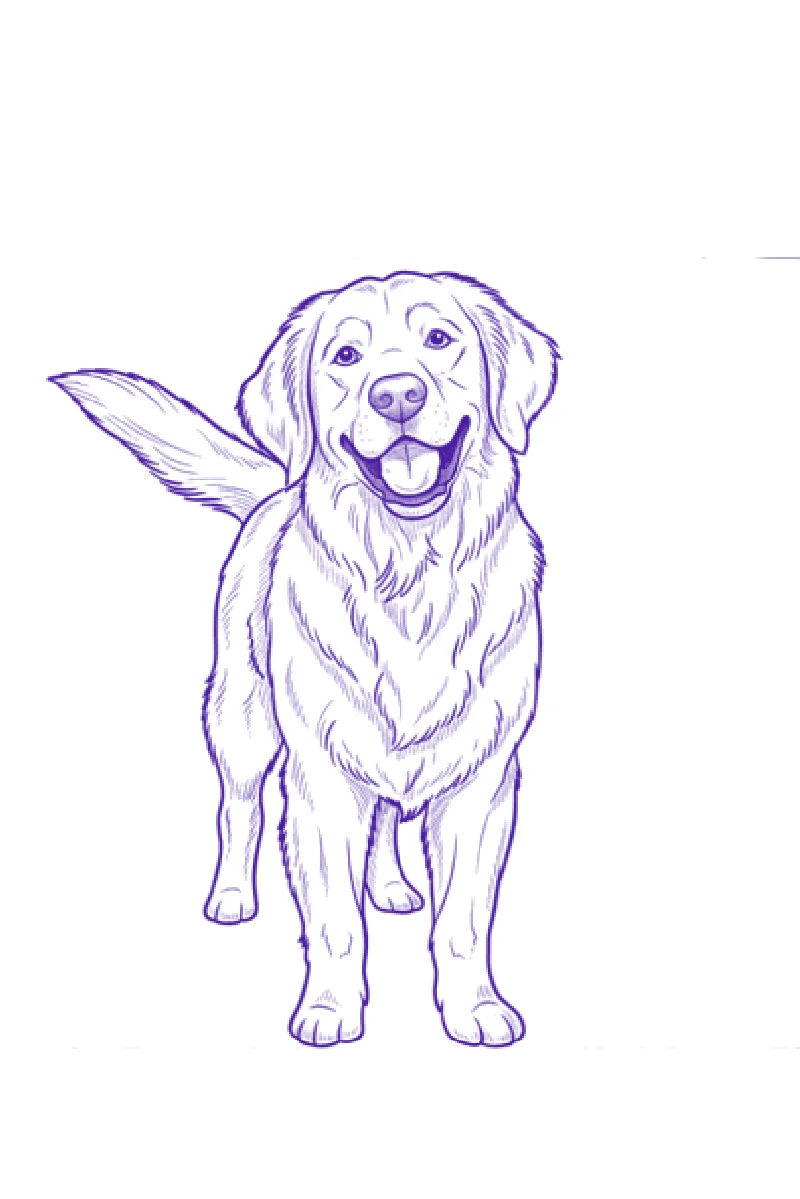
What a good dog stencil needs
- Eyes and nose placed exactly as in the photo. These are what make the client say "that is my dog".
- Nose as a clear shape with the nostril curves marked, and a highlight left white.
- Fur as directional strokes that follow the coat: long on the ears and chest, short on the muzzle.
- A clean outer edge, especially on light-coloured dogs where the fur fades into the background in the photo.
Styles and how the stencil changes
Black and grey realism
Full eye and nose detail, fur as a value and direction guide. Four to six inches on the forearm.
Fine line
Outline of the head and ears, eyes and nose only, no fur. Common for small memorial pieces.
Illustrative
Stylised outline with a collar, flowers or a name. Convert the face, add the rest in the editor.
Paw print and silhouette
No face detail; the silhouette or a paw converted at high contrast.
Placement and size
- Inner forearm: the most common pet memorial placement, three to six inches.
- Outer bicep: five to eight inches, room for a name or dates.
- Calf: six to nine inches.
- Ankle and wrist: fine-line head or paw print at two to three inches.
Make your own dog stencil from a reference
- Ask the client for a sharp, front-lit photo with the dog looking at the camera. Most phone photos of dogs are taken from above; a photo at eye level converts far better.
- Crop to the head and shoulders. Remove grass, furniture and other pets.
- Convert and raise contrast until the coat texture drops to strokes. Stop before the eyes lose their edges.
- Check the nose and the inner eye corners against the photo at the same size.
- For light dogs, add the outer edge by hand if the converter lost it against a bright background.
Stencify does the conversion step in about 30 seconds on iPhone, iPad or Android, with line weight and contrast controls, try-on at real size, and PNG or PDF export sized for stencil paper. The first two uses are free: get it on the App Store or on Google Play.
Frequently asked questions
Is the dog stencil on this page real app output?
Yes. The golden retriever was converted by Stencify from a phone photo and recoloured for thermal paper. Most other subjects in this library use sample stencils in the same style.
What photo should a client send for a dog portrait tattoo?
A sharp photo taken at the dog's eye level, front-lit, with the dog looking at the camera and a plain background. Photos from above distort the muzzle and should be avoided.
How do I stencil a dog with long or curly fur?
Raise contrast until the fur becomes direction strokes rather than curls, keep the eyes and nose sharp, and let the artist render the coat. Trying to stencil curls individually produces a stencil that will not transfer.
More subjects
Related reading
- How to Make a Tattoo Stencil - the full method from reference to skin
- How to Make a Tattoo Stencil From a Picture - converting photos step by step
- Tattoo Stencil Designs - the full gallery with notes on line weight
Convert your own dog reference
Photo or sketch in, clean line work out in about 30 seconds. Two free uses, then $4.99 a week or $47.99 a year.