Stencil library
Tiger tattoo stencil
Tigers convert better than most animals because the stripes give the converter real edges to work with. The risk is the opposite of a lion: too many lines rather than too few. A good tiger stencil draws each stripe as a closed shape the artist can fill, keeps the face symmetrical, and separates the fur texture of the cheeks from the stripes so they do not merge.
- Sample stencil, Stencify style
- Line work for thermal or hand transfer
- Prints on A4 or letter
- Updated Oct 4, 2026
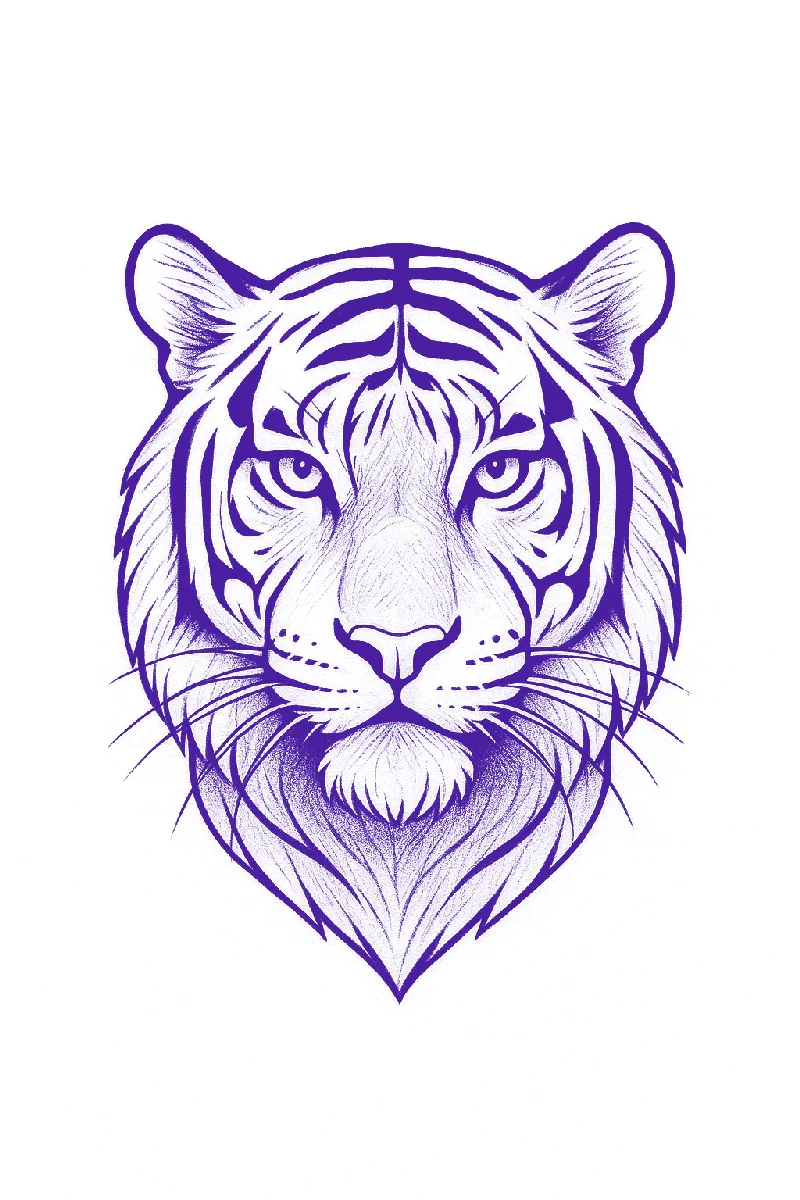
What a good tiger stencil needs
- Stripes as closed shapes with a clear edge on both sides, so the artist can pack them solid without guessing the width.
- Face centred and symmetrical: the nose bridge, the two eyes and the mouth as the strongest marks.
- Cheek fur suggested with a few strokes that show the direction, not converted hair.
- Ears with the inner shape marked. Converted ears often lose the inside and read as flat triangles.
Styles and how the stencil changes
American traditional
Bold outline, open mouth, stripes as thick solid shapes, often leaping. Convert flash line art rather than a photo.
Realism
Full face detail with stripes as value guides. Keep fur to a few directional strokes.
Japanese
Stylised tiger with bamboo or wind bars. Compose the scene first so everything converts at one weight.
Geometric
Half face in realism, half in polygons. Build the polygons in a design app and convert the whole image.
Placement and size
- Forearm: face at four to six inches, stripes filling to the edges.
- Thigh: a full-body leaping tiger at eight to twelve inches, two sheets.
- Chest and shoulder: face at six to eight inches, often the start of a Japanese sleeve.
- Back of the hand: traditional tiger head at two to three inches with no fur detail.
Make your own tiger stencil from a reference
- Choose a front-on or three-quarter face in even light. Dappled light through leaves creates false stripes.
- Crop to the head, or to the whole body for a leaping pose.
- Convert and raise contrast until the fur texture drops out and the stripes become clean shapes.
- Check that stripes are closed shapes. Join any that have broken open in the editor.
- Lower line weight for the whiskers or remove them and draw six to eight by hand.
Stencify does the conversion step in about 30 seconds on iPhone, iPad or Android, with line weight and contrast controls, try-on at real size, and PNG or PDF export sized for stencil paper. The first two uses are free: get it on the App Store or on Google Play.
Frequently asked questions
How many stripes should a tiger stencil have?
As many as the reference, but each as a closed shape. The problem with tiger stencils is rarely stripe count; it is stripes that merge with cheek fur. Raise contrast until the fur drops and the stripes stand alone.
Can I make a tiger stencil from a cartoon or illustration?
Yes, and it is often cleaner. Line illustrations convert at one consistent weight; photos need more contrast adjustment.
What size should a tiger face be on a forearm?
Four to six inches wide. Smaller than that and the stripes merge at the chin; larger and it wraps too far around the arm.
More subjects
Related reading
- How to Make a Tattoo Stencil - the full method from reference to skin
- How to Make a Tattoo Stencil From a Picture - converting photos step by step
- Tattoo Stencil Designs - the full gallery with notes on line weight
Convert your own tiger reference
Photo or sketch in, clean line work out in about 30 seconds. Two free uses, then $4.99 a week or $47.99 a year.