Stencil library
Dragon tattoo stencil
Dragons are long, so a dragon stencil is really two problems: the head, where all the character is, and the body, which has to flow around a limb without the scales turning into noise. Japanese dragons add whiskers, horns, mane and clouds, and each of these needs its own line weight or they merge. The stencil below keeps the head readable at four inches and uses a few scale rows as a guide rather than drawing every one.
- Sample stencil, Stencify style
- Line work for thermal or hand transfer
- Prints on A4 or letter
- Updated Oct 4, 2026
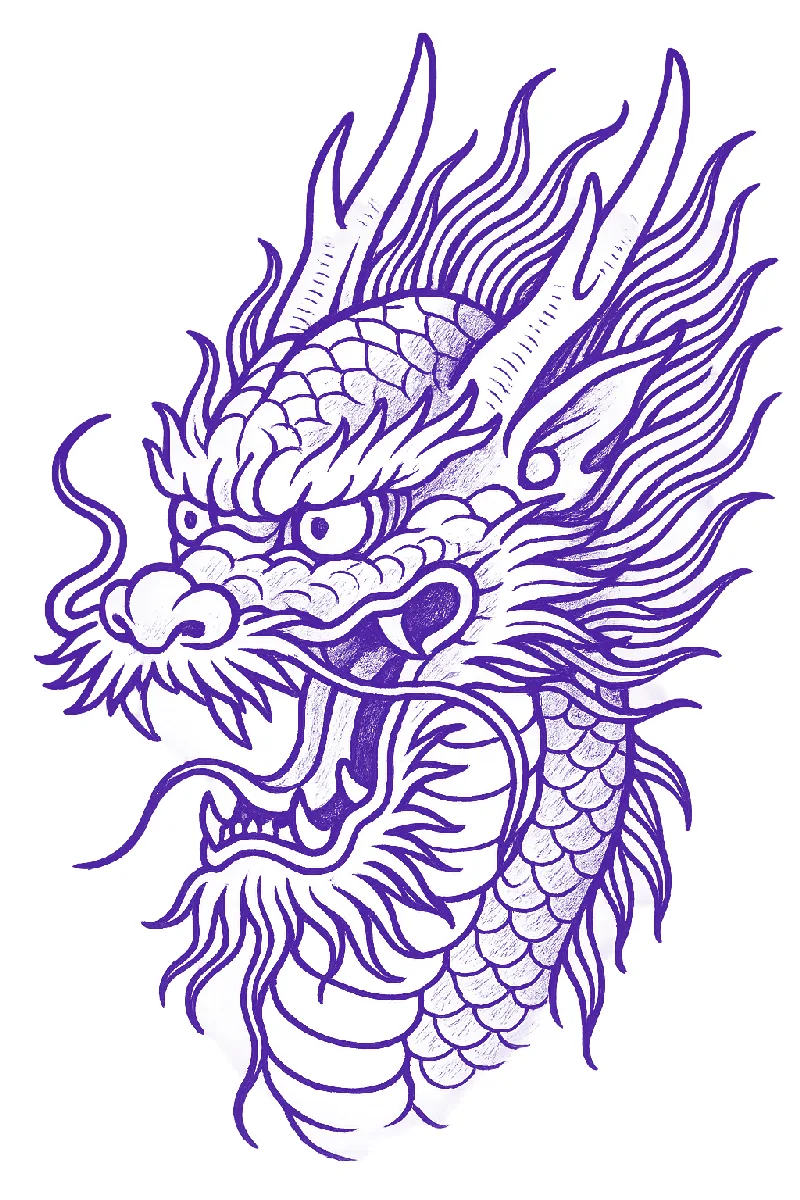
What a good dragon stencil needs
- One unbroken spine line from the back of the head to the tail tip. The artist follows this to keep the body flowing; everything else hangs off it.
- Scales drawn as a few representative rows along the belly and back. A photo or illustration with every scale produces a stencil that transfers as a grey band.
- Horns, whiskers and mane at three different weights: horns heaviest, mane medium, whiskers lightest.
- Claws and teeth as simple pointed shapes with a clear base. Converted claws often lose their base line and float.
Styles and how the stencil changes
Japanese (irezumi)
Bold outline, mane and whiskers kept, scales suggested in bands. Clouds, waves or flames around the dragon should be in the reference so they share line weight.
Chinese
Longer, more serpentine body, smaller head, flowing tendrils. The stencil needs the body curve more than the detail; keep inner lines sparse.
Western
Bat-like wings, heavier body, often with a castle or knight. Wings convert well because the membrane edges are clear; simplify the body scales.
Fine line and minimal
Outline only with the mane reduced to a few strokes. Works for small dragons behind the ear or along the collarbone.
Placement and size
- Full sleeve or half sleeve: print across two or three sheets and join along the spine line. Mark the join on each sheet before cutting.
- Spine or side of the torso: a dragon that reads vertically; rotate the reference before converting so the stencil prints in the right orientation.
- Forearm wrap: the head sits on the outer forearm and the body wraps inside. Use try-on to check that the head lands where the client expects.
- Thigh: room for a full dragon with clouds at eight to twelve inches, usually a two-sheet print.
Make your own dragon stencil from a reference
- Start from line art rather than a painted or 3D-rendered dragon when you can. Rendered dragons are all gradient and produce almost no clean edges.
- If the reference is a painting, raise contrast until only the outline and major inner lines remain, then add scale rows by hand.
- Convert the head and body in one pass so the line weights match. Converting them separately almost always produces two different weights.
- Check whiskers and mane tips at print size. If they break up, raise line weight one step and accept a slightly heavier head.
- Print with registration marks if the stencil spans more than one sheet, and apply the head first.
Stencify does the conversion step in about 30 seconds on iPhone, iPad or Android, with line weight and contrast controls, try-on at real size, and PNG or PDF export sized for stencil paper. The first two uses are free: get it on the App Store or on Google Play.
Frequently asked questions
How do I keep dragon scales from turning into a grey smear?
Do not stencil every scale. Keep two or three rows along the belly and back as guides, and either hand-draw the rest in the editor or leave them to the artist. Scales below about 3 mm will not transfer as separate shapes.
What size should a dragon stencil be for a forearm?
Most forearm dragons are eight to twelve inches long and two to three inches wide at the head. Print at 100 percent and check with try-on; the stencil wraps further than it looks on screen.
Can I convert a dragon from a tattoo photo?
You can, but tattoo photos carry skin texture, healing and lighting that produce stray lines. A flash drawing or illustration converts cleaner. If you must use a tattoo photo, crop tight and raise contrast more than usual.
More subjects
Related reading
- How to Make a Tattoo Stencil - the full method from reference to skin
- How to Make a Tattoo Stencil From a Picture - converting photos step by step
- Tattoo Stencil Designs - the full gallery with notes on line weight
Convert your own dragon reference
Photo or sketch in, clean line work out in about 30 seconds. Two free uses, then $4.99 a week or $47.99 a year.