Stencil library
Eagle tattoo stencil
Eagles are a feather problem with a sharp focal point. The beak and eye convert cleanly because they have hard edges; the feathers do not, and a wing with every feather drawn transfers as a grey wedge. The stencil below keeps the head feathers as a few layered rows, draws the beak as the heaviest line on the page, and keeps the eye small and sharp.
- Sample stencil, Stencify style
- Line work for thermal or hand transfer
- Prints on A4 or letter
- Updated Oct 4, 2026
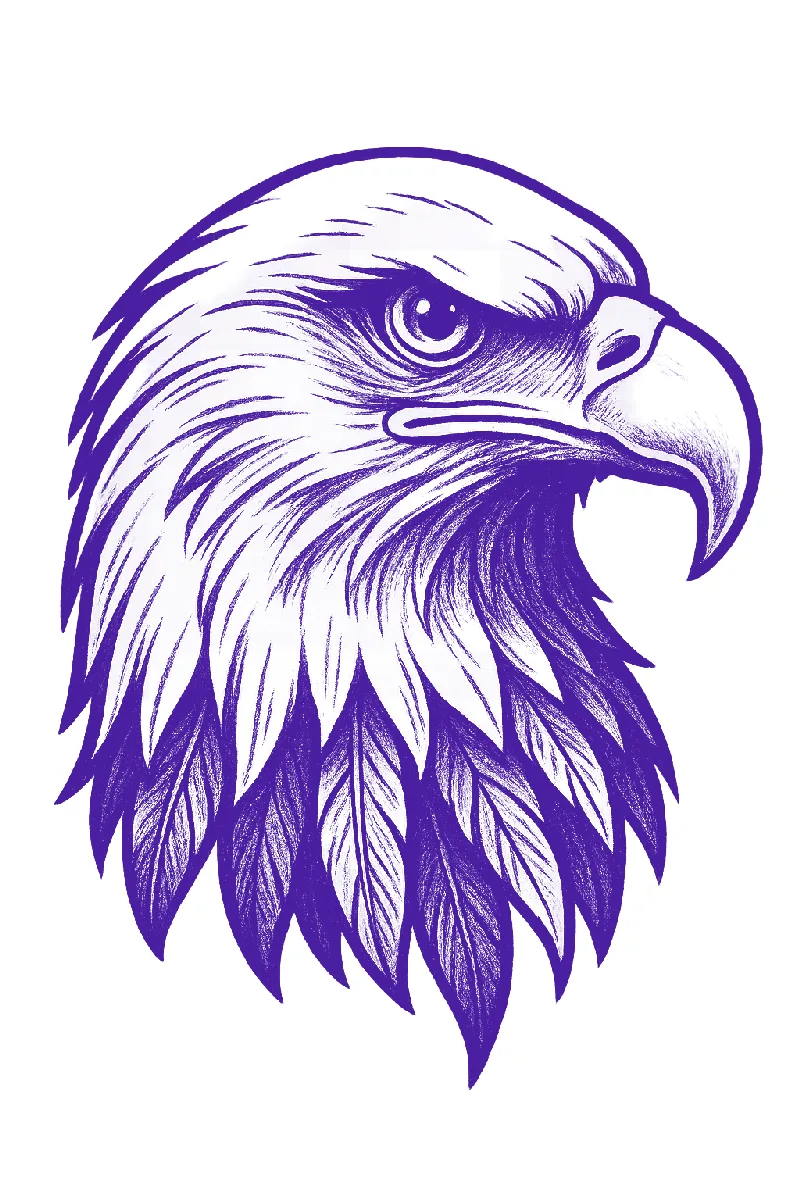
What a good eagle stencil needs
- Beak as a clean hooked shape with the nostril marked, drawn heavier than the feathers.
- Eye as a small circle under a clear brow ridge. The brow is what gives an eagle its expression.
- Head and neck feathers as layered rows of five to eight strokes, pointing back and down.
- For spread wings: primary feathers as separate shapes, secondaries as a scalloped edge, coverts as texture left to the artist.
Styles and how the stencil changes
American traditional
Bold outline, spread wings, often with a banner, flag or anchor. Convert flash line art; photos lose the shapes traditional needs.
Realism
Head portrait with full beak and eye detail, feathers as a direction and value guide.
Fine line
Outline of a head or a soaring silhouette, no feather detail.
Chest piece
Wings spread across the chest with the head centred. Print across two sheets and join at the body.
Placement and size
- Chest: the classic placement, wings spanning ten to fourteen inches across two sheets.
- Outer forearm: head at four to six inches, or a soaring eagle at five to seven.
- Shoulder blade: a landing or soaring eagle at six to nine inches.
- Back: a full-span eagle at twelve inches or more, two or three sheets with registration marks.
Make your own eagle stencil from a reference
- Pick a reference with the head in profile or three-quarter and the beak clearly against a plain background.
- Crop to the head for a portrait, or to the full wingspan for a chest piece.
- Convert and raise contrast until the feather texture drops to rows of strokes.
- Sharpen the beak and eye by hand if the converter softened them.
- For multi-sheet prints, mark the join through the body rather than through a wing so the feathers line up.
Stencify does the conversion step in about 30 seconds on iPhone, iPad or Android, with line weight and contrast controls, try-on at real size, and PNG or PDF export sized for stencil paper. The first two uses are free: get it on the App Store or on Google Play.
Frequently asked questions
How do I stencil eagle wing feathers?
Separate the primaries (the long fingers at the tip) as individual shapes, draw the secondaries as a scalloped edge, and leave the small covert feathers to the artist. A stencil with every covert drawn will not transfer cleanly.
What size is an eagle chest piece stencil?
Usually ten to fourteen inches across. Print on two sheets at 100 percent with the join at the body, and apply the centre first.
Traditional or realism eagle: which converts better?
Traditional, if you start from line art. Photos for realism need more contrast adjustment and hand cleanup on the feathers, but the beak and eye convert well either way.
More subjects
Related reading
- How to Make a Tattoo Stencil - the full method from reference to skin
- How to Make a Tattoo Stencil From a Picture - converting photos step by step
- Tattoo Stencil Designs - the full gallery with notes on line weight
Convert your own eagle reference
Photo or sketch in, clean line work out in about 30 seconds. Two free uses, then $4.99 a week or $47.99 a year.