Stencil library
Snake tattoo stencil
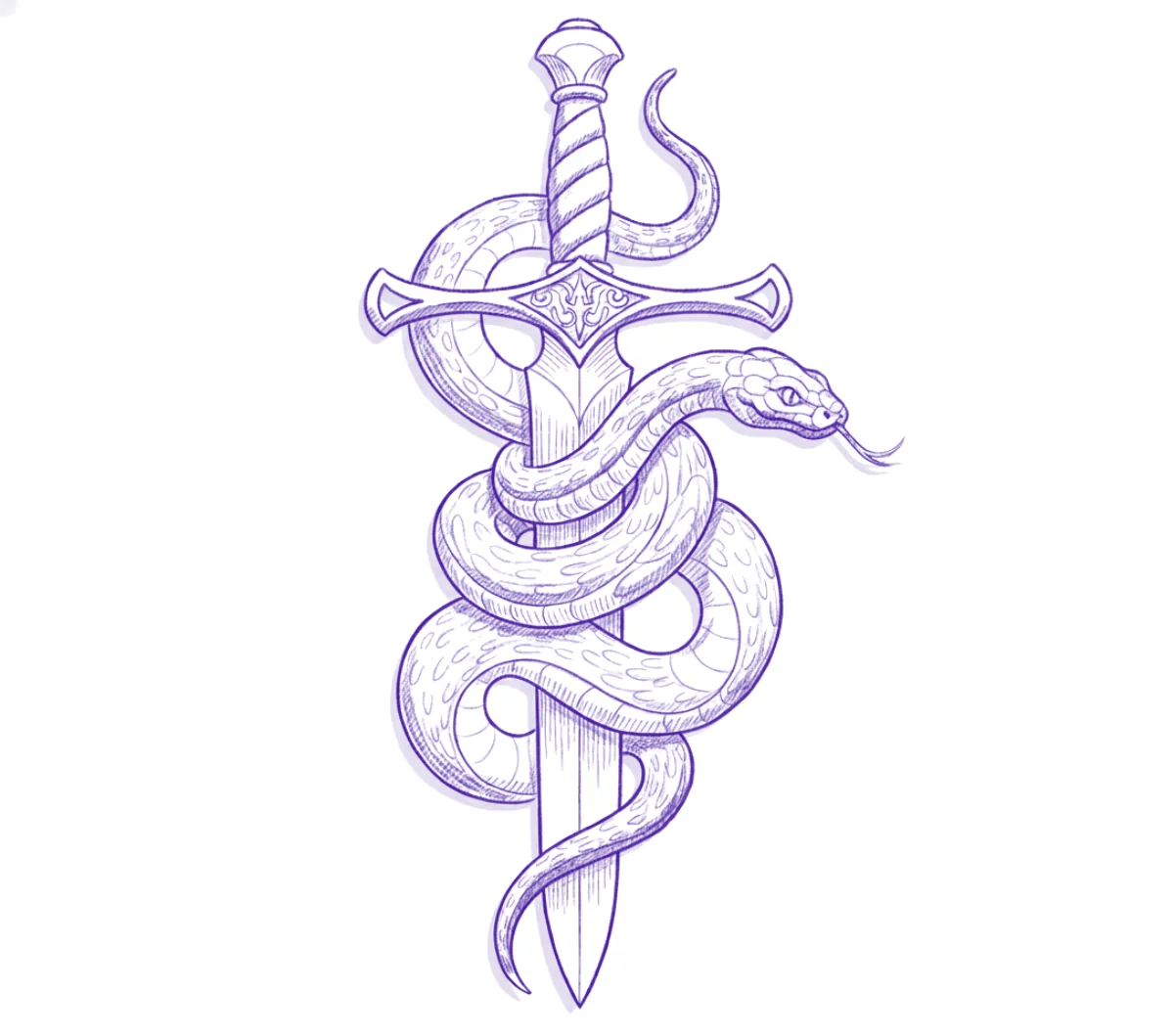
The snake stencil below is real Stencify output from a photo reference, not a drawn sample. Snakes are a good test of any converter because the coils cross each other and the scales run in diagonal bands that change direction at every bend. A good snake stencil tells the artist which coil is in front at each crossing, keeps the head and fangs crisp, and uses the scale pattern as texture only where it helps.
- Real Stencify output
- Line work for thermal or hand transfer
- Prints on A4 or letter
- Updated Oct 4, 2026
What a good snake stencil needs
- Clear overlap at every crossing. Where the body passes behind itself, the back coil line must stop at the front coil edge. This is the single most common error in snake stencils.
- Head drawn heavier than the body, with the eye, jaw line and fangs as the sharpest marks on the stencil.
- Scale bands suggested along the back and dropped on the belly. The belly scales are wide and flat and read as stripes, which is usually what you want.
- Tail that tapers to a real point. Converted tails often end in a blunt line; fix this by hand before printing.
Styles and how the stencil changes
American traditional
Bold outline, open mouth, a few diamond-pattern scales along the spine. Often wrapped around a dagger, rose or skull, which should be in the same reference.
Fine line
Single thin outline with no scales at all, often a long single curve along a collarbone or down the spine.
Realism
Outline plus scale bands as a texture guide. Keep the head detail and let the body fade to outline toward the tail.
Japanese
Heavier line, stylised head, often with flowers. The scales are drawn as a repeating pattern rather than converted from a photo.
Placement and size
- Forearm wrap: the head on the inside of the wrist and the body coiling up the arm. Print at 100 percent, cut along one coil and apply in two pieces.
- Spine: a vertical snake eight to fourteen inches long. Rotate the reference before converting so the printed orientation matches.
- Hand and finger: fine-line snake at two to three inches, no scales, head on the back of the hand.
- Thigh and hip: room for a coiled snake with a rose or dagger at six to ten inches.
Make your own snake stencil from a reference
- Use a reference where the snake is on a plain background. Snakes on leaves, rocks or skin produce dozens of stray edges.
- Crop so the whole body is in the frame. A cropped coil loses the information about what is in front.
- Convert, then check every crossing. If a back coil line runs through a front coil, erase it in the editor.
- Raise contrast until the small scales drop out and only the bands remain, then lower line weight slightly for the tail.
- For wrapped placements, try it on at real size, since a snake that looks right on screen often needs to be 20 percent longer on the arm.
Stencify does the conversion step in about 30 seconds on iPhone, iPad or Android, with line weight and contrast controls, try-on at real size, and PNG or PDF export sized for stencil paper. The first two uses are free: get it on the App Store or on Google Play.
Frequently asked questions
Is the snake stencil on this page real app output?
Yes. The snake and dagger was converted by Stencify from a photo reference and recoloured for thermal paper. Most other subjects in this library use sample stencils in the same style.
How do I stencil a snake that wraps around an arm?
Convert the snake flat, print at 100 percent, then cut the stencil paper along one coil so you can apply the head section and the body section separately. Stretch the skin slightly on the inside of the arm before pressing.
Should I include the scales?
Include a few bands along the back as a guide and skip the rest. Full scales below about 3 mm will not transfer cleanly, and most artists prefer to render scales freehand.
More subjects
Related reading
- How to Make a Tattoo Stencil - the full method from reference to skin
- How to Make a Tattoo Stencil From a Picture - converting photos step by step
- Tattoo Stencil Designs - the full gallery with notes on line weight
Convert your own snake reference
Photo or sketch in, clean line work out in about 30 seconds. Two free uses, then $4.99 a week or $47.99 a year.