Stencil library
Skull tattoo stencil
A skull stencil lives or dies on three decisions: the outline of the cranium, the shape of the eye sockets, and how many teeth you draw. Photo references of real skulls carry hundreds of fine cracks and sutures that look like detail on screen and like dirt on a thermal transfer. The stencil below keeps the big shapes, hatches the sockets so the artist knows where the darkness lands, and pairs the skull with roses, which is the combination most clients ask for.
- Sample stencil, Stencify style
- Line work for thermal or hand transfer
- Prints on A4 or letter
- Updated Oct 4, 2026
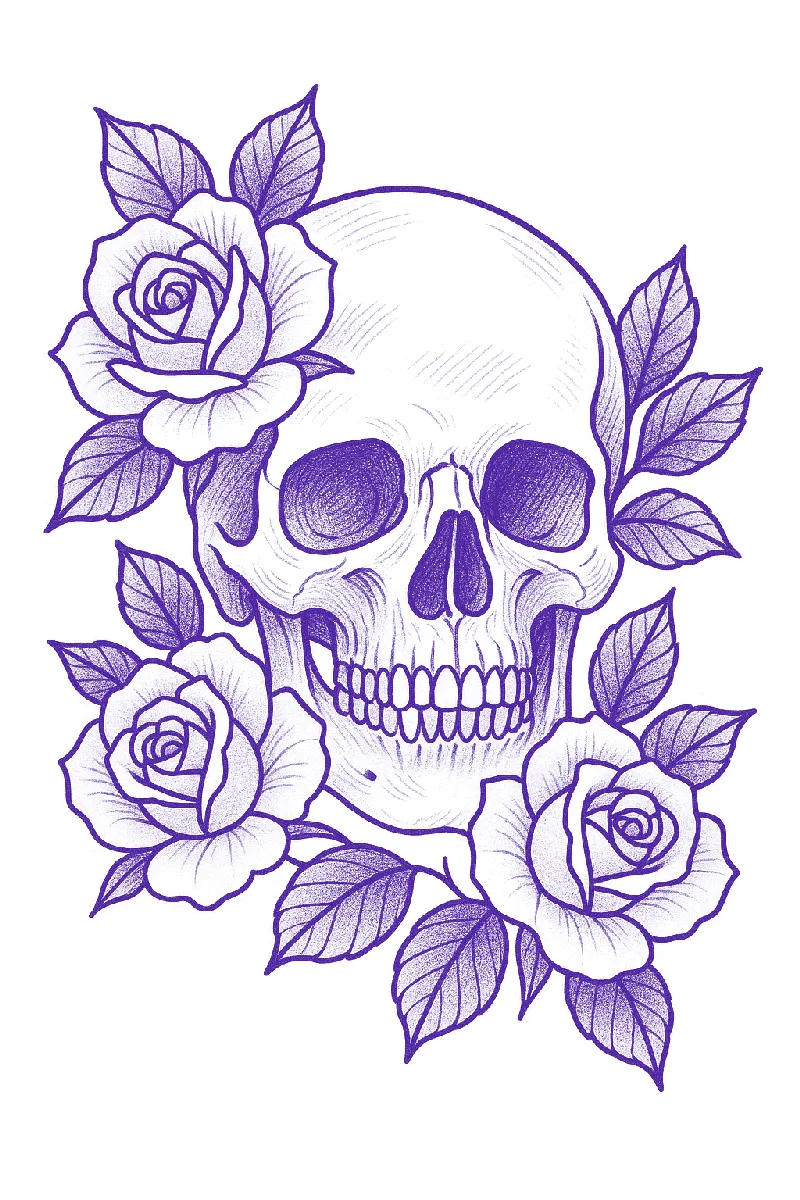
What a good skull stencil needs
- A single continuous outline around the cranium and jaw. Breaks in this line are the first thing clients notice on the finished tattoo.
- Eye sockets and nasal cavity shown as shapes, either solid-edged or hatched, not as photographic shading.
- Teeth drawn as a row of separated rectangles with a slight curve. Photo teeth come out uneven and distract from the rest.
- Cheekbone and temple lines kept to one or two strokes each. These are where realism skulls get their form, and where most references over-deliver.
Styles and how the stencil changes
American traditional
Thick outline, solid black sockets, five or six oversized teeth. The stencil only needs the outline and the socket shapes.
Realism
Thin outline with the socket, nasal and cheekbone edges marked. Keep hatching to show value direction and leave the rest to the needle.
Neo-traditional
Outline plus a few decorative lines: cracks that follow the suture pattern, a crown, or flowers around the jaw. Draw these in rather than converting them from a photo.
Blackwork and geometric
Outline only, often with a mandala or lines cut through the cranium. Convert the skull, then add geometry in a drawing app before printing.
Placement and size
- Forearm, outer: four to six inches, usually with roses or a dagger filling the width.
- Hand: a skull at two to three inches works only in bold traditional style with no inner texture.
- Chest and sternum: larger pieces of eight to twelve inches, printed across two sheets with the join running through a flat area such as the forehead.
- Knee and elbow: skulls are a classic here because the socket shapes wrap the joint. Test placement with try-on, then stretch the skin while applying the transfer.
Make your own skull stencil from a reference
- Choose a reference at a three-quarter angle. Straight-on skulls flatten; profile skulls lose the second socket.
- Crop to the skull and whatever sits with it. Background bone, text or other skulls in the frame will confuse the edges.
- Convert and raise contrast until the suture lines and surface texture disappear. You want the outline, sockets, nasal cavity and teeth, nothing else.
- Check the teeth. If they have merged, lower line weight a step or clean them by hand in the editor.
- Add roses, daggers or text in the reference before you convert, so everything comes out at one consistent line weight.
Stencify does the conversion step in about 30 seconds on iPhone, iPad or Android, with line weight and contrast controls, try-on at real size, and PNG or PDF export sized for stencil paper. The first two uses are free: get it on the App Store or on Google Play.
Frequently asked questions
Should a skull stencil include the cracks and sutures?
Only if the style calls for it. Traditional and blackwork skulls drop them; realism skulls keep two or three as guides. Converting every crack from a photo produces lines too fine to transfer.
How do I keep the eye sockets from filling in?
Treat the sockets as shapes with an edge, not as shaded areas. Raise contrast so the interior drops to white, then hatch or mark the darkest point by hand if you want a guide.
Does the skull and roses combination need a separate stencil for each element?
No. Place both in one reference, convert once, and the line weights match. Separate stencils for skull and roses almost always come out at different weights.
More subjects
Related reading
- How to Make a Tattoo Stencil - the full method from reference to skin
- How to Make a Tattoo Stencil From a Picture - converting photos step by step
- Tattoo Stencil Designs - the full gallery with notes on line weight
Convert your own skull reference
Photo or sketch in, clean line work out in about 30 seconds. Two free uses, then $4.99 a week or $47.99 a year.