Birth Flower Tattoos by Month: Flowers and Stencil Tips
• by Stencify • 8 min read
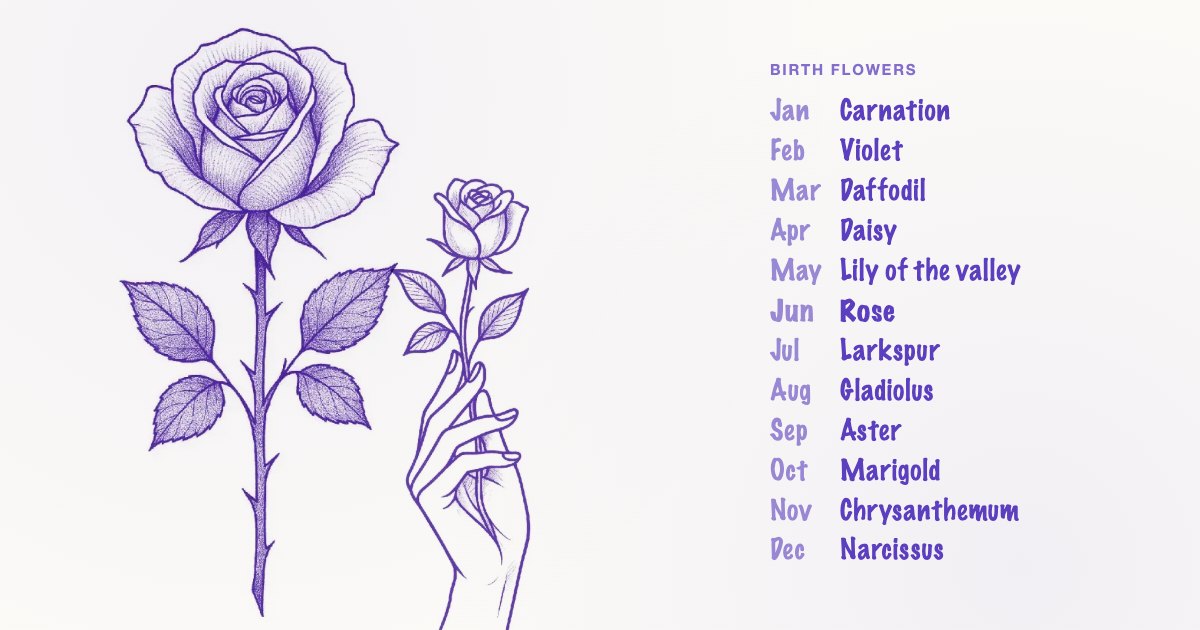
Birth flower tattoos are popular because they carry meaning without needing words: one stem for your own month, or a small bouquet for each person in a family. They are also deceptively hard to draw well. Some flowers, like cosmos or snowdrops, are made of a few clean shapes. Others, like marigolds and chrysanthemums, are dense layers of petals that turn to a dark blob if they are drawn too small. This guide lists the flower for each month, notes where common US and UK lists differ, and gives line-weight and stencil notes for each flower.
Key takeaways
- Most lists agree on ten of the twelve months. January, February and December are where US and UK sources differ most.
- Open, few-petal flowers (cosmos, violet, primrose, snowdrop) work at small sizes. Dense ones (marigold, chrysanthemum, carnation) need more room or a simplified drawing.
- Use a heavier outline and lighter interior lines. Petal veins and texture should be suggested, not drawn line for line.
- In a family bouquet, keep one line weight across every flower so the piece reads as one design.
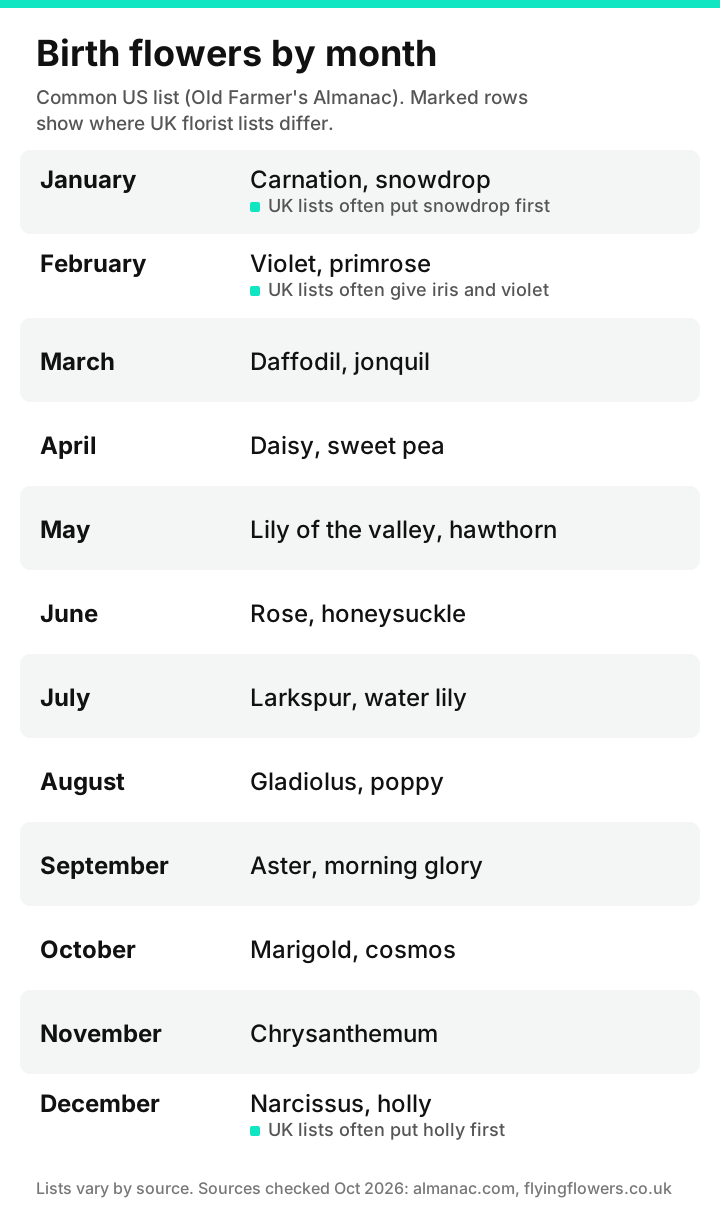
Birth flowers by month
US and UK lists: where they differ
Birth flowers are a tradition kept by almanacs and florists, not a fixed standard, so lists vary. The pairs in the chart follow the Old Farmer's Almanac list (almanac.com, checked October 2026), which most US sources repeat. UK florist lists, for example Flying Flowers (flyingflowers.co.uk, checked October 2026), match it for ten months and differ in three places:
| Month | Common US list | UK florist list |
|---|---|---|
| January | Carnation, snowdrop | Snowdrop listed first, then carnation |
| February | Violet, primrose | Iris and violet |
| December | Narcissus, holly | Holly listed first, then paperwhite narcissus |
If a client was born in February in the UK and says their flower is an iris, they are not wrong. Ask which flower they mean before drawing anything, and if they are unsure, offer both.
Stencil notes by month
Sizes below are rough guides for the height of a single stem or head, in black line work. Colour and heavy shading change the picture, and every artist's hand is different.
January: carnation and snowdrop
Carnation. The serrated, ruffled petal edges are the identity of the flower and also the problem. At small sizes, draw three or four notches per petal instead of a continuous zigzag, and keep the inner layers as a few curved strokes. Aim for 5 cm or more for a single head. Snowdrop. One of the cleanest birth flowers to tattoo: three drooping outer petals, a small inner cup and a thin arching stem. It works as fine line from about 4 cm. Keep the gap between the outer petals open.
February: violet, primrose and iris
Violet. Five rounded petals and heart-shaped leaves. Two or three short vein lines on the lower petal are enough. Primrose. A flat, open face with notched petal tips and a ring in the centre; it reads well very small. Iris. The most complex of the three, with upright standards and drooping falls that overlap. Give it at least 6 to 7 cm and draw the vein pattern on the falls with sparse, separated lines.
March: daffodil and jonquil
Daffodil. Six outer petals and a central trumpet. A three-quarter view reads better than a flat front view, because the trumpet shows its depth. Draw the trumpet's ruffled rim as a gentle wave, not a sharp zigzag. Jonquil. Several small daffodil-like heads on one stem. Reduce it to two or three heads for anything under 8 cm.
April: daisy and sweet pea
Daisy. Many thin petals around a disc. At small sizes, cut the petal count to around 12 to 16 and keep a clear gap between each. Mark the centre with a circle and a few dots spaced well apart instead of dense stipple. Sweet pea. Ruffled, winged petals and curling tendrils. The tendrils are single thin lines that give the design movement, which makes sweet pea a good choice for wrapping a wrist or ankle.
May: lily of the valley and hawthorn
Lily of the valley. Small bell-shaped flowers hanging from an arched stem, with long blade leaves. Each bell needs to stay at least about 4 to 5 mm across, so five or six bells is plenty on a small piece. Hawthorn. Clusters of tiny five-petal blossoms, lobed leaves and thorns. A full cluster gets busy fast; pick three blossoms and a sprig of leaves.
June: rose and honeysuckle
Rose. The most tattooed flower of all. Keep the spiral at the centre simple, with four or five inner petal lines rather than ten. Our rose stencil page covers sizes and placements in detail. Honeysuckle. Long tubular flowers with stamens that stick out past the petals. Draw the stamens as thin, well-spaced lines; they are what makes it recognisable.
July: larkspur and water lily
Larkspur. A tall spike of small florets, ideal for a forearm, spine or the side of the ribs. Reduce the number of florets toward the tip so the top stays open. Water lily. Pointed petals radiating from the centre, often with a round pad beneath. It is wide rather than tall, so it suits a shoulder, upper arm or the top of a foot. Keep any water ripple lines light and few.
August: gladiolus and poppy
Gladiolus. Another tall spike, with larger ruffled florets than larkspur. It needs length, 10 cm or more, to show three or four florets clearly. Poppy. Four crinkled, papery petals and a dark centre. On the stencil, outline the centre and the seed head but leave the dark fill to the tattoo itself. Two or three crinkle lines per petal are enough.
September: aster and morning glory
Aster. Like a daisy with finer, more numerous petals. Simplify harder than you would for a daisy, or go larger. Morning glory. A trumpet-shaped flower with a five-pointed star pattern from the centre, on a vine with heart-shaped leaves. The vine makes it a natural fit for wrapping placements, and the star lines are a strong, simple detail.
October: marigold and cosmos
Marigold. A dense, round head of ruffled petals. This is one of the hardest birth flowers to keep clean at small sizes. Draw the outer silhouette and a few inner arcs, not every petal, and allow at least 5 to 6 cm. Cosmos. Usually eight broad petals with notched tips around a small centre. Clean, open and a very good fine-line flower even at 3 to 4 cm.
November: chrysanthemum
Chrysanthemum. Many layers of narrow petals. In a realistic style it needs real size, around 8 cm or more. The alternative is a stylised version, such as the bold, rounded chrysanthemums of Japanese tattooing, which reduces the petals to clear shapes that hold up for decades.
December: narcissus and holly
Narcissus (paperwhite). Clusters of small, six-petal star flowers with a short cup. Keep each flower distinct and the cluster to three or four heads. Holly. Spiky leaves and round berries. Make the leaf points sharp but not hair-thin, and draw berries as clean circles at least 3 mm across so they do not fill in.
Line weight for flowers
Flowers look best with a clear hierarchy of lines. A practical setup for black line work:
- Outline: the heaviest line, around the flower head, leaves and stem.
- Petal overlaps: a medium line where one petal sits in front of another.
- Veins and texture: the lightest lines, short and few, never touching the outline at both ends.
On the stencil, you mostly need the outline and overlaps. Texture can be marked with a few guide strokes and finished freehand. Keep lines at least about 1 mm apart at the final size, which is the same rule our small tattoo guide uses. For how line weight changes between fine line, bold and traditional styles, see stencil technique by style.
Combining several birth flowers
A family bouquet, with one flower for each partner or child, is one of the most requested versions. A few things keep it readable:
- Keep real proportions. A lily of the valley bell is small and a rose head is large. Scaling them to the same size looks odd to anyone who knows flowers.
- Put the dense flower at the centre. Roses, marigolds and chrysanthemums anchor a bouquet. Spikes such as larkspur and gladiolus go at the back, adding height.
- Use one line weight system across every flower, even if the references came from different sources.
- Plan for additions. If the client may add a flower later, leave space on one side and agree where it will go.
Expect a bouquet of four or five flowers to need a forearm, upper arm or ribs placement. For memorial versions, such as a parent's birth flower, our memorial tattoo ideas post covers combining flowers with names and dates.
From reference to stencil
Draw from photographs of the real flower, not from other people's tattoos. A good botanical photo shows how the petals actually overlap, which is what makes a drawing believable. If you are sketching, draw at the final size from the start so you see early whether the detail fits.
To speed this up, you can convert a flower photo or your sketch into line work and adjust from there. Stencify does this in about 30 seconds, with controls for line weight and contrast, edits by text prompt (for example, fewer petals or a thicker outline), and a try-on preview to check the size on the body before you print. It exports PNG or PDF for A4 or US Letter. It runs on iPhone, iPad and Android, with two free uses: App Store or Google Play. Before printing, follow how to size and print a tattoo stencil so the flower comes out at the size you measured.
Frequently asked questions
What is the birth flower for each month?
A common list is: January carnation and snowdrop, February violet and primrose, March daffodil and jonquil, April daisy and sweet pea, May lily of the valley and hawthorn, June rose and honeysuckle, July larkspur and water lily, August gladiolus and poppy, September aster and morning glory, October marigold and cosmos, November chrysanthemum, December narcissus and holly.
Are UK birth flowers different from US birth flowers?
Mostly they match. UK florist lists often give iris and violet for February instead of violet and primrose, and put snowdrop first for January and holly first for December.
Which birth flowers are best for small tattoos?
Open flowers with few petals: cosmos, violet, primrose, snowdrop and lily of the valley. Dense flowers such as marigold, chrysanthemum and carnation need more size or a simplified drawing.
How big should a birth flower bouquet tattoo be?
It depends on the flowers, but a bouquet of four or five usually needs a forearm, upper arm or ribs placement so each flower keeps its detail and lines stay about 1 mm apart.
Related reading
- Small Tattoo Ideas - sizes that keep tiny designs readable
- Memorial Tattoo Ideas - flowers, names and dates
- Rose Tattoo Stencil - a full rose example
- Stencil Technique by Style - line weight in fine line and traditional
Turn a flower photo into clean line work
Stencify converts a photo or sketch into a print-ready stencil in about 30 seconds, with line weight and contrast controls.