How Much Does a Tattoo Cost? Prices, Minimums and Tipping
• by Stencify • 6 min read
There is no single price for a tattoo. The same small design can cost very different amounts in a small town and a big city, from an apprentice and from an artist with a two-year waitlist. What can be explained is how artists charge, which factors move a price, and the rough ranges published for the US. This guide covers all three, with the source and date for every number, so you can read a quote with some context. Prices change, and they vary by country, city and artist, so treat every figure here as a starting point, not a promise.
Key takeaways
- Most shops have a minimum charge that covers setup, so even a tiny tattoo costs at least that amount. US guides published in 2026 put minimums at roughly $80 to $200.
- Larger and custom work is usually priced by the hour or by the day; flash is usually a fixed price per design.
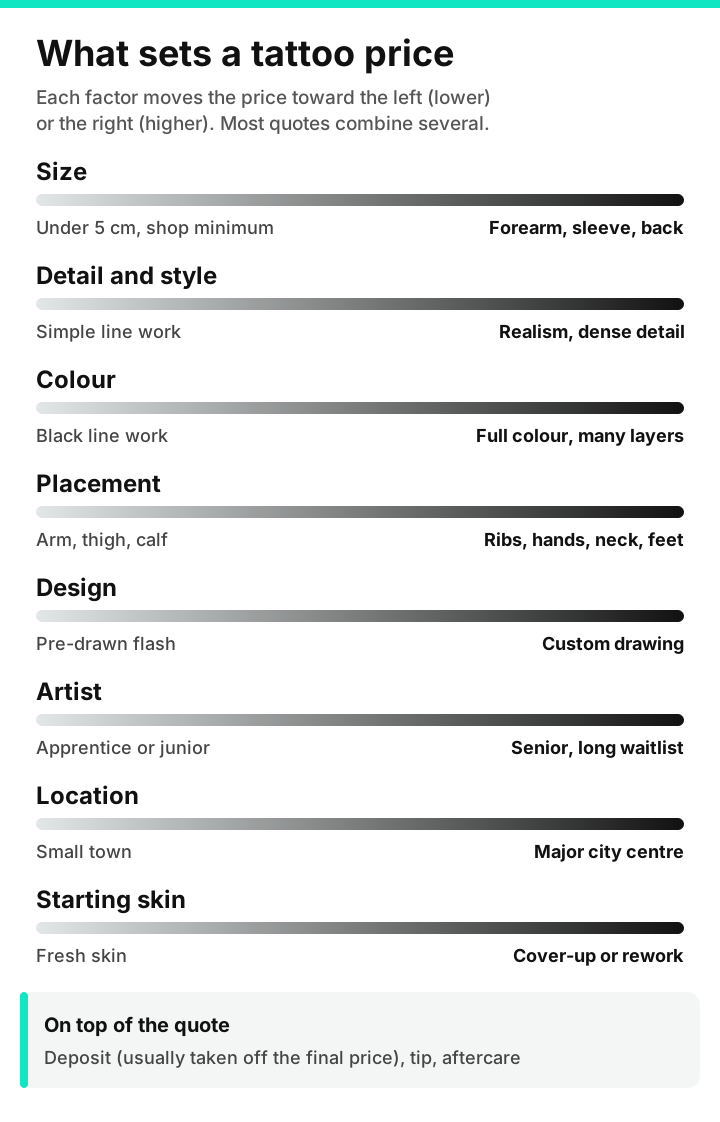
- Size, detail, colour, placement, the artist's experience and the city matter most. Cover-ups cost more than fresh work.
- In the US, a tip of 15 to 20% is commonly suggested. Customs differ in other countries.
How artists charge
- Shop minimum. The lowest price for any tattoo, however small. It covers the needle, ink, barrier film, setup and cleaning, which cost the same for a 2 cm heart as for a much bigger piece. Most small tattoos are charged at the minimum or a little above it.
- Hourly rate. Common for custom and larger work. The final cost depends on how long the tattoo takes, so the artist will usually give an estimate in hours.
- Flat rate (by the piece). A fixed price agreed in advance. Typical for flash, where the design is already drawn, and for small to medium custom pieces where the artist can judge the time well.
- Day rate. For large projects such as sleeves and back pieces, some artists charge per full-day session instead of per hour.
Ask which model applies when you get a quote. An hourly estimate and a flat price can look similar at the start and end up quite different.
Published US price ranges
There is no official national survey of tattoo prices. The figures below come from two US guides updated in 2026. Both are published by businesses (a services marketplace and a tattoo supply retailer), not independent researchers, and their numbers differ, so read them as rough benchmarks.
| What | Airtasker (updated 1 Oct 2026) | Tommy's Supplies (4 May 2026) |
|---|---|---|
| Shop minimum | $80 to $150+ | $80 to $200 |
| Hourly, junior or apprentice | $50 to $100 | $80 to $130 |
| Hourly, mid-level | $100 to $150 (2 to 5 years) | $130 to $250 (3 to 7 years) |
| Hourly, senior | $150 to $300; $300 to $500+ for experts | $250 to $400; $400+ for the most in-demand |
| Small tattoo | $70 to $200+ (2 to 3 in) | $150 to $400 (2 to 4 in) |
| Large tattoo | $500 to $1,500+ (7 to 9 in) | $500 to $2,000 (6 in and up) |
| Day rate | Not given | $800 to $2,000 |
Sources: Airtasker, "Tattoo cost" price guide (airtasker.com/us), last updated October 1, 2026; Tommy's Supplies, "The Complete Guide to Tattoo Pricing: How Much Does a Tattoo Cost in 2026?" (tommyssupplies.com), May 4, 2026. Tommy's Supplies also estimates that prices in major metro areas run about 20 to 40% above the national baseline.
What moves the price
Size
Bigger tattoos take longer, but the relationship is not linear. Below a certain size every tattoo costs the minimum, and above it time rises with area and detail. A tiny tattoo is rarely much cheaper than a slightly larger one, which is worth knowing if a design would read better a little bigger. Our small tattoo guide explains why going too small can hurt the result as well.
Detail and style
Simple line work is fast. Realism, fine detail, dense shading and intricate patterns take many more hours at the same size. A 10 cm outline and a 10 cm realistic portrait are different jobs.
Colour
Colour work often takes longer than black line work because of packing, blending and layering, and many artists charge more for it.
Placement
Ribs, hands, feet, neck and other areas with thin, stretchy or bony skin are slower to work on and harder to keep steady. Expect a higher price or a longer time estimate there than on an outer arm or calf.
Flash versus custom
Flash is drawn once and tattooed many times, so it is usually cheaper and priced up front. Custom work includes drawing time, which some artists build into the price and others charge separately.
The artist and the city
Experience, reputation and demand all raise rates, and so does rent. A senior artist in a major city centre will typically charge several times an apprentice's rate in a small town.
Cover-ups and rework
Covering or fixing an existing tattoo takes more planning and usually more time and saturation than fresh skin. Tommy's Supplies (May 2026) estimates cover-ups at 1.5 to 2 times the cost of a new tattoo of the same size. Our cover-up stencil guide explains why they take longer.
Deposits, tips and touch-ups
Deposits. Most artists take a deposit to book an appointment, especially for custom work. It is commonly taken off the final price and is often non-refundable if you cancel late or do not show up. Ask about the policy before paying.
Tips. In the US, both guides above suggest tipping. Tommy's Supplies (May 2026) gives 15 to 20%, with 20% the most common; Airtasker (October 2026) gives 15 to 25%, with 20% as the benchmark. On a $300 tattoo, 20% is $60. Tipping norms are different elsewhere: in many countries tips are appreciated but not expected, so follow local custom.
Touch-ups. Many artists include one free touch-up after the tattoo heals if something did not settle evenly. Policies vary, so ask.
Aftercare. Budget a little for a fragrance-free ointment or film and a mild soap.
Outside the US
The ranges above are US figures in US dollars. We did not find reliable published data for other countries, and converting dollar prices would be misleading, because rents, wages and tipping customs differ. The most accurate guide anywhere is the artists themselves: many list their minimum and hourly or day rate on their website or booking page. Compare a few artists whose work you like in your own city.
How to get an accurate quote
Artists can only quote what they can see. A message that includes the following gets a real number instead of "it depends":
- The placement, ideally with a photo of the area.
- The size in centimetres or inches. Measure it; do not guess.
- Reference images, and which parts of them you want.
- Black and grey or colour.
- Whether it covers an existing tattoo.
Seeing the design at its real size on your body before you book helps you settle on a size, which settles the price. Stencify's AI try-on places a design on a photo of the placement. It runs on iPhone, iPad and Android, and the first two uses are free; after that it is $4.99 a week or $47.99 a year in the US. See Stencify pricing or how tattoo try-on works.
A few ways to keep the cost down without cutting corners: choose a flash design, simplify the detail, pick a placement that is easier to work on, or plan a large piece over several sessions. Do not choose an artist on price alone. A cheap tattoo that needs a cover-up costs far more in the end.
For artists setting rates
Clients compare quotes, so be clear about what yours includes: the minimum, whether drawing time is charged, the deposit and cancellation policy, and whether touch-ups are free. Publishing your minimum and rate saves a lot of messages. Time spent on consultations and design is part of the job, and quoting accurately gets easier when it is shorter; our post on streamlining tattoo consultations covers that side.
Frequently asked questions
How much does a small tattoo cost?
Usually the shop minimum or a little above it. US guides updated in 2026 put minimums at roughly $80 to $200, depending on the city and the artist. Prices differ by country.
Do tattoo artists charge by the hour?
Many do for custom and larger work. Flash and small pieces are usually a fixed price, and some artists charge a day rate for sleeves and back pieces.
How much should I tip a tattoo artist?
In the US, 15 to 20% is commonly suggested, with 20% the usual benchmark. In many other countries tips are appreciated but not expected, so follow local custom.
Why do tattoo prices vary so much?
Size, detail, colour, placement, flash versus custom, the artist's experience and demand, the city, and whether the tattoo is a cover-up all change how long it takes and what the artist charges.
Related reading
- Small Tattoo Ideas - designs that stay clean at small sizes
- Cover-Up Tattoo Stencils - why cover-ups take longer
- Tattoo Try-On - seeing the real size first
- Streamline Tattoo Consultations - for artists quoting work
See the tattoo at real size before you book
Stencify places a design on a photo of your placement, so you can settle the size, and the quote, before the appointment.