Morse Code Tattoos: Accurate Alphabet and Spacing Guide
• by Stencify • 6 min read
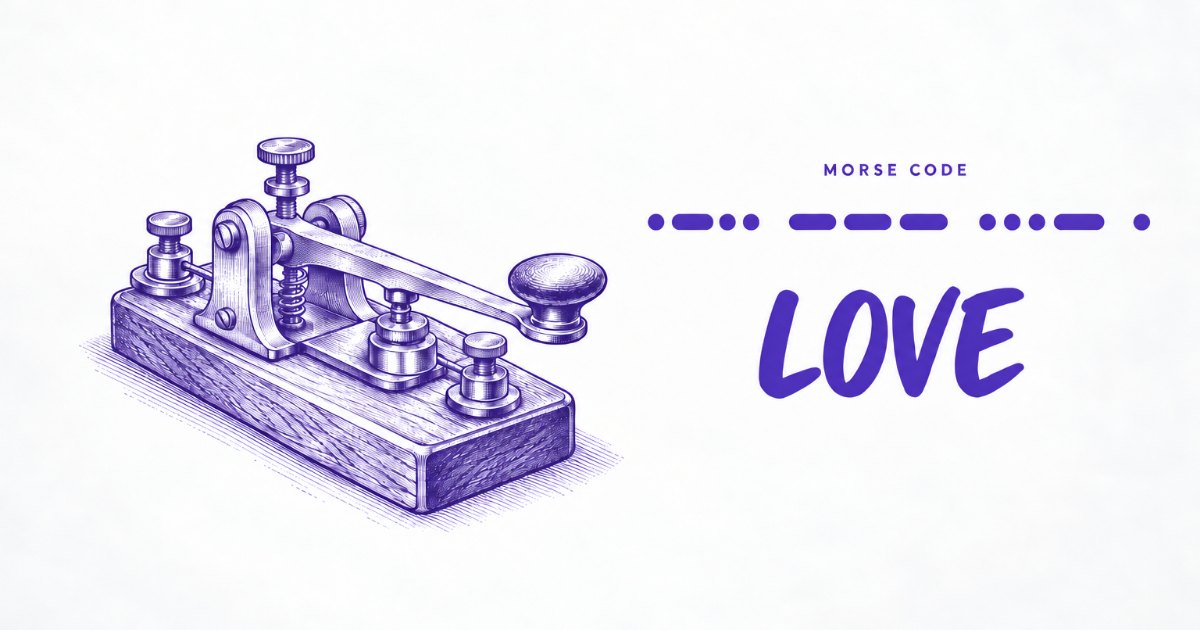
Morse code tattoos are popular because they keep a word private: a name, a date or a short phrase that only reads as dots and dashes. That same privacy means mistakes go unnoticed until someone who knows Morse reads it. Most errors are not wrong letters. They are wrong spacing, which turns a word into a different string of letters. This guide gives you the full International Morse alphabet, the spacing rules, and the dot and dash sizes that survive on skin.
Key takeaways
- Use International Morse code. American (railroad) Morse uses different codes for several letters.
- A dash is three dots long. Gaps are 1 unit inside a letter, 3 units between letters and 7 units between words.
- Without the letter gaps the tattoo cannot be decoded: six dots in a row could be HI, IH, SS or EEEEEE.
- Pick a dot size of about 1.5 to 2 mm, then count units to get the real length before you draw.
The International Morse alphabet
The current standard is ITU-R Recommendation M.1677-1, published by the International Telecommunication Union. The chart below covers all 26 letters and the ten digits. Signals are traditionally called "dit" for a dot and "dah" for a dash.
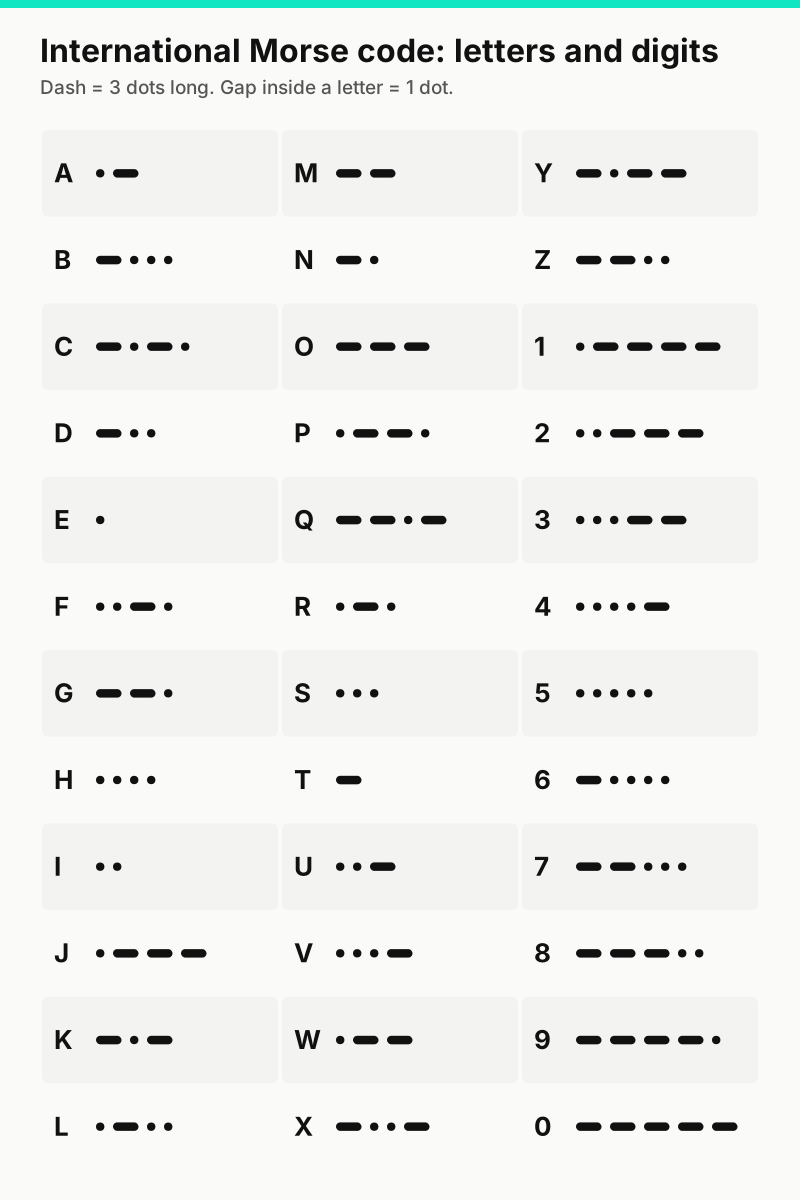
Online translators are generally reliable for letters, but some mix in American Morse or non-standard punctuation. Translate with any tool you like, then check every letter against this chart. It takes two minutes.
The spacing rules
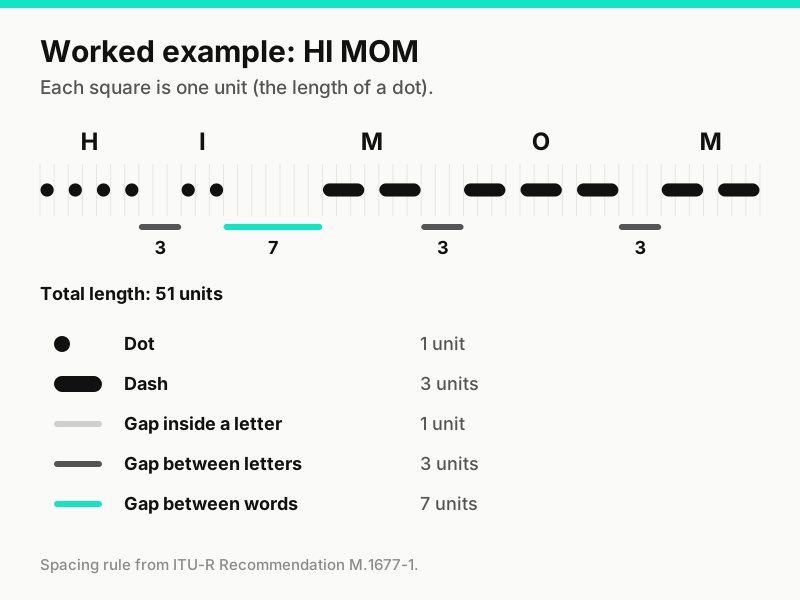
Morse code is built on one unit of time, the length of a dot. Everything else is a multiple of it:
| Element | Length |
|---|---|
| Dot (dit) | 1 unit |
| Dash (dah) | 3 units |
| Gap between signals inside one letter | 1 unit |
| Gap between letters | 3 units |
| Gap between words | 7 units |
On paper and skin, time becomes distance. If your dot is 2 mm, a dash is 6 mm, letters are separated by 6 mm and words by 14 mm.
Why the gaps matter more than the symbols
Write HI without the letter gap and you get six evenly spaced dots. That reads as HI, but just as well as IH, SS, EEEEEE or several other combinations. The gaps carry as much meaning as the dots and dashes. Stencils lose this when letter gaps are drawn the same as the gaps inside letters, or when the design is squeezed to fit a wrist.
Translators often show the word gap as a slash (/). The slash is not part of the code. Some clients like it as a visual divider, which is fine as a design choice, but keep the 7 unit space around it so the structure stays readable.
How long will the tattoo be?
Count units. For each letter, add 1 for every dot, 3 for every dash and 1 for each gap inside the letter. Then add 3 between letters and 7 between words.
| Text | Morse | Units | Length at 1.5 mm unit | Length at 2 mm unit |
|---|---|---|---|---|
| DAD | -.. .- -.. | 25 | 3.8 cm | 5.0 cm |
| MOM | -- --- -- | 31 | 4.7 cm | 6.2 cm |
| LOVE | .-.. --- ...- . | 39 | 5.9 cm | 7.8 cm |
| HOPE | .... --- .--. . | 39 | 5.9 cm | 7.8 cm |
| FAMILY | ..-. .- -- .. .-.. -.-- | 61 | 9.2 cm | 12.2 cm |
| 1998 | .---- ----. ----. ---.. | 75 | 11.3 cm | 15.0 cm |
Numbers are long because every digit has five signals. A full date in Morse can easily pass 20 cm, which is more than most wrists and forearms can take in one line. For dates, consider the year only, or another format such as Roman numerals.
Dot and dash sizes for a stencil
The unit is the one number that controls everything. Three things limit how small it can go:
- The 1 unit gap. The gap between signals inside a letter is the tightest space in the design. Ink spreads a little over the years, and gaps of less than about 1 mm tend to close. A unit of 1.5 mm gives a 1.5 mm gap; 2 mm is safer for longevity.
- Dots must read as dots. Very small dots can heal unevenly or blur into short dashes. A dot of about 1.5 to 2 mm is a common working size.
- Dashes must stay three times a dot. If dashes shrink to twice the dot length, dashes and dot pairs start to look alike.
Fine line artists sometimes work smaller. That depends on their technique and the client's skin, so treat these as safe defaults rather than limits. Our small tattoo ideas post covers the same minimums for other small designs.
Design choices that keep it readable
- Dot shape. Round dots with round-ended dashes look softest. Square dots with square dashes look more graphic. Do not mix the two.
- A line through the code. Some designs run a thin line through or under the signals, like a heartbeat line. Keep at least 1 mm between the line and the signals, or it will merge with the dots.
- Wrapping around a wrist or ankle. Measure the circumference and leave a clear gap where the ends meet, so the start of the word is obvious.
- Vertical placements such as the spine or behind the ear read top to bottom. Agree the reading direction with the client before drawing.
Common Morse code tattoo mistakes
- Even spacing everywhere. The most common error. Gaps inside letters, between letters and between words all drawn the same, so the word cannot be decoded.
- Short dashes. Dashes drawn about twice a dot instead of three times. They start to look like two dots run together.
- American Morse. Letters such as C, O, R and Y are different in American (railroad) Morse. Use International Morse unless the client specifically wants the railroad code.
- Lowercase and punctuation. Morse has no capitals or lowercase. Punctuation exists but adds length; most designs leave it out.
- Copied from a font without checking. Some decorative Morse fonts shorten dashes or tighten gaps to fit more on a line.
- Squeezed to fit. Shrinking the unit to fit a long phrase on a small placement. Shorten the phrase instead.
Making the stencil
- Translate and verify. Write the text, translate it, and check every letter against the chart above.
- Draw from shapes, not a font. Morse fonts vary in their dash length and spacing. In a drawing app, make one dot and one dash at the right ratio, then duplicate and space them on a grid of units.
- Size to the body. Count units, multiply by your unit size, and check the result fits the placement. If it does not, shorten the text rather than shrinking the unit.
- Print at 100% and measure. A ruler across one dash should show three times the dot. See how to size and print a stencil.
- Decode the printout with the client before it goes on skin.
If you draw the code by hand or in a drawing app, Stencify can turn a photo of it into clean stencil lines with adjustable line weight, show it on a photo of the client at real size, and export a PNG or PDF for A4 or US Letter. Check the dot and dash proportions on the result as you would with any conversion. It runs on iPhone, iPad and Android with two free uses: get Stencify on the App Store or on Google Play.
Frequently asked questions
Is the slash part of Morse code?
No. Morse code separates words with a silent gap of seven units. Translators often show that gap as a slash, and some people keep it as a design choice, but it is not a signal in the code.
How long is a dash compared to a dot in Morse code?
In International Morse code a dash is three times as long as a dot. The gap inside a letter is one dot, the gap between letters is three dots and the gap between words is seven dots.
How do you write numbers in Morse code?
Every digit has five signals. 1 is .----, 2 is ..---, 5 is ....., 6 is -...., and 0 is -----. Dates therefore get long quickly; a four digit year is about 75 units.
How big should a Morse code tattoo be?
Choose a unit, the size of one dot, of about 1.5 to 2 mm. A word such as LOVE is 39 units long, which is about 6 to 8 cm. Count the units of your own word to get its length.
Related reading
- Roman Numeral Tattoos - another coded way to write a date
- Small Tattoo Ideas - minimum sizes for small designs
- Geometric Tattoo Stencils - keeping repeated shapes even
- How to Size and Print a Stencil - printing at exact size
Check the code, then check the size
Stencify turns your drawing into clean stencil lines, previews it on skin at real size and exports for A4 or US Letter.