How to Mirror a Tattoo Stencil: When to Flip a Design and When Not To
• by Stencify • 9 min read
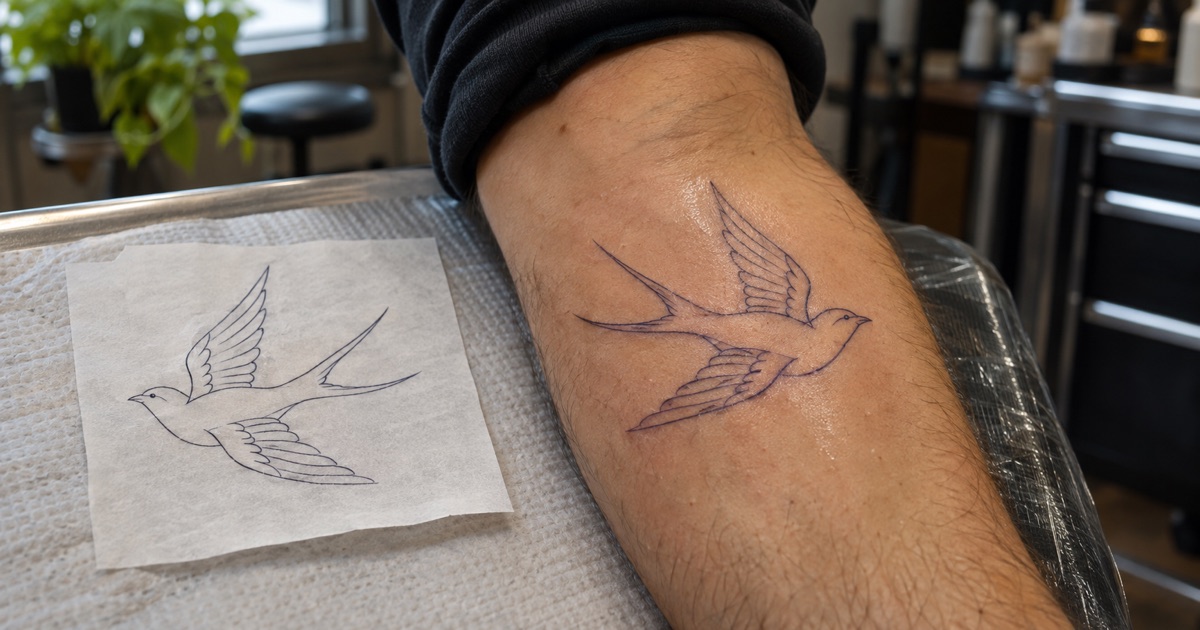
Most tattoo stencils should not be mirrored. A thermal stencil, or one traced by hand on hectograph paper, flips the design twice: once onto the back of the top sheet and once more onto the skin, so a design drawn or printed the normal way ends up reading correctly. You mirror on purpose in three situations: when the method puts the printed or drawn face straight onto the skin, when you need a left and right version of a matching pair, and when you build a symmetrical design from one half. This guide explains each case and the quick check that catches a backwards stencil before it reaches the skin.
Key takeaways
- Thermal and hand-traced hectograph stencils transfer the right way round. Do not mirror the design first.
- The side that touches the skin should always read backwards. Check it before every application.
- Mirror the drawing, never the lettering, when you make the second half of a matching pair.
- A client checking a stencil in a mirror sees it reversed. Read text directly or in a normal photo.
Why most stencils do not need mirroring
Hectograph stencil paper has a white top sheet, a thin protective tissue and a carbon sheet underneath, with the carbon facing the back of the top sheet. When a thermal printer heats the paper, or when you trace firmly over the front of the top sheet with a pen, the carbon deposits a copy of the lines on the back of that sheet. That copy is a mirror image of what is on the front.
The back of the top sheet is the side that goes onto the skin. Pressing it face down flips the image a second time, so the tattoo stencil reads the same way as the original design. Two flips cancel out. If you mirror the design before printing or tracing, you add a third flip and the stencil lands on the skin backwards.
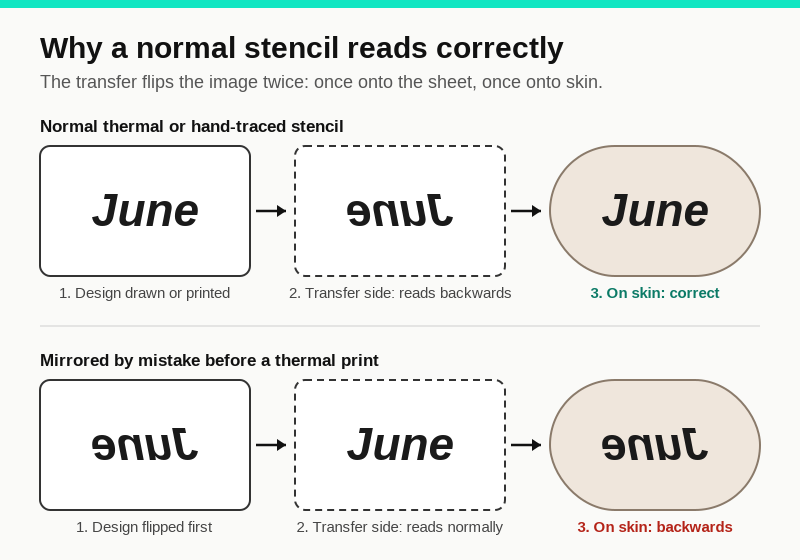
The same reasoning applies to a thermal copier: the original print goes in the right way round and the copy on the stencil sheet comes out reversed, ready to transfer. For a step by step on tracing by hand, see how to trace a tattoo stencil, and for how the layers of hectograph paper work, the tattoo stencil paper guide.
When the transfer method does need a mirrored print
The rule is simple once you look at which face touches the skin. If it is a carbon copy made through the paper, do not mirror. If it is the face you printed or drew on, mirror, because that face will be flipped only once.
| Method | Face that touches skin | Mirror first? |
|---|---|---|
| Thermal printer or thermal copier on hectograph paper | Carbon copy on the back of the top sheet | No |
| Tracing over the front of hectograph paper by hand | Carbon copy on the back of the top sheet | No |
| Inkjet stencil paper or stencil ink printed directly | The printed face | Usually yes; follow the paper's instructions |
| Drawing with a stencil pen or hectograph pencil on paper, then pressing the drawing onto skin | The drawn face | Yes |
| Plain inkjet print pressed onto skin with stencil solution | The printed face | Yes, and the result is faint and unreliable |
Inkjet systems vary, so read the instructions that come with the paper or ink. The inkjet tattoo stencil paper guide covers how those setups differ from thermal printing. Some printers and printer apps also have their own mirror setting. If you print to normal thermal paper, make sure it is switched off, or it will undo the double flip.
The check before you apply
Whatever method you use, one rule holds: the side that touches the skin must show the design reversed. It takes a few seconds to check, and it is the last chance to catch a mistake before it is on the client.
- Look at the transfer side. Turn the sheet so you are looking at the carbon or ink lines that will touch the skin. Any lettering, numbers or one-sided detail should read backwards.
- Hold it to the light. Turn the sheet over and hold it against a window or lightbox with the transfer side facing away from you. Seen through the paper, the design should now read the right way, exactly as it should look on the body.
- Check direction, not only text. For a design without letters, pick one feature with a clear direction, such as which way a bird faces or which side a flower stem curves to, and confirm it against the approved drawing.
- Check again after transfer. Once the sheet is lifted, read the stencil on the skin directly, not in a mirror.
Lettering: the most expensive mistake
A reversed flower can sometimes pass unnoticed. A reversed word cannot, and it is very hard to fix once tattooed. Names, dates, Roman numerals, coordinates and quotes all depend on direction, and so do symbols with a fixed orientation, such as a clock face or a compass rose.
- Treat the light check as mandatory for any text. Letters like "b", "d", "p" and "q", and numbers like 2, 3, 5, 7 and 9, give a backwards stencil away at once.
- Rotation is not mirroring. A wrist or forearm script meant to be read by the wearer is rotated 180 degrees so it faces them. It still reads normally; it is just turned upside down for everyone else. Never use a mirror flip to get that effect.
- Mirror-reading text is a deliberate choice. Some people ask for a word on the chest or collarbone that reads correctly in their bathroom mirror. That means the tattoo reads backwards to everyone else, including in most photos. If a client asks for this, confirm it twice, in writing, and label the stencil clearly.
- Phone cameras can mislead. Many phones show a mirrored preview in selfie mode, so text can look backwards on screen even when the stencil is correct. Check with the rear camera or by reading the skin directly.
Spacing and minimum letter size matter just as much as direction; the tattoo lettering stencil guide covers both. For a design that is all numbers, such as a location, the coordinates tattoo guide has notes on formatting and size.
Matching tattoos on both arms or both sides
This is where you do mirror on purpose. A pair of birds on two wrists, a moon on each collarbone, or a matching design shared by two people on opposite arms often looks best when both halves face inward, towards the body's centre line or towards each other. That needs a left version and a right version of the same drawing.
- Decide on the sides first. If both tattoos go on the same side, for example two people each with a design on the left wrist, use the same version for both. Mirror only when they sit on opposite sides and the facing direction matters.
- Flip the drawing, then fix the text. Mirroring the whole image mirrors any name or date with it. Flip the artwork and put the lettering back the right way round before printing.
- Leave fixed-orientation subjects alone. A real map, a constellation, a specific building or a portrait has one correct orientation. A mirrored portrait in particular can look subtly wrong to people who know the face, so think twice before flipping it.
- Label both stencils. Two mirrored sheets look almost identical. Write "left" or "right", or each person's name, on the paper before printing the next one.
- Size each one to its own body. A matching pair does not have to be identical in size. If one wrist is narrower, adjust the width slightly rather than forcing the same measurement.
For ideas and try-on tips for two people, see matching couple tattoos.
Using a flip to build symmetry
Symmetrical subjects such as butterflies, wings, mandalas, chest pieces and front-facing animal heads are usually built from one half. Draw a straight centre line, finish one side completely, then mirror a copy and join it along that line. Every line then has an exact partner, which is very hard to achieve by drawing both sides freehand.
- Keep the centre clean. Lines that cross the centre line can double up or leave a gap at the join. Stop them just short of it, or draw the centre detail once after joining.
- Do not mirror anything seen at an angle. A butterfly in flight or a face in three-quarter view is not symmetrical; mirroring it makes the far side too large.
- Mark the centre on the skin. Bodies are rarely symmetrical. Mark a centre line or landmark with a skin marker and line up the stencil's centre to it, then check from a step back with the client standing naturally.
The butterfly stencil designs are a good example of subjects built this way.
Using "Mirror" in Stencify
In Stencify, "Mirror" flips the finished stencil from left to right. Use it for the second side of a pair, for building the other half of a symmetrical design, or for a transfer method that needs a mirrored print. For normal thermal paper, leave the stencil as it is.
- Make and clean up the stencil first, so both versions share the same lines.
- Tap "Mirror" to flip it for the opposite side or the second person. If the design has text, put the text right again before printing.
- Set the exact print size in cm or inches, print at 100% with any "fit to page" option turned off, and measure the check ruler. Small pieces on wrists often fall around 3 to 6 cm (1.2 to 2.4 in), so a few millimetres matter. The full process is in how to size and print a tattoo stencil.
- Label the printout and do the light check before applying.
At the consultation
- Say which side each tattoo goes on. For pairs, tell the artist which arm, wrist or collarbone each one is for, and which direction each design should face.
- Say who should read the text. Readable by others, rotated to face you, or mirrored to read in your own mirror are three different stencils.
- Read the stencil directly. Before the artist starts, look at the stencil on your skin, not in the studio mirror. If you cannot see the placement, ask for a photo taken with the rear camera.
Frequently asked questions
Do you need to mirror a tattoo stencil before printing?
Not for thermal stencil paper. The thermal printer puts a reversed copy on the back of the top sheet, and pressing that onto skin flips it back, so the design reads correctly. Mirror only for a matching pair on the opposite side, or when your paper or ink prints directly onto the face that touches the skin.
Do you need to mirror a design when tracing hectograph paper by hand?
No, if you trace over the front of the top sheet with the carbon sheet underneath. The carbon leaves a reversed copy on the back of the top sheet, and the transfer flips it back. Mirror only if you draw directly on the face that will touch the skin.
How can I tell if a stencil is backwards before applying it?
Look at the side that will touch the skin: lettering and other one-way details should read backwards. Then hold the sheet to the light with that side facing away from you. Seen through the paper, the design should read exactly as it should look on the body.
Should matching tattoos on both arms be mirrored?
Mirror one of them if the two designs sit on opposite sides and should face inward or towards each other. If both go on the same side, use the same version. Never mirror lettering: flip the drawing, then put any text back the right way round.
Why does my stencil look backwards in the mirror?
A mirror reverses everything, so a correct stencil reads backwards when you look at it in one. Many phones also show a mirrored preview in selfie mode. Check the stencil by looking at your skin directly or in a photo taken with the rear camera.
Related reading
- Tattoo Lettering Stencil - letter size, spacing and curves
- Matching Couple Tattoos - ideas and try-ons for two people
- How to Size and Print a Stencil - exact size, printer settings and checks
- Tattoo Stencil Paper Guide - how hectograph and thermal paper work
Flip a stencil only when you mean to
Stencify turns a photo or sketch into a clean stencil, prints it at an exact size with a check ruler, and uses "Mirror" for the second side of a matching pair.