Coordinates Tattoo: Getting the Numbers, Font and Size Right
• by Stencify • 9 min read
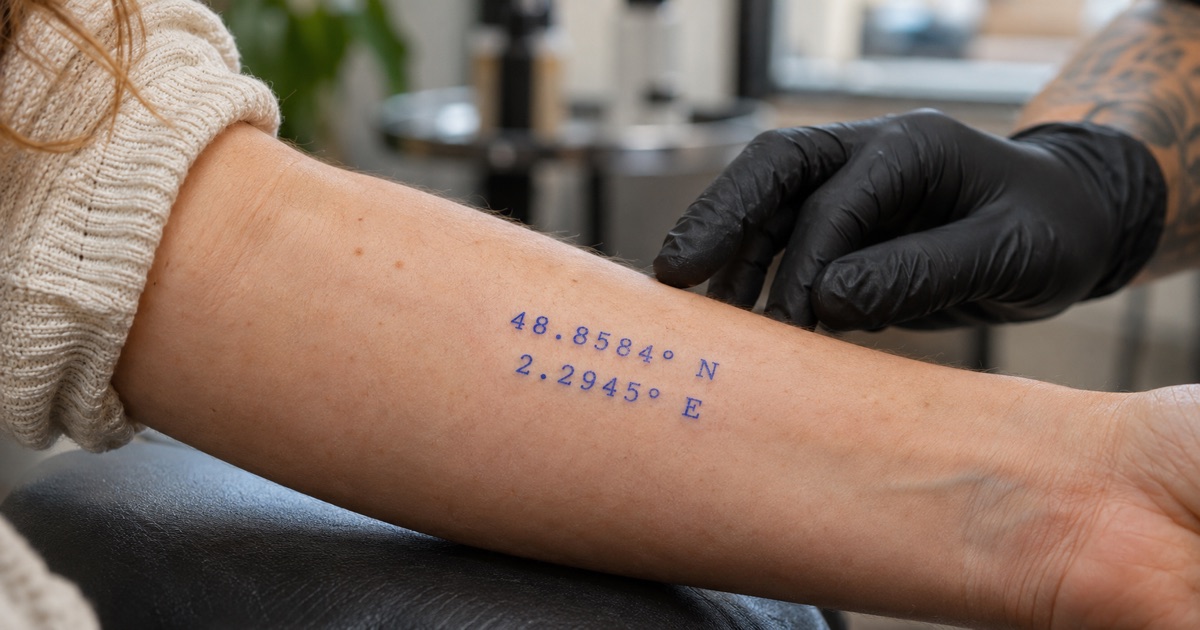
A coordinates tattoo is a latitude and longitude written as numbers, marking a place that matters to the wearer: a hometown, the place two people met, where a child was born, or a grave. It looks simple but leaves little room for error. One wrong digit moves the place, a wrong letter puts it in another hemisphere, and digits that are too small blur together as the tattoo ages. This guide covers getting the numbers right, choosing a format, sizing the digits, placement, and making a stencil that transfers every digit cleanly.
Key takeaways
- Take the coordinates from a pin dropped on the exact spot in a map app, then paste them back in to confirm the pin lands in the same place.
- Pick one format: decimal degrees (48.8584° N, 2.2945° E) or degrees, minutes and seconds (48°51′30″ N, 2°17′40″ E). Four decimals or whole seconds are precise enough for a single building.
- Write N, S, E or W instead of a minus sign, and keep digits at least about 5 mm (0.2 in) tall.
- Check every digit against the source before printing, and again on the skin before the first line goes in.
What the numbers mean
Latitude says how far north or south of the equator a place is, from 0° at the equator to 90° at each pole. Longitude says how far east or west it is from the prime meridian, the line through Greenwich in London, from 0° up to 180°. Together the two values point to one spot on Earth. By convention latitude is written first and longitude second.
This guide uses a public landmark as its example, the Eiffel Tower in Paris, at about 48.8584° N, 2.2945° E: 48.8584 degrees north of the equator and 2.2945 degrees east of Greenwich. Because the meaning of the numbers is private, coordinates are often chosen as a quiet tribute; memorial tattoo ideas covers other ways to mark a person or a place.
Coordinate formats explained
The same place can be written in three common formats. All are correct; choose one and do not mix them.
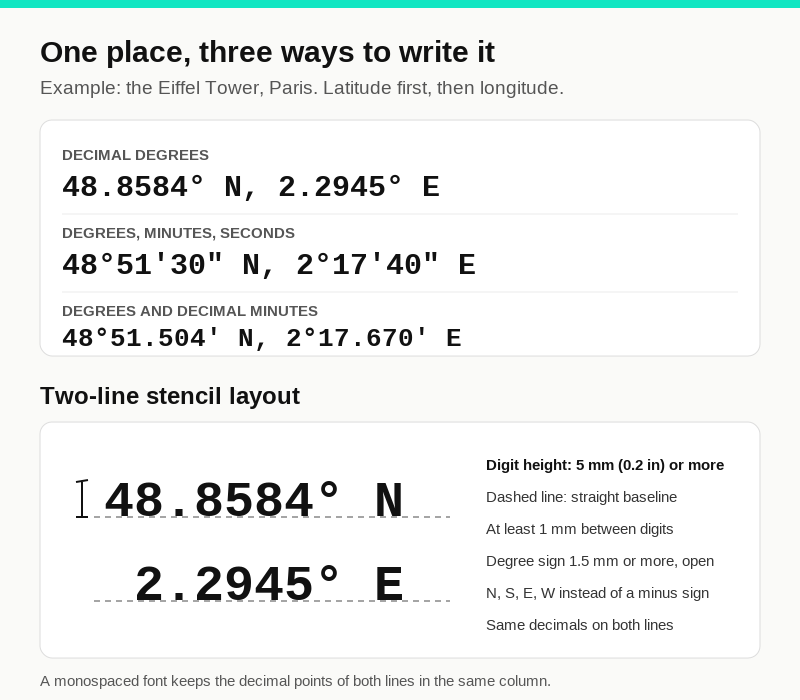
Decimal degrees
Decimal degrees write each value as one number, such as 48.8584 and 2.2945, the format most map apps show. In this form, places south of the equator have a negative latitude and places west of Greenwich, such as New York or Mexico City, have a negative longitude.
For a tattoo, replace the minus sign with a letter. A value of -12.3456 (a placeholder, not a real place) becomes 12.3456° S if it is the latitude, or 12.3456° W if it is the longitude. A minus sign is easy to drop while designing, easy to read as a dash, and easy to lose in fine line.
Degrees, minutes and seconds
The older format splits each degree into 60 minutes and each minute into 60 seconds. It uses the degree sign (°), a prime (′) for minutes and a double prime (″) for seconds. The Eiffel Tower in this format is 48°51′30″ N, 2°17′40″ E. It looks like the coordinates on older maps and charts, but it carries more symbols, so it needs more space and care in the stencil.
Degrees and decimal minutes
A third format, used by many GPS units and on boats, keeps whole degrees and writes the minutes with decimals: 48°51.504′ N, 2°17.670′ E. It works on skin too, but be careful when copying it. 48°51.5′ is not the same as 48.515°, and mixing the two moves the point by kilometres.
Converting between formats
Decimal degrees equal the degrees plus the minutes divided by 60 plus the seconds divided by 3,600. For the Eiffel Tower latitude, 48 + 51/60 + 30/3,600 is about 48.8583; the small difference from 48.8584 comes from rounding the seconds. Whatever you convert, paste the result into a map app and check where the pin lands.
How many decimal places you need
Every extra decimal place makes the point about ten times more precise. One degree of latitude is roughly 111 km (69 miles), so:
| Decimal places | Precision (north to south) | Good for |
|---|---|---|
| 2 | about 1.1 km (0.7 miles) | A town or a district |
| 3 | about 110 m (360 ft) | A neighbourhood or a large park |
| 4 | about 11 m (36 ft) | A house, a building or a grave |
| 5 | about 1.1 m (3.6 ft) | Finer than a tattoo needs |
In degrees, minutes and seconds, a whole second of latitude is about 31 m (100 ft) and a whole minute is about 1.85 km (1.15 miles). East to west, a degree of longitude covers less ground the further you are from the equator, so the same number of decimals is a little more precise in longitude.
Four decimal places, or whole seconds, are enough for almost every coordinates tattoo. More digits only make the line longer and harder to keep readable. Use the same number of decimals on both values.
Getting the coordinates right
- Drop a pin on the exact spot. Zoom in until you can see the building or plot and drop a pin on it (on most phones, a long press). An address search often gives a point on the street, not the spot you mean.
- Copy, do not retype. Copy the coordinates shown for the pin into a note. Retyping is where swapped digits come from.
- Paste them back in. Paste the coordinates into the map search bar. If the pin lands in the sea or on another continent, a sign or the order of the values is wrong.
- Label each value. The first number is latitude and takes N or S; the second is longitude and takes E or W. A negative value means S or W.
- Write the final version exactly as it will be tattooed and send it to the artist as text with a screenshot of the pinned map.
The usual mistakes: latitude and longitude swapped, a dropped minus sign giving the wrong letter, decimal minutes copied as decimal degrees, and two neighbouring digits swapped.
Fonts and digit size
Choosing a typeface
- Typewriter and other monospaced fonts are a common choice: every digit has the same width, so stacked lines align column by column.
- Simple sans serif digits stay readable at the smallest sizes.
- Script and very thin fonts are risky for numbers. Pairs like 1 and 7, 3 and 8, 5 and 6, or 0 and 6 can look alike once the lines soften.
- Watch the closed shapes. The holes in 0, 4, 6, 8 and 9 should be about 2 mm (0.08 in) or more across, the same rule the tattoo lettering stencil guide uses for letters like a, e and o.
Minimum sizes
| Element | Minimum | Comfortable |
|---|---|---|
| Digit height, fine line | about 5 mm (0.2 in) | 6 to 8 mm (0.25 to 0.3 in) |
| Digit height, bolder lines | about 6 mm (0.25 in) | 7 to 10 mm (0.3 to 0.4 in) |
| Space between digits | about 1 mm (0.04 in) | 1.5 to 2 mm (0.06 to 0.08 in) |
| Degree sign | about 1.5 mm (0.06 in) across, open | 2 mm (0.08 in) |
Bolder lines need taller digits, because thick strokes close the holes in 6, 8 and 9 sooner. Digit height also sets the overall length. In a typical monospaced font at 5 to 6 mm tall, "48.8584° N, 2.2945° E" runs to roughly 9 to 11 cm (3.5 to 4.5 in) on one line. Stacked on two lines, each line is about 4.5 to 5.5 cm (1.8 to 2.2 in) wide. Check that against the placement; the tattoo size chart shows typical sizes by body part.
Layouts and placements
One line suits long, narrow areas. Two stacked lines, latitude above longitude, suit shorter areas.
- Inner forearm. Room for one or two lines at a comfortable size, and the wearer can read it.
- Inner wrist. Usually two stacked lines about 4.5 to 5.5 cm (1.8 to 2.2 in) wide. Keep the lowest line above the wrist creases.
- Collarbone. One line following the curve of the bone; check it with the client standing.
- Ribs and side. Plenty of length for one line, but more painful than the forearm; see the tattoo pain chart.
- Ankle and side of the foot. Two short lines fit, but feet tend to fade sooner from shoe friction, so stay at the larger sizes.
- Fingers. Generally too small for full coordinates at a readable size.
Adding a symbol or outline
Common pairings are a heart (see the heart stencil designs), a compass, a map pin, a plane, a wave or a mountain outline, and the outline of a country, state or island. Some people add a date in Roman numerals or spell the place name in Morse code under the numbers.
- Keep a gap. Leave about 3 to 5 mm (0.12 to 0.2 in) between the symbol and the digits so neither crowds the other.
- Match the scale. Make the symbol about the height of the digit block or a little larger.
- Simplify outlines. A small coastline has more detail than skin can hold; smooth it to a shape that is still recognisable.
- Keep shading away from the numbers, where it makes them harder to read.
Making the stencil
- Set the digits as text. Paste the confirmed coordinates into the design as type, so no digit is redrawn or retyped by hand.
- Keep a straight baseline. Every digit sits on the same line. Apply the stencil with the limb relaxed in its natural position, or the line will bend when the client moves.
- Space for the symbols. Give the decimal point a clear round dot about 1 mm (0.04 in) across, add a little extra space after the comma and before the hemisphere letter, and keep the degree sign open and level with the tops of the digits.
- Print at the exact size. A line printed slightly too small loses the planned spacing. In Stencify you set the print size in cm or inches and measure the check ruler on the printout before transferring. If the font's strokes are thin, "Thicken outlines" gives a firmer line for the transfer.
- Mirror only if your method needs it, and proofread the digits before mirroring, because reversed numbers are hard to check; see when to mirror a tattoo stencil.
Check every digit three times
- Before printing, the client checks the design text against their note and map pin.
- On the printout, the artist reads each digit aloud while the client follows along in their note.
- On the skin, after the transfer has set, check once more. Use a phone photo rather than a mirror, because a mirror shows the digits reversed.
How coordinates tattoos age
Tattoo lines spread a little over the years. On numbers the small shapes go first: the holes in 6, 8 and 9 fill in, decimal points merge with neighbouring digits, and a tiny degree sign becomes a dot. The sizes and spacing above are the main protection, along with sunscreen on healed skin. A two-line layout at a comfortable height stays readable longer than a long single line squeezed into a small area.
Before you book
- Decide the details first: format, decimals, one line or two, and any added symbol.
- Check the length on your body. Artists using Stencify can place the design on a photo of your arm or wrist with "Place It Myself" to judge length and angle before printing.
- Ask about minimum sizes. If you want the numbers very small, ask what size the artist is comfortable with for that placement.
Frequently asked questions
Which format should a coordinates tattoo use?
Either decimal degrees, such as 48.8584° N, 2.2945° E, or degrees, minutes and seconds, such as 48°51′30″ N, 2°17′40″ E. Both point to the same place. Decimal degrees are shorter and simpler to stencil; degrees, minutes and seconds need more symbols and space. Do not mix formats.
How many decimal places should the coordinates have?
Four decimal places, precise to about 11 m (36 ft), are enough to mark a single house, building or grave. Three decimals mark a neighbourhood, and more than four only add length.
Should I use a minus sign or N, S, E and W?
Use the letters. In decimal degrees a negative latitude means south and a negative longitude means west, so -12.3456 becomes 12.3456° S as a latitude or 12.3456° W as a longitude. A minus sign is easy to drop or misread, especially in fine line.
How small can a coordinates tattoo be?
Keep the digits at least about 5 mm (0.2 in) tall for fine line and about 6 mm (0.25 in) for bolder lines, with about 1 mm between digits. At that size a full set of coordinates is roughly 9 to 11 cm (3.5 to 4.5 in) on one line, or 4.5 to 5.5 cm (1.8 to 2.2 in) wide on two.
How do I make sure the coordinates are correct?
Drop a pin on the exact spot in a map app, copy the coordinates rather than retyping them, and paste them back into the search bar to see that the pin lands in the same place. Then check every digit again on the printed stencil and on the skin before tattooing.
Related reading
- Tattoo Lettering Stencil - letter size, spacing and fonts that last
- Roman Numeral Tattoo Stencil - dates and numbers in Roman numerals
- Morse Code Tattoo - spelling a name or place in dots and dashes
- Tattoo Size Chart - typical sizes by body part
Numbers that print at the right size
Stencify prints coordinates and lettering at the exact size you set in cm or inches, with a check ruler, and can thicken thin lines before you print.