Sun and Moon Tattoos: Ideas, Sizes and Stencils for One or Two
• by Stencify • 9 min read
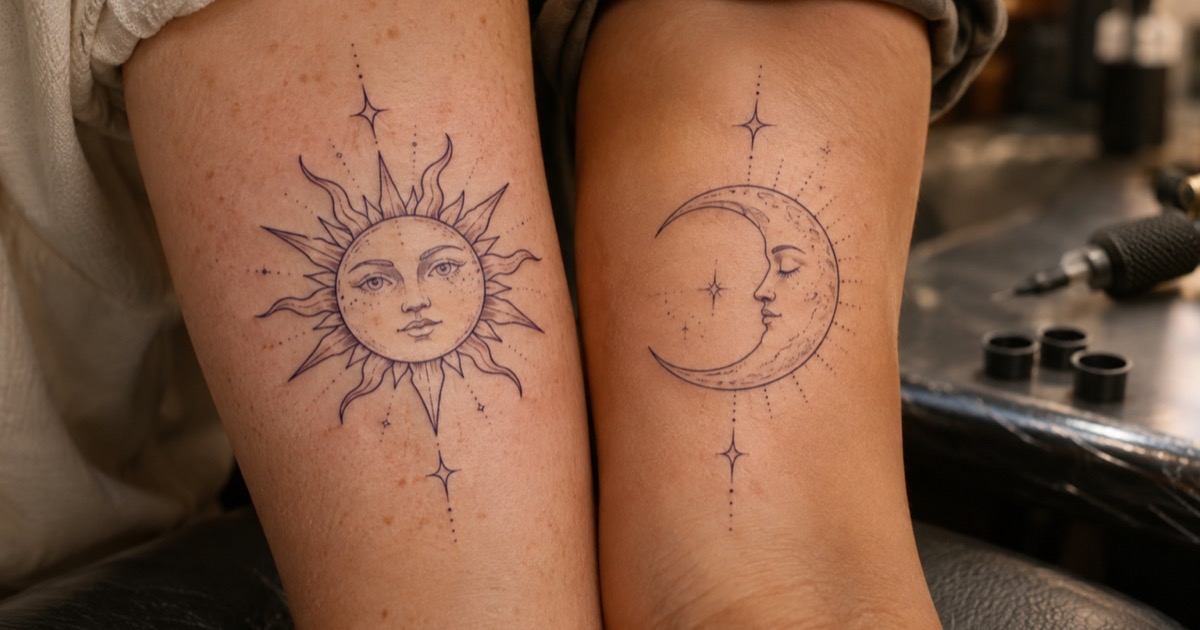
A sun and moon tattoo pairs two of the oldest images in art: day and night, light and dark, two halves that belong together. It works as one small symbol, as a larger ornamental piece, or split between two people so each wears one half. Whichever version you choose, the stencil decides how clean it looks. The circle has to stay round on a curved body, the rays have to be evenly spaced, and any faces have to be simple enough to stay readable as the tattoo ages.
Key takeaways
- A simple sun and moon outline works from about 3 cm (1.2 in). Designs with faces need about 5 cm (2 in) or more.
- Circles and rays show every bit of distortion, so place them on flatter skin and check the stencil from straight on.
- For matching tattoos, make both stencils from one file at the same size so the halves really match.
- Draw one half of a symmetrical sun, then duplicate and flip it, instead of drawing both sides by hand.
What a sun and moon tattoo usually means
Most people choose the pairing for a simple reason: the sun and moon are opposites that complete each other. Common readings include balance, the passing of time, and two people who are different but connected. The pairing also has a long history in art. The tarot deck includes The Sun and The Moon as separate cards of the Major Arcana, and European alchemy linked the sun with gold and the moon with silver.
None of this is required reading. Meaning is personal, and a client does not need to explain theirs. For artists, the useful question at the consultation is practical: is this one design for one person, or a pair that has to match?
Solo or matching: two different jobs
One design for one person
A solo piece usually combines both bodies in a single image. Popular layouts include a crescent moon sitting inside the curve of a rayed sun, a single face split down the middle with a sun on one side and a moon on the other, an eclipse where the moon covers part of the sun, and the two side by side with stars between them. The combined face is the most demanding of these, because the line that splits it has to sit exactly in the middle and both halves need matching features.
Matching tattoos split between two people
Sun and moon is one of the most common choices for pairs, from couples to siblings and friends. There are three ways to do it:
- One sun, one moon. Each person gets a complete, separate design. They read as a pair because the size, line weight and style match.
- One design, cut in half. A single circular design is split down the middle. The halves only form the full image when the two people stand side by side, for example with wrists or forearms together.
- The same full design twice. Both people wear the combined sun and moon, sometimes with one detail changed, such as a date or initial.
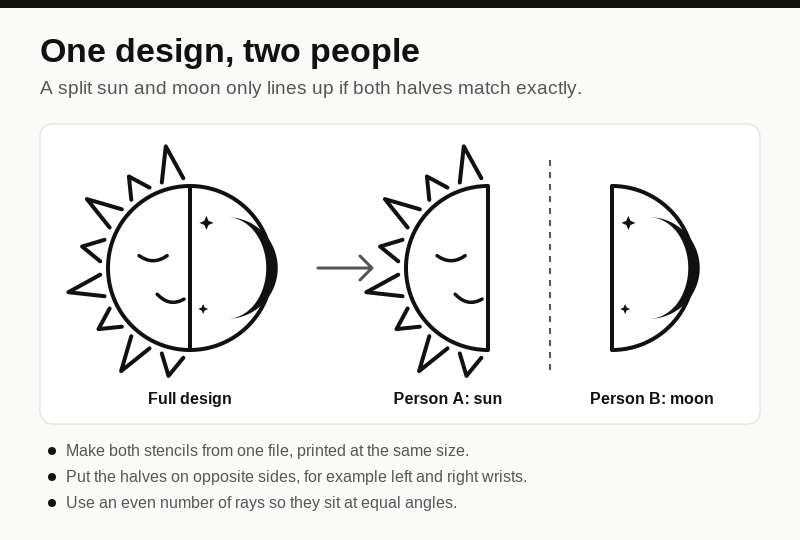
For a split design, decide early where each half goes. Halves that should meet when two people hold hands usually go on opposite sides of the body: one person's left wrist and the other person's right wrist, so the straight edges face each other. If both people choose the same side, one half may need to be flipped so the design still reads correctly when they stand together. Before tattooing, stand them side by side with both stencils on and check that the edges line up.
Matching pieces are often done months apart, sometimes by different artists. Keep the original stencil file, not only a photo of the healed tattoo, so the second half can be printed at exactly the same size. For more pairing ideas, see matching couple tattoos and best friend tattoos.
Styles and how each one ages
Fine line
Thin single lines suit minimal outlines: a plain circle with short rays and a simple crescent. Fine lines soften and spread a little over the years, so keep at least 1 to 1.5 mm of clear skin between neighbouring lines and leave out decoration that only works on paper. Faces in fine line need more size than people expect, because eyes and lips drawn with a single thin line close up first.
Dotwork
Dotwork builds shading from individual dots, which suits a gradient across the moon or a glow around the sun. Dots also soften with time, so a gradient that looks subtle on the day can turn flat after a few years. Keep a clear difference between the darkest and lightest areas, and give the dots room. In a stencil, dotwork areas are usually marked with an outline and a few guide dots rather than every dot.
Traditional
Bold outlines, solid black and a limited palette make traditional sun and moon designs the most durable option. Faces in this style are simplified by design: a few strong lines for the eyes, nose and mouth. They hold up well at small sizes because nothing relies on fine detail.
Ornamental
Ornamental and mandala-style suns use layered rays, lace patterns and repeated elements around a centre. They look precise only when they are precise, so this is where a clean stencil matters most. A sternum or upper back placement gives the symmetry a natural centre line. The geometric and mandala stencil guide covers repeated patterns in more depth, and the stencil technique by style guide explains how line weight changes from fine line to traditional.
Sizes and placements
The right size depends on the most detailed part of the design. A plain outline can go small. A face, dotwork gradient or ornamental border needs more room.
| Placement | Typical size | Works well for |
|---|---|---|
| Behind the ear | 2 to 4 cm (0.8 to 1.6 in) | Simple outlines, small crescent and sun |
| Inner wrist | 3 to 5 cm (1.2 to 2 in) | Split matching halves, minimal symbols |
| Ankle | 4 to 6 cm (1.6 to 2.4 in) | Side-by-side sun and moon, small stars |
| Forearm | 6 to 12 cm (2.4 to 4.7 in) | Faces, dotwork, traditional |
| Sternum or between the shoulder blades | 8 to 15 cm (3 to 6 in) | Symmetrical ornamental designs |
| Upper arm or thigh | 10 to 18 cm (4 to 7 in) | Detailed faces, combined designs with stars and clouds |
These are common studio ranges, not fixed rules. Fingers are a popular spot for tiny sun and moon symbols, but finger tattoos tend to fade and blur faster than most placements, so keep them very simple. For more placements and sizes, see the tattoo size chart, and for a first small tattoo, small tattoo ideas.
Stencil tips for circles, symmetry and faces
Keeping the circle round
A perfect circle on paper can look like an oval on skin. Arms and legs curve, and skin stretches when a limb moves, so the same stencil looks different with the wrist turned up or down. Apply the stencil with the client in the position they normally hold that body part, on the flattest area available, and judge the circle from directly above rather than at an angle. If it looks oval, take it off and reapply it rather than fixing it freehand. On very curved areas, a slightly smaller circle often looks rounder than a large one that wraps around the limb.
Even rays and true symmetry
Uneven rays are the first thing people notice on a sun. Use a number of rays that divides evenly, such as 8, 12 or 16, so every ray sits at the same angle from its neighbours. Keep at least about 1 mm between ray bases where they meet the circle, or the base fills into a solid ring as it heals.
For a symmetrical sun or a combined face, draw one half carefully, duplicate it and flip it in your drawing app, then join the halves along the centre line. This is faster and more accurate than drawing both sides by eye. For matching pairs placed on opposite sides of the body, the "Mirror" option in Stencify flips the finished stencil, so a moon that faces inward on one wrist can face inward on the other.
Simplifying faces
On a 5 cm (2 in) sun, the eyes are only a few millimetres wide. Reduce each feature to a single clear line: one curve for a closed eye, one line for the nose, a simple shape for the lips. Remove fine hatching on the cheeks and replace it with shading the artist adds by hand. If the reference has more detail than the size allows, the "Simplify tiny details" and "Thicken outlines" fixes in Stencify are a quick way to see what will survive before you print.
Checking size before printing
Size problems show up best on the actual body. With "Place It Myself", you can place the stencil on a photo of the client's wrist or forearm and see how big it looks before printing, then print it at an exact size in cm or inches and confirm it with the check ruler. For the full printing workflow, see how to size and print a tattoo stencil.
Planning the appointment
- Bring references for the style, not only the subject. "Sun and moon" covers everything from a 3 cm outline to a full ornamental piece.
- Book matching tattoos together if you can. One artist, one file and one session make it easier to keep both halves identical.
- Ask about the minimum size for faces. If the size you want is too small for the detail, choose between a bigger tattoo or a simpler design.
- Think about the long term. Small, detailed designs blur first. A slightly bigger, simpler design usually looks better in ten years.
Frequently asked questions
What does a sun and moon tattoo mean?
Most often balance between opposites: day and night, light and dark, or two different people who belong together. The pairing appears across art history, including the tarot cards The Sun and The Moon. The meaning is personal, so it can be whatever the wearer wants.
How small can a sun and moon tattoo be?
A simple outline can work from about 2 to 3 cm (0.8 to 1.2 in). Designs with faces, dotwork or ornamental detail need about 5 cm (2 in) or more, so the features stay readable as the lines soften over the years.
How do you make matching sun and moon tattoos line up?
Make both stencils from the same file at the same size, place the halves on opposite sides of the body (for example one left wrist and one right wrist), and check the edges with both people standing side by side before tattooing.
Where is the best placement for a sun and moon tattoo?
The inner wrist, forearm, ankle and behind the ear suit small designs. The sternum and the upper back between the shoulder blades suit symmetrical ornamental suns, because they give the design a natural centre line.
Can two people get the sun and moon in different styles?
Yes, but if the tattoos are meant to read as a pair, keep the size and line weight similar. A fine line moon next to a bold traditional sun looks like two unrelated tattoos rather than a set.
Related reading
- Matching Couple Tattoos - ideas for pairs that fit together
- Geometric and Mandala Stencils - symmetry and repeated patterns
- Small Tattoo Ideas - designs that stay clean at small sizes
- Tattoo Size Chart - typical sizes by placement
Clean circles, even rays, matching halves
Stencify turns a sketch or reference into a clean stencil, prints it at an exact size, and flips it with "Mirror" for matching pairs.