Stencil library
Medusa tattoo stencil
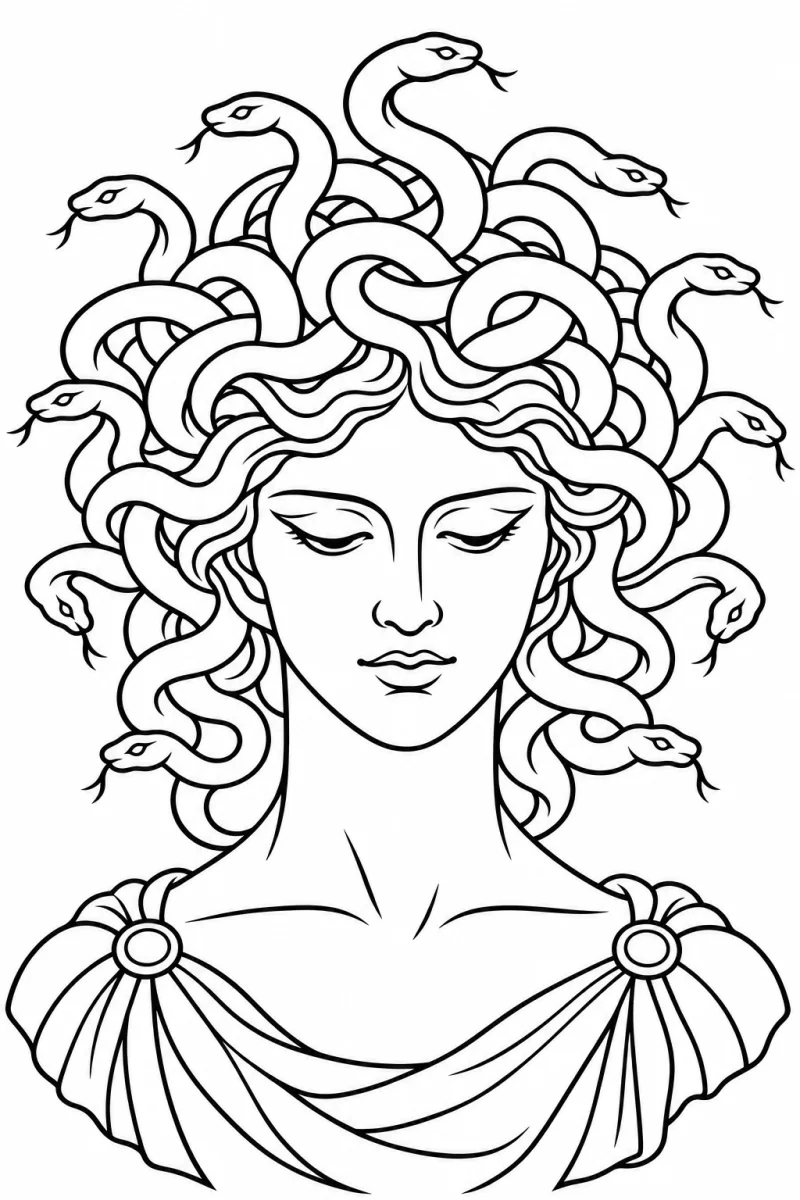
A Medusa stencil has two jobs pulling against each other: a calm, readable face and a head of snakes that is busy by nature. Run a classical statue or painting through a converter and the snakes usually win, with coils and scales crowding into the cheeks and eyes. A clean Medusa stencil keeps the face sparse and gives each snake a clear head, body and direction.
- Free stencils to print
- Line work for thermal or hand transfer
- Prints on A4 or US Letter
What a Medusa tattoo means
In Greek myth Medusa was a Gorgon whose gaze turned people to stone. In some versions of the story she was punished for an assault she suffered, and many clients now wear her as a symbol of survival and of turning harm into protection.
Others choose Medusa for the classical look, or as a sign of a fierce, protective nature. Know the meanings, but do not assume one; let the client tell you what it means to them.
Popular styles and how the stencil changes
Black and grey from statues
The most common approach. Marble statues and busts give clean form and lighting. The stencil marks the features, the jaw and the snake outlines.
Fine line
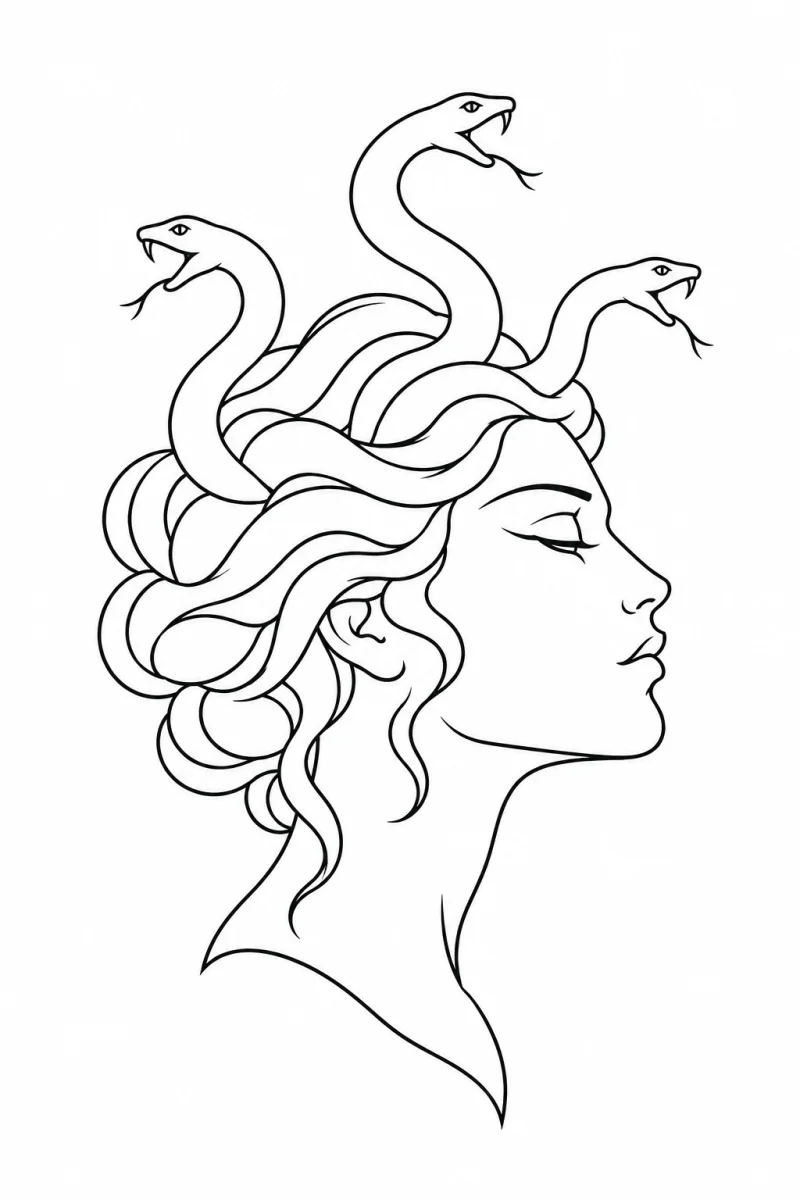
A profile or face outline with a few snakes, one weight. Works at three to five inches.
Neo-traditional
Bold outlines and decorative framing, often with jewellery or a halo. Snakes simplified into strong curves.
Stone and fragment pieces
Cracked stone faces or half-face designs. Keep crack lines sparse and deliberate.
Placement and size
- Forearm and calf take a Medusa portrait at five to eight inches, with snakes extending into the space above.
- Thigh and upper arm suit larger pieces with the full head of snakes.
- Behind the ear and the back of the neck suit small profile pieces with one or two snakes.
- Consider where the gaze points. A face looking toward the centre of the body or along the limb sits better than one staring off the edge.
Line weight tips for a Medusa stencil
- Face lines lightest, snake outlines heavier. The contrast between the two is what lets the face read.
- Give every snake a visible head. Trace each body in the stencil and make sure it leads to a head, not into the hair.
- Do not stencil scales. Mark the belly line of each snake and leave the texture to the shading.
- Statue photos often have eyes without pupils. Decide whether the client wants a stone gaze or living eyes before converting, and add pupils to the reference if needed.
Frequently asked questions
How many snakes should a Medusa stencil have?
As many as stay readable at the final size. Six to ten clear snakes usually read better than a mass of coils, especially under six inches.
Can I use a photo of a Medusa statue?
Yes, statues are popular references. Raise contrast to drop the marble texture, check that each snake head is distinct, and use a photo you have the right to work from.
Why does the face disappear behind the snakes?
The face and snakes came out at the same weight. Lower line weight for the face or redraw the snakes heavier, so the face is the quietest area of the stencil.
More subjects
Related reading
- Realism Tattoo Stencils - how much detail a realism stencil needs
- Stencil Clarity From Complex Photos - simplifying busy references
- Mastering Contrast in Reference Images - preparing statue and painting photos
Make your own Medusa stencil
Convert the statue or drawing, lighten the face, and check that every snake ends in a head. Stencify turns a photo, sketch or text prompt into clean line work in about 30 seconds on iPhone, iPad or Android. Two free uses, then $4.99 a week or $47.99 a year.