Heartbeat and Soundwave Tattoos: From Real Recording to Stencil
• by Stencify • 7 min read

Heartbeat and soundwave tattoos look alike at a glance: a line across the skin that rises and falls. They come from very different sources, though, and they need different stencil rules. A heartbeat line is one continuous stroke with sharp peaks. A soundwave is dozens of separate bars. Treat them the same and you get either a muddy wave or a heartbeat that loses its shape. This guide covers both, from a real recording to a stencil that heals cleanly.
Key takeaways
- An ECG line is one continuous stroke. Keep one even line weight and keep spike legs apart at the base.
- A soundwave is many vertical bars. Merge bars until each is about 1.5 mm wide with gaps of about 1 mm.
- For a real person's heartbeat or voice, start from the real recording and keep its shape. Simplify the drawing, not the data.
- A drawn waveform cannot be played back by itself, whatever the photo on social media suggests.
ECG line vs soundwave: what each one shows
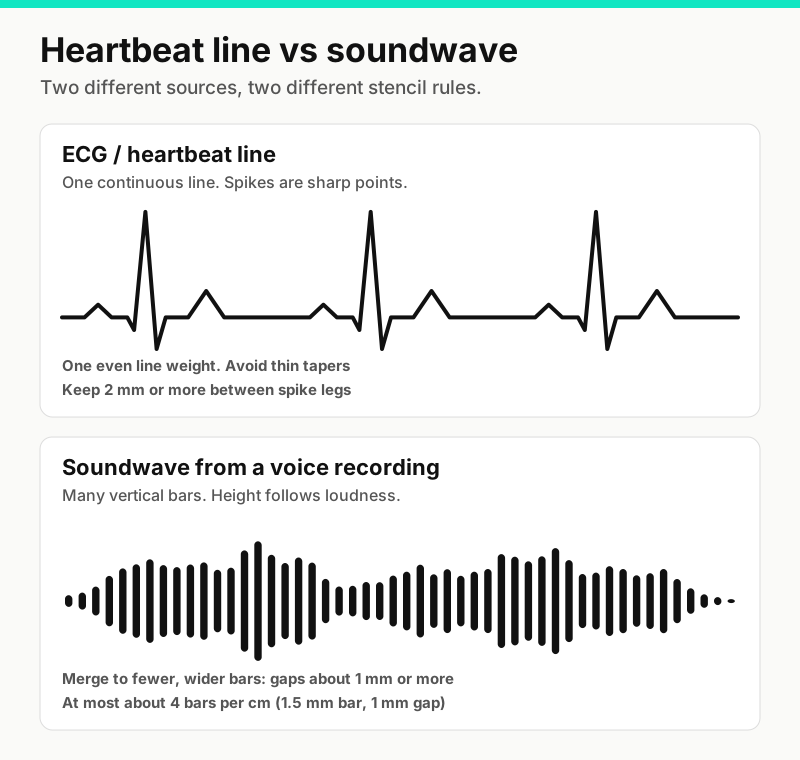
An ECG (electrocardiogram) records the electrical activity of the heart over time. On a printed strip, each beat shows a small bump (the P wave), a tall sharp spike (the QRS complex) and a rounded bump (the T wave), then a flat line until the next beat. A "heartbeat tattoo" is usually a stylised version of this, often with a heart shape or a name worked into the flat part.
A soundwave shows the loudness of a sound recording over time. Most phone voice memo apps draw it as a row of vertical bars, tall where the voice is loud and short in the pauses between syllables. A recording of someone saying a short phrase, a baby's laugh or a pet's bark all make good sources.
One source that surprises people: the heartbeat shown during a pregnancy ultrasound is not an ECG. It is an ultrasound trace, often a Doppler recording of blood flow, which shows as a series of closely packed peaks on a dark background. It works well as a tattoo source too, but it follows the soundwave rules below more than the ECG rules, since it has many closely packed peaks.
Using a real ECG
A generic heartbeat line can be drawn by hand. If the client wants their own heartbeat, or that of someone they have lost, start from an actual recording:
- A printed ECG strip from a hospital or clinic. Patients can usually request a copy of their own records.
- A smartwatch export. Some smartwatches with an ECG feature let the wearer export a recording as a PDF.
- A photo of the strip if that is all that survives. Shoot it flat, in even light, filling the frame.
This is medical information, so handle it with care: use only what the client gives you, and do not keep copies longer than you need.
Reading the strip
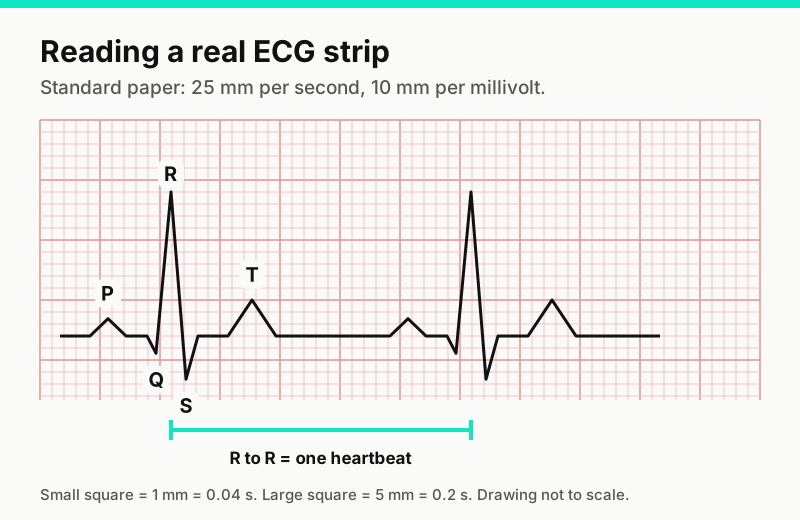
Standard ECG paper runs at 25 mm per second, with 10 mm of height for each millivolt. Each small square is 1 mm, or 0.04 seconds; each large square is 5 mm, or 0.2 seconds. That matters for one practical reason: the spacing between beats reflects the heart rate at the time of recording. At 60 beats per minute, peaks sit about 25 mm apart on the original strip. You will scale the tattoo up or down anyway, but if you keep the spacing in proportion, the tattoo keeps that person's rhythm.
Choose a short run of two or three clean beats. Rhythm strips are often printed from lead II, which usually shows a clear upright spike, but any lead the client cares about can work.
Preparing the trace
- Crop to the beats you want, plus a short flat lead-in and lead-out.
- Remove the grid. The red or pink grid has to disappear completely. High contrast settings usually drop it; check that no grid lines survive along the trace.
- Keep the shape. Resist tidying a real trace into a perfect generic heartbeat. Small irregularities are what make it someone's own.
- Open tight angles. Where the two legs of a spike meet at a sharp point, ink fills the narrow V. Keep the legs at least about 2 mm apart at the base, widening the spike slightly if needed.
Using a real voice recording
Record in a quiet room, close to the phone's microphone. Short phrases work best: two or three seconds gives a wave with clear rises and dips. Trim the silence at both ends, then take a screenshot of the waveform or export it as an image.
The look of a waveform depends heavily on the app. The same recording can appear as a few wide bars or hundreds of thin spikes, depending on zoom and how many bars the app draws. That gives you freedom: you are choosing a drawing of the sound, not a fixed image. Keep the overall shape, the loud and quiet parts in the right order, and adjust the number of bars to suit the size.
Merging bars to fit the size
A phone screen can show a hundred thin bars. Skin cannot. With bars about 1.5 mm wide and gaps about 1 mm, you get roughly four bars per centimetre. So:
| Wave length | Bars that fit (about) | Typical placement |
|---|---|---|
| 6 cm | 24 | Wrist, ankle, behind the ear |
| 10 cm | 40 | Forearm, collarbone |
| 15 cm | 60 | Forearm, ribs, upper arm |
If the source has more bars, merge neighbours by taking the taller of each pair. Keep the tallest bar at about 1.5 cm or more, so the quiet parts of the recording still show as short bars rather than dots.
As for playback: a drawn waveform does not hold enough information to recreate the sound. Some apps link a tattoo to a stored recording that plays when the tattoo is scanned. That depends on the service staying available, so present it to clients as an extra, not as part of the tattoo itself.
Line weight and sizing summary
| ECG / heartbeat line | Soundwave | |
|---|---|---|
| Structure | One continuous line | Separate vertical bars |
| Line weight | One even weight; avoid thin tapers | Bars about 1.5 mm or wider |
| Tightest space | About 2 mm between spike legs at the base | About 1 mm between bars |
| Common length | Two or three beats, often 6 to 15 cm | Often 6 to 15 cm |
| Main risk | Spikes filling in | Bars merging into a block |
These are common studio defaults rather than fixed rules. Fine line artists may go smaller with their own technique. For placement sizes, see our tattoo size chart.
Adding a name, date or heart
Many clients want to combine the line with something else: a heart worked into the flat section, a name written along the baseline, or a date at the end. Keep at least 1 mm of clear skin between the line and any added element, and match line weights so the addition looks like part of the same piece. For lettering sizes, see the lettering stencil guide.
Making the stencil
Whichever source you use, the steps are the same: get a clean image of the real recording, convert it to clear lines, size it to the measured placement, and compare the result with the original before printing. Stencify handles the conversion step from a photo of an ECG strip or a screenshot of a waveform, with line weight and contrast controls to drop the grid and even out the stroke. You can use AI edit with a short text prompt, for example to remove leftover grid lines or add a small heart. Preview it on a photo of the client at real size and export a PNG or PDF for A4 or US Letter. For a real person's trace, lay the result over the original and check the peaks still match. It runs on iPhone, iPad and Android with two free uses: get Stencify on the App Store or on Google Play. For a deeper look at the conversion step, see line art from a photo.
Frequently asked questions
Can you tattoo a real person's heartbeat?
Yes. Use a copy of a real ECG recording, for example a printed strip or a PDF exported from a smartwatch with an ECG feature. Crop it to a few beats, remove the grid, and keep the shape of the trace as it was.
Can a soundwave tattoo be played back?
Not by itself. A drawn waveform does not contain enough information to rebuild the sound. Some services link a tattoo to a stored recording in an app, which depends on that service staying available.
What is the difference between a heartbeat tattoo and an ECG tattoo?
A generic heartbeat tattoo is a stylised line with a spike, drawn by hand. An ECG tattoo copies a specific recording, so the shape and spacing of each beat belong to one person.
How big should a soundwave tattoo be?
Long enough that bars can stay at least about 1.5 mm wide with gaps of about 1 mm. That allows roughly four bars per centimetre, so a 10 cm wave can hold about 40 bars.
Related reading
- Memorial Tattoo Ideas - meaningful designs from a real source
- Handwriting and Signature Stencils - keeping a personal original accurate
- Line Art From a Photo - turning an image into clean lines
- Tattoo Size Chart - typical sizes by placement
Keep the real line, make it tattooable
Stencify turns a photo of an ECG strip or a waveform screenshot into clean stencil lines and shows it on skin at real size.