Wolf Tattoo Ideas: Meaning, Styles, Placement and How to Stencil Fur
• by Stencify • 9 min read
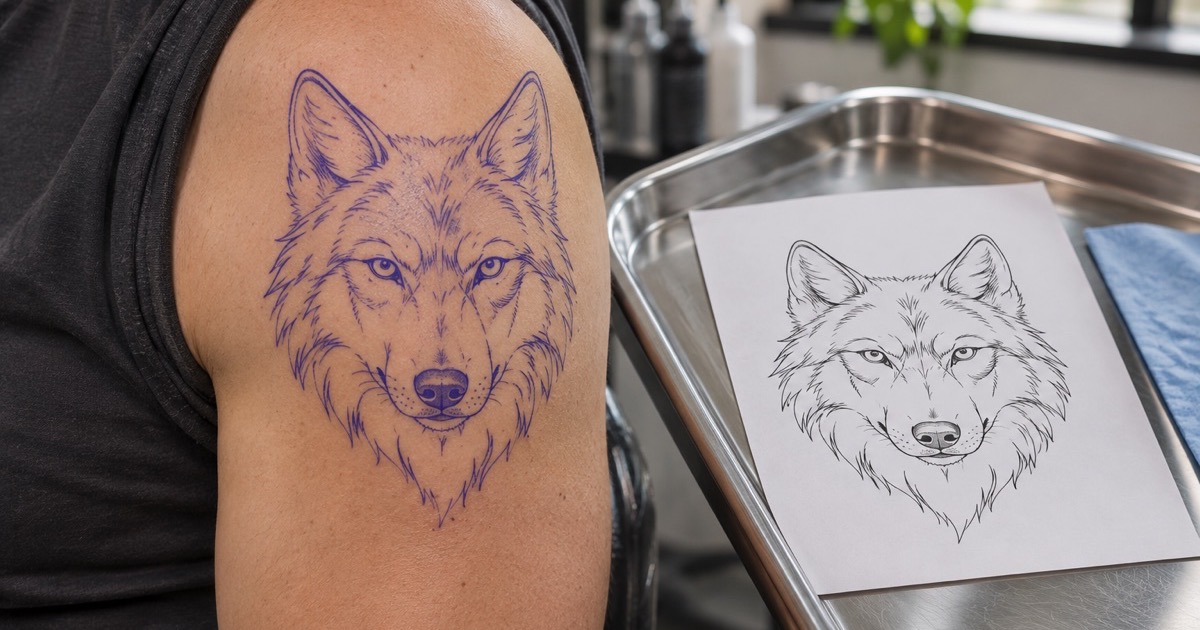
A wolf can be a quiet outline on a wrist or a full realistic portrait across a chest. The hard part is always the same: fur. A wolf photo converted directly into a stencil produces thousands of small marks that no one can follow with a needle. The short answer for planning one: pick the style, size the head so the eyes are large enough to hold detail, and stencil the fur as a small number of directional clumps. This guide covers meanings, styles, sizes and placements, and how to build that stencil.
Key takeaways
- Wolves are most often linked with loyalty and family, because a wild pack is a family, and with independence through the idea of the lone wolf.
- Realistic wolf heads need room: about 10 cm (4 in) or more so the eyes and fur have space.
- Stencil fur as clumps and direction lines, never hair by hair. The eyes carry the expression, so place and size them first.
- A front-facing wolf must be symmetrical. Check the eyes and ears against a centre line before printing.
What a wolf tattoo means
- Loyalty and family. A wild wolf pack is usually a family: a breeding pair and their offspring from the last few years. This is the root of the most common meaning, and the reason wolves are popular for tattoos about parents, children and siblings.
- Independence. The "lone wolf" is real. Young wolves often leave their pack to find a mate and territory of their own. As a tattoo it stands for self-reliance or a period spent finding your own way.
- Protection. Wolves defend their pack and their territory, so the image is often chosen as a guardian.
- Instinct. A wolf can stand for trusting your own judgement or for a wilder side of your character.
Wolves in myth
In Norse myth the wolf Fenrir is a force of destruction, while Odin keeps two wolves, Geri and Freki, at his side. In the founding story of Rome, a she-wolf nurses the twins Romulus and Remus. Many Native American nations hold the wolf in high regard, and its meaning differs from nation to nation. If a design draws on a specific culture's art, it is worth learning the background and avoiding sacred or clan imagery that is not yours to wear.
Two popular ideas that are not quite right
The "alpha wolf" who fights his way to the top came from early studies of unrelated wolves kept in captivity. In the wild, the leaders of a pack are simply the parents. Wolves also do not howl at the moon. They howl to keep in contact with each other and to mark territory, and lift their heads because it helps the sound carry. Neither fact stops a howling wolf under a full moon from being a strong image, but it is useful to know what the picture shows.
Wolf tattoo styles
Realism
A portrait from a photo, usually black and grey, with the eyes as the focus. It needs a good reference: sharp, well lit from one side, with the eyes clearly visible. The realism stencil guide covers how to map shadows.
Geometric
A wolf head split between a realistic half and a half built from straight lines, triangles or circles, or a wolf drawn entirely in facets. Straight lines must be exact, so draw them with a ruler at final size. See the geometric stencil guide.
Traditional and neo-traditional
A wolf head in profile or three-quarter view, often snarling, with bold outlines and fur drawn as a few pointed tufts. Neo-traditional adds depth, varied line weight and elements such as roses, arrows, moons or daggers.
Blackwork and dotwork
Solid black shapes with fur suggested by the edge of the silhouette, or shading built from dots. Outline every filled area on the stencil and mark it as filled.
Fine line and minimal
A single-line outline, a small howling silhouette or a simplified face. These work at small sizes because they leave the fur out completely.
Nordic and knotwork
Wolves drawn in interlaced bands in the style of Viking-age carving. Every over-and-under crossing has to be correct, so check each one on the stencil before printing.
Popular compositions
- Head portrait, front view. Direct and symmetrical. Suits the chest, the upper arm and the back of the hand.
- Howling wolf. A side view with the head raised, often with a moon or a line of pines. It reads well even as a small silhouette.
- Wolf and forest. A double exposure, with trees or mountains inside the outline of the wolf. The outer contour must stay clean so the shape still reads.
- Pack or pair. Two or more wolves for family. Overlap them and vary the sizes; a row of identical heads looks stiff.
- Wolf with skull, rose or arrow. Common in traditional and neo-traditional work. Decide what sits in front at each overlap.
Sizes and placements
| Placement | Typical size | Notes |
|---|---|---|
| Wrist or ankle | 3 to 6 cm (1.2 to 2.5 in) | Outline or silhouette only |
| Back of the hand | 7 to 9 cm (2.75 to 3.5 in) | Front-facing head; expect faster fading |
| Forearm | 10 to 18 cm (4 to 7 in) | Head portrait, or a full howling wolf along the arm |
| Upper arm or shoulder | 12 to 20 cm (5 to 8 in) | The most common spot for a realistic head |
| Calf | 12 to 20 cm (5 to 8 in) | Suits tall compositions such as a wolf with trees |
| Chest or thigh | 15 to 25 cm (6 to 10 in) | Front-facing portraits and pairs |
| Back | 25 cm (10 in) and up | Packs and full scenes |
For realism, treat about 10 cm (4 in) of head height as a practical minimum. Below that, the eyes become too small to hold a highlight and the fur turns into a grey patch as the tattoo ages. The tattoo size chart gives general ranges for each body part.
A wolf has a long muzzle, so a three-quarter view is noticeably wider than a front view. On an arm, point the muzzle toward the front of the body or along the limb, not into the inner elbow.
How to stencil a wolf
1. Start with the eyes
The eyes decide whether the wolf looks alert, calm or aggressive. A wolf's eyes are set at a slight upward slant toward the outside and are small compared with the head. Mark the outline of each eye, the pupil and the highlight on the stencil. Leaving the highlight as open skin is what makes the eye look alive, so it has to be planned and not left to chance.
2. Block in the big shapes
Before any fur, the stencil needs the structure: the triangle of the ears, the brow, the bridge and tip of the nose, the line of the mouth, and the ruff of longer fur around the cheeks and neck. If these are right, the wolf reads even with very little fur drawn.
3. Turn fur into clumps
Fur grows in a pattern: short and tight on the muzzle, fanning out from between the eyes, then long and layered around the cheeks and neck. On the stencil, draw:
- The edge of each clump as a short, tapered stroke, mainly along the outline and where one layer overlaps another.
- A few direction lines inside large areas to show which way the fur lies.
- Shadow borders as thin or dotted lines under the brow, beside the muzzle and under the jaw.
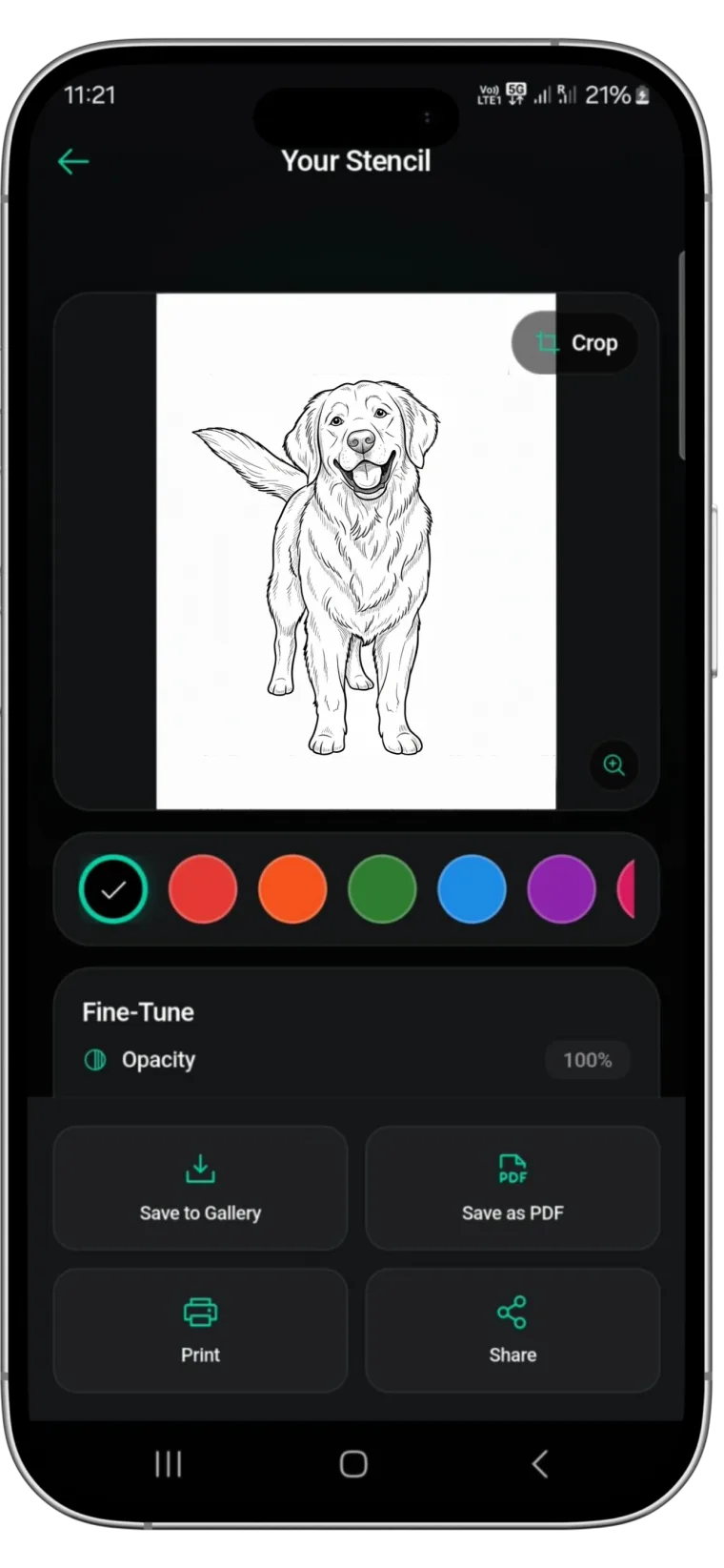
Everything else is shaded freehand, following the direction lines. A photo converted with every hair kept gives a stencil that smears into a purple patch after the first wipe. If your conversion has too many marks, "Simplify tiny details" in Stencify clears the smallest ones and "Thicken outlines" strengthens the contour. The pet portrait guide uses the same approach for dog and cat fur.
4. Check symmetry on front views
Draw a centre line from between the ears through the nose. The eyes should sit level on either side of it and the ears should match in height. Flipping the design with "Mirror" makes uneven eyes obvious. On the body, a front-facing head should sit on a flat, centred area, since a curve will pull one side out of line.
5. Print at exact size
Measure the placement and print at 100% at that size. Large chest, thigh and back pieces can be printed across several sheets and taped together. Full steps are in how to size and print a tattoo stencil.
For reference drawings, see the wolf stencil designs.
Frequently asked questions
What does a wolf tattoo mean?
Most often loyalty and family, because a wild wolf pack is a family made up of two parents and their offspring. A lone wolf stands for independence, and wolves are also chosen as symbols of protection and instinct. Meanings vary between cultures and people.
How big should a wolf tattoo be?
An outline or silhouette works at 3 to 6 cm (1.2 to 2.5 in). A realistic wolf head needs about 10 cm (4 in) or more in height so that the eyes and fur have room, and most realistic pieces on the upper arm, chest or thigh are 12 to 25 cm (5 to 10 in).
Where is the best place for a wolf tattoo?
The upper arm and shoulder are the most common places for a realistic head. The forearm and calf suit taller designs such as a howling wolf, and the chest, thigh and back give room for front-facing portraits, pairs and packs.
How do you stencil wolf fur?
Do not draw every hair. Mark the edges of the main fur clumps with short tapered strokes, add a few direction lines inside large areas, and mark the borders of the main shadows with thin or dotted lines. The rest is shaded freehand.
Do wolves really howl at the moon?
No. Wolves howl to keep in contact with their pack and to mark territory, at any time of day or night. They raise their heads because it helps the sound carry, which is where the picture of a wolf howling at the moon comes from.
Related reading
- Wolf Stencil Designs - reference drawings and stencil notes
- Realism Tattoo Stencils - mapping shadows from a photo
- Pet Portrait Tattoos - fur, eyes and choosing a reference photo
- Geometric and Mandala Stencils - exact lines and symmetry
Wolf stencils without the noise
Stencify turns a wolf photo into clean line work, reduces fur to readable shapes with "Simplify tiny details" and prints at the exact size for the placement.