Stencil library
Barbed Wire tattoo stencil
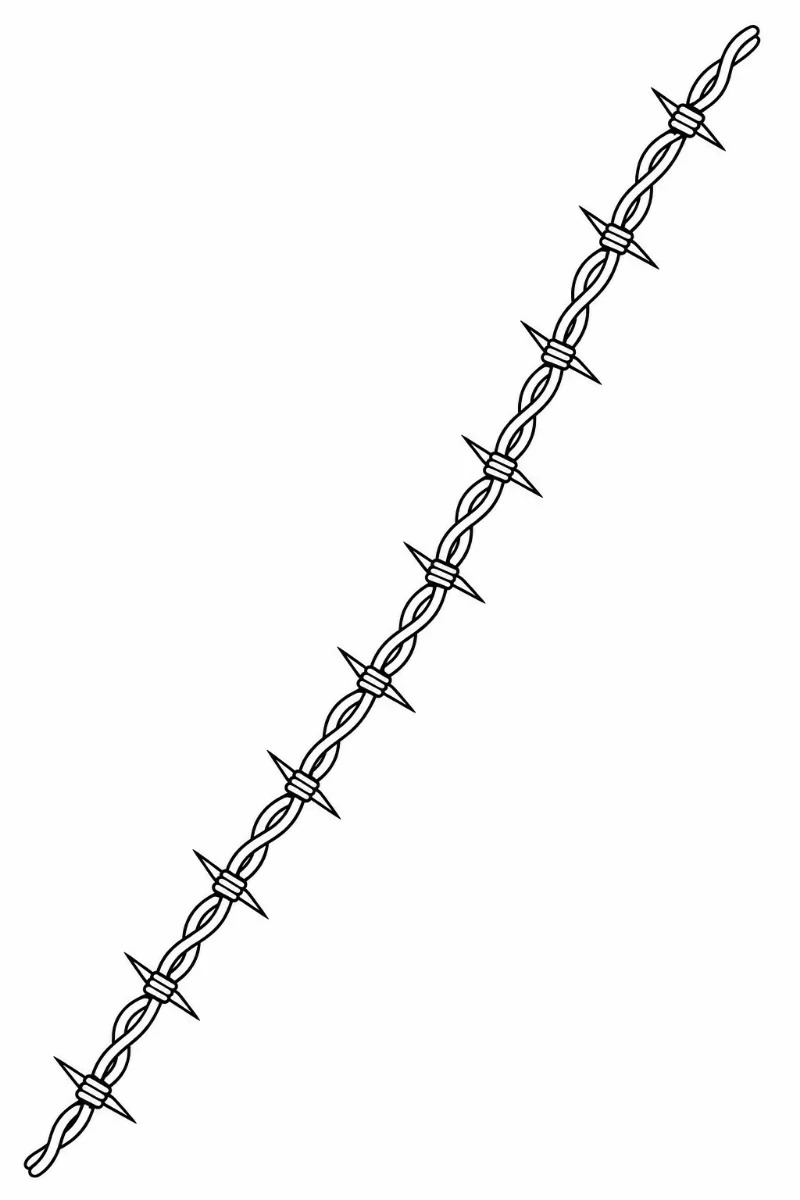
Barbed wire is a repeat pattern pretending to be a drawing. Two strands twist around each other, barbs sit at regular intervals, and the whole thing usually has to wrap a limb and meet itself at the back. The stencil decides whether the twist looks believable and whether the band closes cleanly, so this is one subject where measuring matters more than drawing.
- Sample stencils, Stencify style
- Line work for thermal or hand transfer
- Prints on A4 or US Letter
- Updated Oct 19, 2026
What a barbed wire tattoo means
Barbed wire was invented for fencing in the nineteenth century, and as a tattoo it usually stands for hardship, endurance, confinement or a period the wearer came through. It can also mark time in prison, loyalty or plain toughness. The armband version became one of the defining tattoos of the 1990s, and it has come back in fine-line and blackwork forms. Broken or snapped wire is often chosen for release or recovery.
Popular barbed wire tattoo styles
Armband
The classic: a twisted pair of strands circling the upper arm or forearm. Bold outlines, often with simple shading on each twist.
Fine line
A single thin strand with small barbs, often along a collarbone, wrist or ankle. Lighter and more graphic than the 1990s version.
Combined pieces
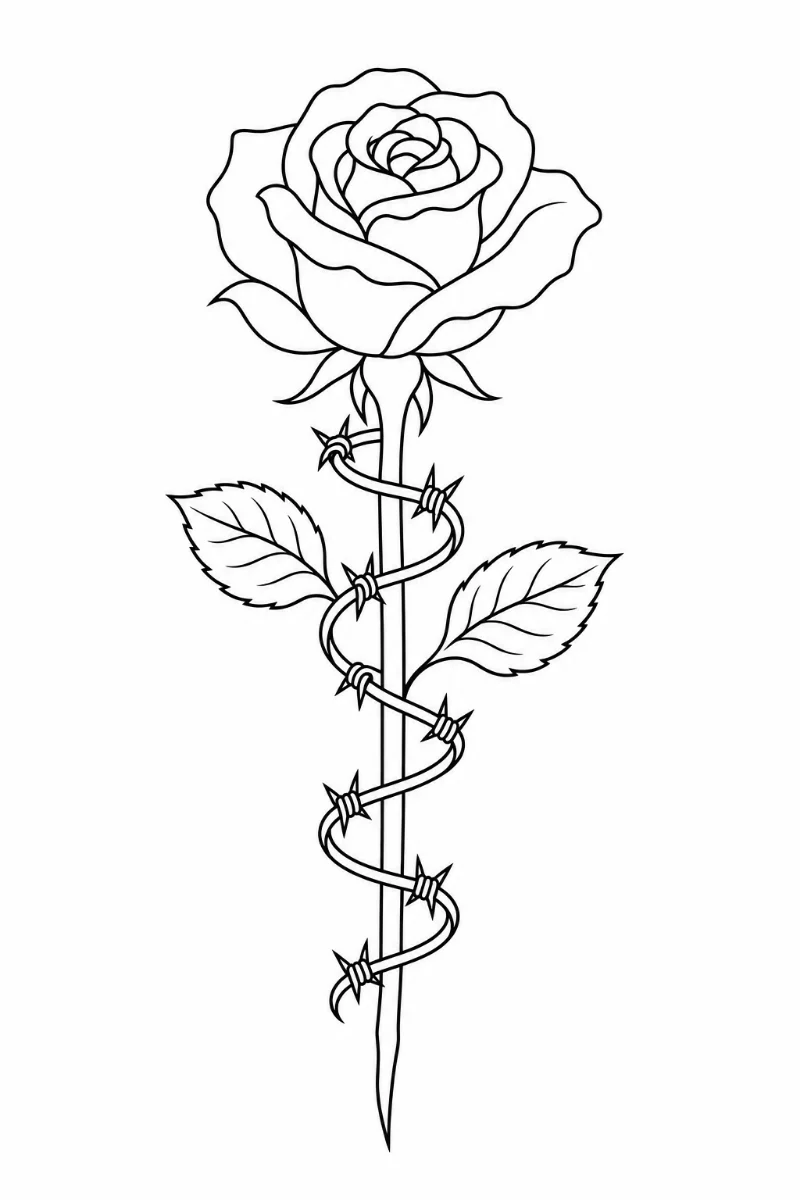
Wire wrapped around roses, hearts, crosses or lettering. The wire usually needs to pass in front of and behind the main subject, which has to be clear on the stencil.
Placement and size
- Upper arm bands are the classic choice. Measure the arm where the band will sit, relaxed, and size the pattern to that length.
- Forearm and wrist bands taper, so the strand spacing needs to vary slightly around the limb.
- Collarbone and hip lines suit single-strand fine-line wire that follows the bone.
- Put the seam where the band meets itself on the inner arm, where it is least visible.
Line weight tips for a barbed wire stencil
- Draw the twist as two overlapping strands with one line winning at each crossing. Double lines at the crossings are what make wire look flat.
- Barbs need consistent spacing and size. Lay them out on a straight reference first, then curve it, rather than placing them freehand.
- Barb points must be sharp. Lower line weight if the tips fill in at print size.
- For combined pieces, give the wire behind the main subject a break in its line where it passes behind, so the depth reads.
- Print the band as a long strip and apply it in one go, starting at the outer arm and working round to the seam.
Frequently asked questions
How do I size a barbed wire armband stencil?
Measure the arm at the band position, relaxed. Size the pattern so the repeats divide evenly into that length and put the join on the inner arm.
Why does my wire look flat?
Usually the crossings are drawn with both strands at full line. Break the strand that goes behind at each crossing so the twist reads.
Can barbed wire be done in fine line?
Yes. Use a single strand and small barbs, keep the weight thin, and leave enough gap between barbs that they stay separate after healing.
More subjects
Related reading
- Tattoo Placement and Anatomy - why stencils must follow the body
- How to Size and Print a Tattoo Stencil - printing at actual size
- Cover-Up Tattoo Stencils - planning the design first
Make your own barbed wire stencil
Draw a short section of wire or describe the band in a text prompt, then check the barb spacing at real size before printing the strip. Stencify turns a photo, sketch or text into print-ready line work in about 30 seconds on iPhone, iPad or Android. Two free uses, then $4.99 a week or $47.99 a year (US).