Finger Tattoos: Ideas, Pain, Fading and How to Stencil Them
• by Stencify • 8 min read
Finger tattoos are small, visible and popular, and they are also the tattoos most likely to fade, blur or need a touch-up. The short answer: keep the design simple, put it on the top of the finger between the knuckles where ink holds best, expect it to soften sooner than a tattoo on your arm, and plan for at least one touch-up. This guide covers what works, what to expect and how artists stencil such a small, curved area.
Key takeaways
- Hands are washed, rubbed and exposed to sun all day, and finger skin renews quickly. That is why finger tattoos fade faster than most.
- The top of the finger holds ink best. The sides fade more, and the palm side fades most.
- Simple shapes with open space last. Tiny lettering, fine shading and tight detail blur.
- Many artists will warn you about fading before agreeing to a finger tattoo, and some do not offer them. That is honesty, not reluctance.
Why finger tattoos fade and blur
Three things work against ink on a finger.
- Constant use. Fingers bend, grip and rub against things thousands of times a day, and they are washed far more often than any other tattooed area.
- The skin itself. On top of the finger the skin is thin and sits close to bone and tendon. On the sides and the palm side it is thick and renews quickly. Both make it harder to place ink at an even depth: too shallow and it falls out as the skin heals, too deep and the line spreads into a blur.
- Sun. Hands are rarely covered, and sunlight fades tattoo ink over time.
None of this means a finger tattoo cannot look good. It means the design and the position have to be chosen with these limits in mind.
Where on the finger
| Position | How it holds | Notes |
|---|---|---|
| Top of the finger, between the knuckles | Best | The flattest and most stable area. The usual place for symbols and letters. |
| Over a knuckle | Fair | The skin creases and stretches, so lines can break up. Keep detail off the crease. |
| Side of the finger | Weaker | Popular for hidden words and small symbols, but rubs against the next finger and fades unevenly. |
| Palm side and inner finger | Weakest | Thick, fast-renewing skin. Often fades heavily or falls out in patches. |
| Around the finger, as a band | Mixed | The top holds while the underside fades, so a band often needs touching up underneath. |
The section between the base knuckle and the middle knuckle gives the most room, roughly 2 to 3 cm (0.8 to 1.2 in) long and 1.5 to 2 cm (0.6 to 0.8 in) wide on most adult hands. Measure the actual finger; they vary a lot.
Finger tattoo ideas that hold up
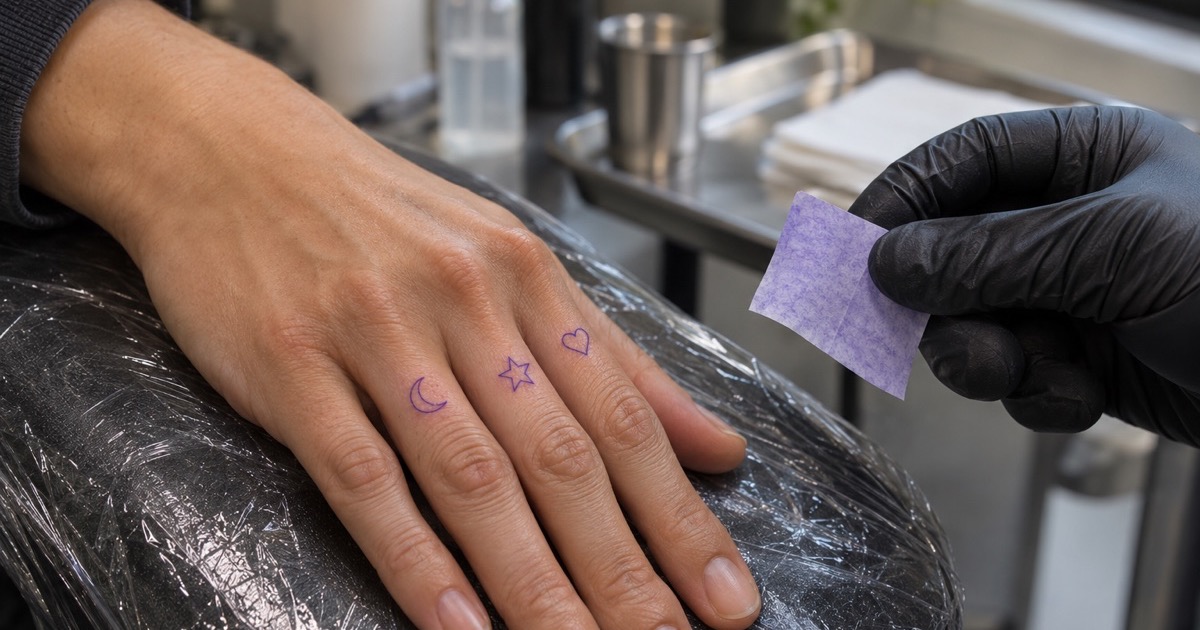
- Simple symbols. A moon, star, heart, arrow, cross, wave, sun or small leaf. One clear shape with open space inside it. The semicolon is a common choice because it is two simple marks.
- A single letter or initial. One letter can be made large enough to stay readable. The lettering stencil guide covers fonts that survive small sizes.
- Dots and small marks. One to three dots, short lines or tiny chevrons are among the longest-lasting finger designs because there is nothing fine to lose.
- Ring and band tattoos. A plain line, a double line or a small pattern in place of a ring. Popular for couples; see matching couple tattoos. Plan for the underside to need more upkeep than the top.
- Roman numerals. A short date or a single number along the finger. Straight strokes hold better than curves at this size; see the Roman numeral guide.
- Knuckle lettering. One letter per finger, classically four letters per hand. Bold block letters are traditional for a reason: they stay readable.
- A small vine or snake. A line that runs the length of the finger or wraps it once. Keep it as a single outline without interior detail.
Designs to avoid
Whole words in small script, portraits, fine shading, tight geometric patterns and anything with lines closer together than about 1 mm. These can look sharp on the day and turn soft within a year or two. If the idea needs that much detail, it probably belongs on the wrist or forearm. The small tattoo ideas guide has options for both.
How much do finger tattoos hurt?
Fingers are usually reported as one of the more painful places to be tattooed. There is very little padding between skin and bone, and fingertips and hands have a high density of nerve endings. The knuckles and the sides tend to be described as the sharpest. The good news is the size: most finger tattoos take minutes, not hours. The tattoo pain chart compares placements, and pain differs a lot from person to person.
Healing and touch-ups
Your artist's aftercare instructions come first. The difficulty with fingers is that you cannot stop using your hands.
- Washing. You will still need to wash your hands. Use a mild soap, pat the tattoo dry and avoid scrubbing it.
- Soaking and friction. For the first weeks, avoid long soaks such as dishwashing without gloves, swimming and baths, and anything that rubs the spot, including rings and tight gloves.
- Sun. Once healed, sunscreen on the hands slows fading.
- Touch-ups. It is common for a finger tattoo to heal with small gaps or lighter areas. Ask before booking whether a touch-up is included and when the artist wants to see it again.
Before you book
A finger tattoo is always on show. Some workplaces still have rules about visible tattoos, and a finger cannot be covered by a sleeve. It is also worth trying the design first: draw it on with a pen, or use a photo of your hand to see the size. The guide on how to try on a tattoo explains the options.
How to stencil a finger tattoo
1. Measure the finger
Measure the width and the length between the knuckles with a soft tape or a ruler, with the finger straight. Leave a margin of 2 to 3 mm from each side so the design does not wrap over the edge, where it will distort and fade.
2. Simplify the design to the size
Print or view the design at its real size before anything else. If two lines sit closer than about 1 mm, or an enclosed space is smaller than the tip of a pen, simplify it. In Stencify, "Simplify tiny details" removes the smallest marks and "Thicken outlines" brings thin lines up to a weight that will transfer cleanly and hold.
3. Decide which way it faces
Letters and symbols with a clear top can face the wearer or the people looking at the hand. Hold the hand out, fingers pointing away, and agree on the direction before the stencil goes on. For knuckle lettering, check the order of the letters with both fists side by side.
4. Cut the stencil small
Trim the paper close to the design, leaving a few millimetres all round. A large sheet will not sit flat on a finger and tends to crease or slide. For several fingers, cut one piece per finger.
5. Apply with very little solution
Use a thin film of stencil solution and wait until it is tacky. Too much makes a small stencil bleed, and on a design this size a bleed can close a gap completely. Keep the finger straight and relaxed, press the paper on from the centre outward, hold for a few seconds and peel. The steps are the same as in getting the stencil to stick.
6. Check it bent and straight
Have the client make a fist and then open the hand. A design that looks centred on a straight finger can drift toward a crease when the hand closes. For matching designs on several fingers, check that they line up when the fingers are together.
Bands are often drawn directly with a skin marker instead of a printed stencil, using a strip of paper wrapped around the finger as a guide so that the ends of the line meet.
Frequently asked questions
Do finger tattoos fade quickly?
They usually fade and soften faster than tattoos on the arms or legs, because hands are washed, rubbed and exposed to sun all day and finger skin renews quickly. The top of the finger holds ink best, the sides fade more, and the palm side fades most. Touch-ups are common.
How long do finger tattoos last?
A simple design on the top of the finger can stay clear for years, though it will usually soften sooner than a tattoo elsewhere. Designs on the side or the palm side of the finger can lose ink within months. How long it lasts depends on position, design, the artist's technique and how you use your hands.
Do finger tattoos hurt more?
Fingers are commonly reported as one of the more painful placements, because there is little padding over the bone and many nerve endings. Most finger tattoos are small, so the session is short. Pain varies a lot between people.
What designs work best on a finger?
Simple shapes with open space: small symbols, a single letter, dots, plain bands and bold knuckle letters. Avoid small script, shading and tight detail, and keep lines at least about 1 mm apart.
Why do some artists refuse to do finger tattoos?
Because results are less predictable than on other parts of the body. Finger tattoos often heal patchy, blur or need touch-ups, and some artists prefer not to offer work they cannot stand behind. Others do them after explaining the limits.
Related reading
- Small Tattoo Ideas - designs and minimum sizes that last
- Behind the Ear Tattoos - another small, curved placement
- Tattoo Pain Chart - where it hurts most and least
- Tattoo Size Chart - common sizes by placement
Small stencils with lines that hold
Stencify cleans a small design down to the lines that matter with "Simplify tiny details", strengthens them with "Thicken outlines" and prints at exact size.