Semicolon Tattoo: Meaning, Size, Placement and a Clean Stencil
• by Stencify • 8 min read
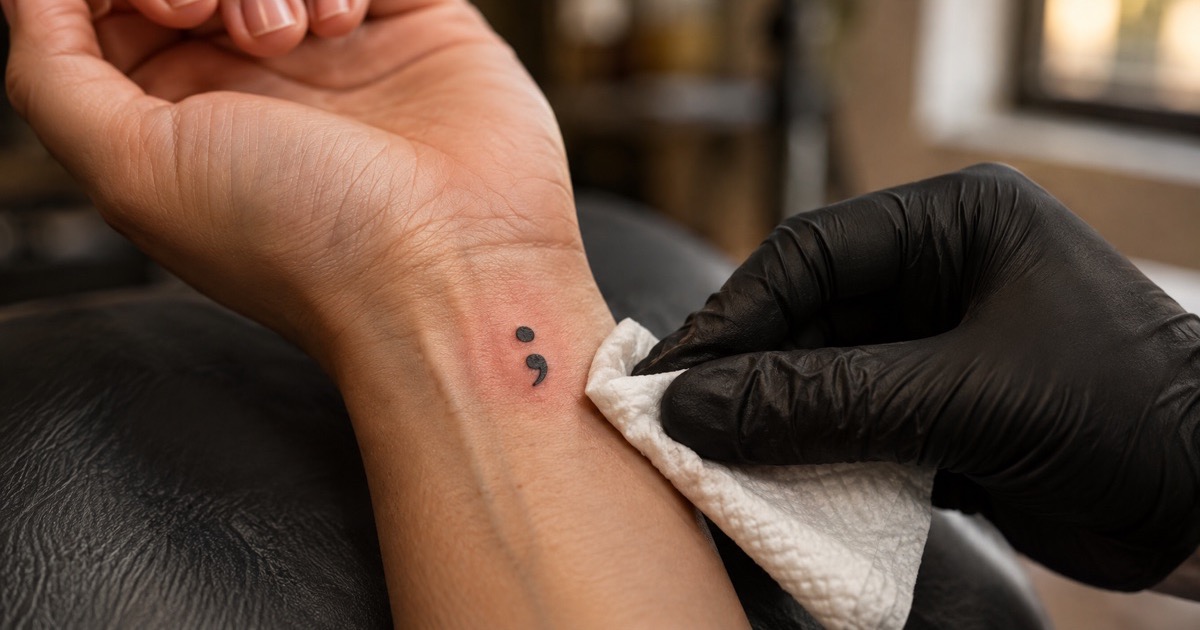
A semicolon tattoo is a small punctuation mark with a specific meaning: it stands for mental health awareness and for choosing to keep going. The symbol comes from Project Semicolon, a nonprofit movement started in the United States in 2013, and it is often worn by people who have lived through depression, self-harm or suicidal thoughts, or by those who support them. Most semicolon tattoos are 1 to 2.5 cm (0.4 to 1 in) tall, placed on the inner wrist, and they depend on one detail more than any other: enough space between the dot and the comma.
Key takeaways
- The semicolon marks a pause, not an ending. The meaning is personal, so let the wearer share as much or as little as they want.
- Around 1 cm (0.4 in) tall is the smallest common size. 1.5 to 2.5 cm (0.6 to 1 in) gives the gap between dot and comma room to stay open as the tattoo ages.
- The inner wrist is the classic spot. Decide with the client whether the mark should read the right way up for them or for people facing them.
- For such a small piece, print the stencil at the exact measured size and check orientation before it touches the skin.
What a semicolon tattoo means
In writing, a semicolon is used where an author could have ended a sentence but chose to continue. Project Semicolon, founded in 2013, used that as a metaphor for mental health: you are the author, and the sentence is your life. The movement encouraged people to draw or tattoo a semicolon as a quiet sign that their story was not over, and as a way to start conversations about depression, suicide, addiction and self-harm.
The tattoo spread widely through social media in the years that followed, and today it carries a few overlapping meanings:
- Personal survival. A reminder of a hard period the wearer came through.
- Support. Solidarity with a friend or family member who is struggling.
- Remembrance. A tribute to someone lost to suicide. Some people pair it with a name or date, much like other memorial tattoos.
- Awareness. A visible signal that mental health can be talked about.
None of these can be read from the tattoo itself. A semicolon on someone's wrist says only that it means something to them.
If you are struggling right now, a tattoo can be a meaningful marker, but it is not a substitute for support. In the US, you can call or text 988 to reach the 988 Suicide & Crisis Lifeline. In the UK and Ireland, Samaritans can be reached on 116 123. Elsewhere, contact your local emergency number or a local crisis line.
For artists: handling the consultation with care
Clients asking for a semicolon often expect to be asked why. Many are happy to talk about it; some are not. A few habits keep the appointment comfortable:
- Do not ask for the story. Ask about size, placement and style. If the client wants to share more, they will.
- Talk about visibility. The inner wrist is seen by others every day. Some clients want that; others prefer a spot they can choose to show, such as the ankle or behind the ear.
- Be practical about scars. If the client wants the semicolon on or near scarred skin, assess it in person. Scars should be fully healed and settled before tattooing, which can take many months, and scar tissue can take ink differently from the skin around it. If you are not sure, suggest a placement nearby and say why.
- Keep it short and calm. A semicolon is a quick tattoo. A relaxed setup and a clear explanation of each step matter more than speed.
Size: how small is too small
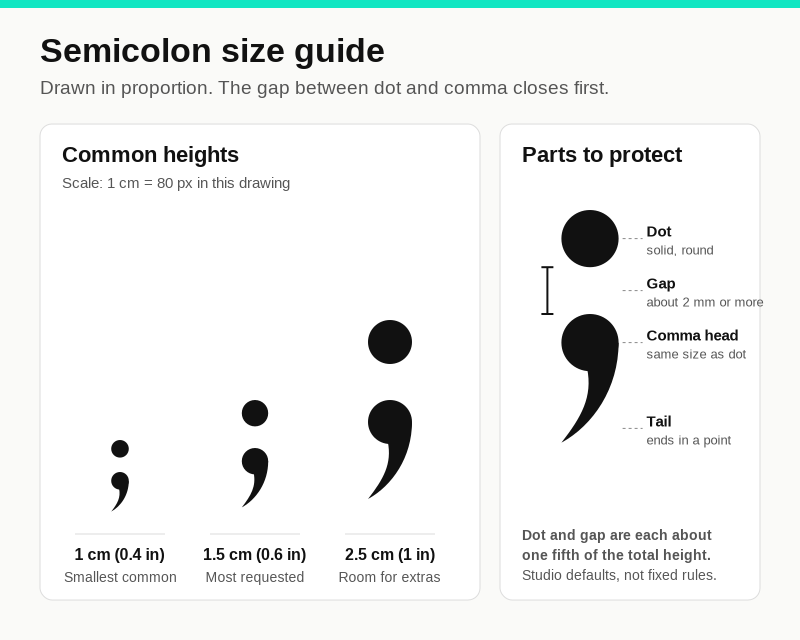
A semicolon has three parts that have to stay separate: the dot, the comma head, and the clear skin between them. Tattoo ink spreads slightly under the skin over the years, so the gap is the first thing to close. When it does, the mark starts to read as a smudge, a lowercase i, or an exclamation mark.
| Height | Dot | Gap | Good for |
|---|---|---|---|
| 1 cm (0.4 in) | About 2 mm | About 2 mm | A plain semicolon; the smallest size most artists are comfortable with |
| 1.5 cm (0.6 in) | About 3 mm | About 3 mm | The common choice for the wrist, finger side or ankle |
| 2.5 cm (1 in) | About 5 mm | About 4.5 mm | A semicolon with small extras, such as a heart or short wings |
| 4 to 6 cm (1.5 to 2.5 in) | Varies | Varies | Butterfly, flower or lettering designs built around the mark |
These are common studio defaults rather than fixed rules. Fine line artists may go smaller with their own technique, and some clients prefer a tiny mark knowing it may soften over time. For placement sizes in general, see the tattoo size chart.
Solid or outlined?
At 1 to 2.5 cm, a solid dot and a solid comma heal more evenly than outlined shapes. An outlined dot at 2 mm leaves almost no room inside the line, so it tends to fill in anyway. Outlines start to make sense at larger sizes, or when the semicolon is drawn as part of a fine line illustration.
Placement
Inner wrist
The most common spot, and the original one for many wearers because it is easy to see. Keep it a little above the wrist crease, since skin that folds all day blurs fine work sooner. The inner wrist is thin-skinned and close to tendons, so it is usually described as moderately painful; the tattoo pain chart covers this in more detail.
Side of the finger
Discreet and easy to show. Hands and fingers fade faster than most areas because of washing, sun and friction, so expect touch-ups and keep the design simple.
Behind the ear, ankle, collarbone
Good choices for a mark the wearer wants to show only sometimes. Each has its own size limits; our behind-the-ear tattoo guide covers the curved space there.
Which way should it face?
On the wrist this matters more than people expect. A semicolon that reads the right way up for the wearer, looking down at their own arm, appears upside down to someone facing them, and the reverse. There is no correct answer. Ask the client, then place the stencil and let them look from both points of view before you start.
Design variations
- Plain semicolon. A single solid mark, fine line or bold. Simple and clear at any size from 1 cm up.
- Semicolon butterfly. The semicolon forms the body, with wings drawn on either side. One of the most popular variations. Allow at least 2.5 cm (1 in) of width so the wings do not crowd the dot. Our butterfly stencils show how wing outlines hold up at small sizes.
- Semicolon heart. The comma tail curves into half of a heart outline, or the mark sits inside a small heart.
- In a word or phrase. The semicolon replaces punctuation in a short phrase such as "keep going;" or sits at the end of a name. Lettering has its own minimum sizes; see the lettering stencil guide.
- With flowers or a birth flower. A small stem or sprig grows out of the comma tail.
- Matching semicolons. Friends, siblings or parents and children getting the same mark. If the group wants slightly different versions, keep the semicolon itself identical so the set still reads as one idea.
Making a clean stencil for a tiny piece
Small tattoos leave no room to hide stencil errors. A crooked line on a sleeve disappears into the design; a crooked semicolon on a wrist is the whole design. A few steps help:
- Draw it large, then scale down. Sketch or design the mark at several times its final size, so the curve of the comma and the round dot are clean. Small wobbles become invisible when scaled down; big ones do not.
- Measure the spot. Measure the available space on the client with a ruler or tape and decide the height in centimetres or inches before printing.
- Print at the exact size. Printers and apps can rescale without telling you. Check the printed stencil against a ruler before cutting it out.
- Check orientation. A semicolon is not symmetrical, so a reversed transfer is easy to miss on a tiny mark. Confirm whether your printer and paper need the design flipped before the stencil is made.
- Trim close and align. Cut the stencil small, with a little margin, and line it up with the length of the forearm or the edge of the finger rather than with the wrist crease, which is rarely straight.
- Let the client check. Ask them to look at it in a mirror and from their own viewpoint, with the arm relaxed. Wiping off and reapplying a small stencil takes a minute; moving a tattoo is not possible.
Stencify can help with the sizing and the preview. Photograph a sketch or reference and it becomes a clean stencil in about 30 seconds; use "Simplify tiny details" for a butterfly or flower variation that is too busy for its size, and "Thicken outlines" if fine lines look faint. With "Place It Myself", you can place the design on a photo of the client's wrist and agree on size and direction before printing. Then print at the exact size in cm or inches, confirm it with the check ruler, and use "Mirror" if your setup needs a flipped print. It runs on iPhone, iPad and Android: get Stencify on the App Store or on Google Play.
Healing and how it ages
A small solid mark heals quickly, usually within a few weeks on the surface. Follow your artist's aftercare instructions, keep it clean and out of the sun while it heals, and avoid soaking it in baths or pools during that time. Over the long term, sun is the main thing that blurs small tattoos, so sunscreen on a healed wrist tattoo helps it stay sharp. If the gap between dot and comma starts to close after some years, a touch-up can redefine the edges.
Frequently asked questions
What does a semicolon tattoo mean?
It is a symbol of mental health awareness and of choosing to continue. A semicolon marks a place where a sentence could have ended but goes on, so the tattoo is often worn by people who have lived through depression, self-harm or suicidal thoughts, or by those who support them or have lost someone.
Where did the semicolon tattoo come from?
From Project Semicolon, a nonprofit movement started in the United States in 2013. It encouraged people to draw or tattoo a semicolon as a sign that their story was not over and as a way to start conversations about mental health.
How small can a semicolon tattoo be?
Around 1 cm (0.4 in) tall is the smallest size most artists are comfortable with, leaving about 2 mm for the dot and about 2 mm for the gap. At 1.5 to 2.5 cm (0.6 to 1 in), the gap has more room to stay open as the tattoo ages.
Where is the best place for a semicolon tattoo?
The inner wrist is the most common choice because the wearer can see it easily. The side of the finger, behind the ear, the ankle and the collarbone also work. Fingers fade faster than the other spots.
Can a semicolon tattoo go over scars?
Sometimes. Scars need to be fully healed and settled first, which can take many months, and scar tissue can take ink differently. An artist should assess the area in person and may suggest a placement nearby.
Related reading
- Small Tattoo Ideas - designs that stay clear at small sizes
- Memorial Tattoo Ideas - meaningful designs for someone you have lost
- Tattoo Try-On - previewing a design on the body before booking
- How to Size and Print a Stencil - getting the exact size on paper
Small mark, exact size
Stencify turns a sketch or photo into a clean stencil, prints it at the exact size in cm or inches, and lets the client see it on a photo of their wrist first.