Mother-Daughter Tattoos: Ideas and How to Plan Them Together
• by Stencify • 9 min read
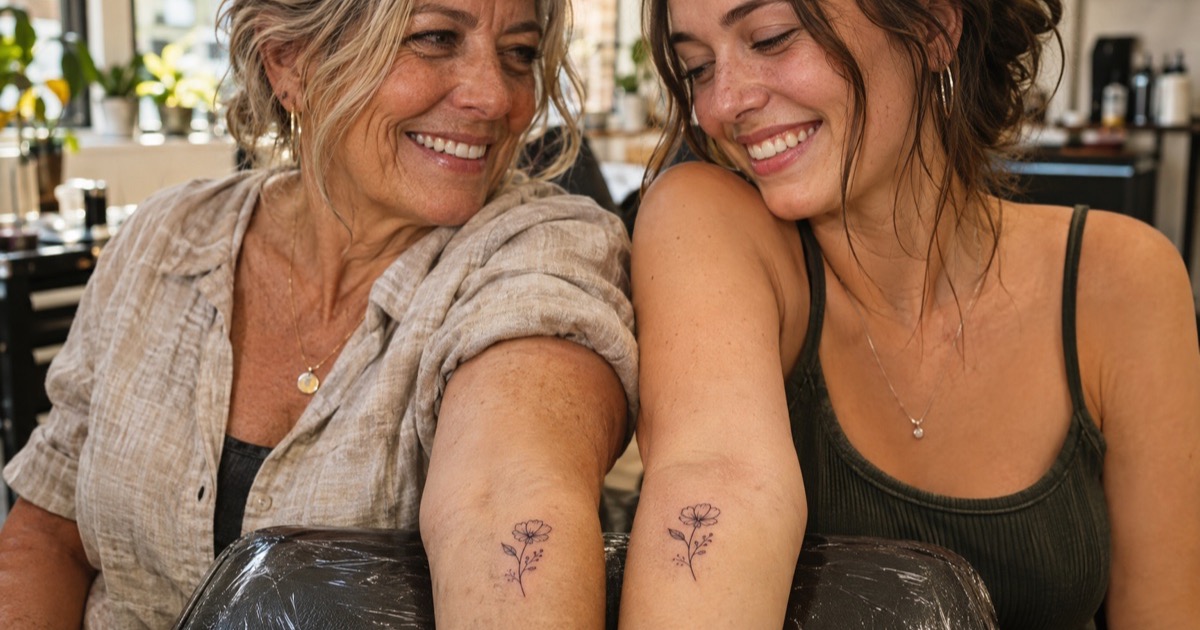
Mother-daughter tattoos work best when you treat them as one design adapted for two people, not one stencil copied twice. Choose the kind of match first (identical, complementary, split or handwritten), then each person's placement, and only then fix the size. A design drawn for the smaller of the two placements scales up cleanly. One drawn large and shrunk down usually does not.
Key takeaways
- Decide the kind of match before the subject: the same design, complementary designs, a split design or handwriting.
- Different placements are fine. Size the design for the smaller one first, then scale it up.
- At the smallest size, keep gaps between lines of about 1 mm and script letters about 5 mm tall.
- Book one consultation for both of you, and ask whether the shop minimum and deposit apply per person.
Four ways to match
Most mother-daughter pieces fall into one of four types. Each one asks something different of the design and the stencil, so it helps to know which you want before you start collecting references.
The same design on both of you
The simplest option: one design, tattooed on both of you. It reads instantly as a pair, and it is the easiest to plan because the artist makes one drawing. The catch is that "the same" rarely means the same size. If one of you wants it on the inner wrist and the other on the shoulder blade, the design has to work at both scales, which is covered further down.
Good subjects have a clear outline and little interior detail: a single flower stem, a small bird in flight, a crescent moon, a heart drawn as one continuous line.
Complementary designs
Two different designs that belong together. Each of you gets something of your own, and the link shows when you are side by side. Common approaches:
- Each other's birth flower. The mother wears the flower for her daughter's birth month, and the daughter wears her mother's. Our birth flower guide lists the flower for every month.
- Sun and moon. A classic pairing, and easy to keep in proportion because both shapes are round. The sun and moon tattoo guide covers designs and sizing.
- An older and a younger version of one thing. A full rose and a bud, a tree and a sapling, a large bird and a small one. The difference in size is part of the meaning.
The rule that makes complementary designs work: same style, same line weight, same level of detail. A fine line rose next to a bold traditional bud looks like two unrelated tattoos, however well each one is done.
Split designs
One image divided between two people, so it is only complete when you stand together: half a heart each, a mountain range that continues from one arm to the other, a branch on one wrist and the bird that sits on it on the other.
Split designs photograph well, but they ask the most of the planning. The halves only meet if the placements line up when you stand naturally side by side, at the same height on the arm and the same angle. You will rarely stand in exactly that position, so each half should also look like a finished tattoo by itself.
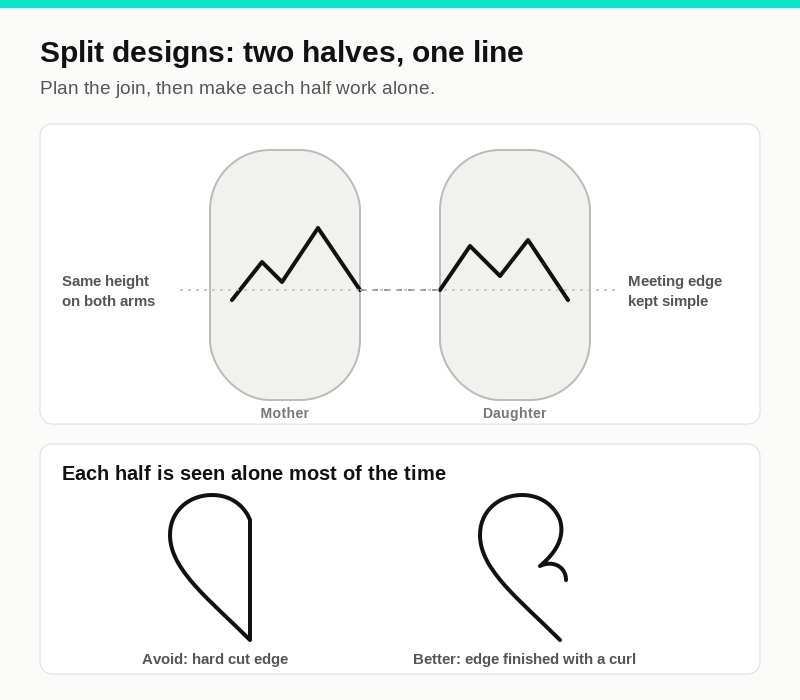
In practice: mark the meeting edge on both stencils, apply them while you stand side by side in front of a mirror, and check the join before the artist starts either tattoo. Small differences in arm length are normal, so keep the meeting edge simple enough that a few millimetres of mismatch do not show.
Handwriting
A word, name or short line written by one of you and worn by the other. It might be the mother's handwriting on the daughter, taken from an old birthday card, and the daughter's on the mother. It might be a line from a letter or recipe card written by a grandmother and worn by both. Handwriting is personal in a way no font can be, and it suits a family tattoo better than most symbols.
It needs some care to stay legible. Write the words several times on plain white paper with a fine felt tip pen, pick the best version, and photograph it flat in even light. At final size, keep lowercase letters at least about 5 mm (0.2 in) tall, because small loops in script letters close up as a tattoo ages. Our guide to handwriting and signature stencils covers cleaning up a real sample without losing what makes it someone's own.
Ideas that suit a mother and daughter
The best ideas come from something you share rather than from a list, but these are good starting points. The sizes are the smallest at which each idea usually stays clear, assuming a simple, open drawing.
| Idea | Type of match | Works from about |
|---|---|---|
| A flower from a garden you shared | Same or complementary | 3 cm (1.2 in) |
| Each other's birth flower | Complementary | 4 cm (1.6 in) |
| Rose and rosebud | Complementary | 3 cm (1.2 in) for the bud |
| A larger and a smaller bird | Complementary | 2.5 cm (1 in) |
| Two hands holding, as a single line | Same or split | 5 cm (2 in) |
| Half a heart each, finished as a design | Split | 3 cm (1.2 in) per half |
| A handwritten word or name | Handwriting | 5 mm (0.2 in) letter height |
| A shared date in Roman numerals | Same | 4 cm (1.6 in) long |
Detailed or shaded versions of any of these need more room. If you are not sure, go a size up: a design that is slightly larger than planned rarely disappoints, while one that is too small for its detail blurs over time.
Two people, two placements
A mother and daughter often want different placements. One of you may want the design where it can be covered at work, the other somewhere visible. One may already have tattoos near the spot the other prefers. That is fine, as long as you plan the size around both.
| Placement | Typical size | Notes |
|---|---|---|
| Inner wrist | 2.5 to 6.5 cm (1 to 2.5 in) | Keep clear of the crease where the hand bends |
| Ankle | 2.5 to 7.5 cm (1 to 3 in) | Curves around the bone; check from several angles |
| Collarbone | 5 to 15 cm (2 to 6 in) | Suits long, narrow designs and lettering |
| Inner forearm | 5 to 20 cm (2 to 8 in) | The most flexible spot for size |
| Shoulder blade | 7.5 to 18 cm (3 to 7 in) | Mostly flat, good for detail |
These are typical ranges from our tattoo size chart, not rules. If one of you chooses the inner wrist and the other the shoulder blade, the design will end up at very different sizes. If you want the pair to look identical when you hold your arms together, choose the same placement, such as both inner forearms. Pain also varies from one spot to another, so each of you should pick a placement you are comfortable sitting for.
Skin is part of the picture. It tends to become thinner and less elastic with age, and forearms and hands often show sun damage. Experienced artists adjust their technique for this, and many suggest a slightly bolder, more open design for mature skin. Mention it at the consultation rather than hoping it will not matter.
Making one design work at two sizes
When you scale a design, everything scales with it, including the lines and the gaps between them. Halve the size and every gap becomes half as wide. That is why the order matters:
- Design for the smaller placement first. Make the design work at the smallest size: gaps between lines of about 1 mm, enclosed spaces (inside petals, loops and eyes) of about 2 mm, and no detail finer than the artist can place.
- Scale it up for the larger placement. Every gap gets wider, so the design stays readable. At the larger size the outlines may look heavy; the artist can use a finer line or add a little shading that the extra space can now hold.
- Do not shrink a large design without editing it. A drawing made at 12 cm and reduced to 5 cm loses its gaps. Thicken the lines back to a tattooable weight and remove detail until every gap clears about 1 mm again.
- Check both versions at final size. Print both at 100% and lay them side by side. If they still read as the same design, you are ready.
A worked example: a single-stem flower for a 4 cm (1.6 in) inner wrist and a 9 cm (3.5 in) inner forearm. Drawn at 4 cm with 1 mm gaps, the gaps grow to just over 2 mm at 9 cm, which is comfortable. The same flower drawn at 9 cm with 1 mm gaps would shrink to gaps under half a millimetre at 4 cm, and those close up as the tattoo heals and settles.
For the stencil, Stencify prints a design at an exact size in cm or inches with a check ruler on the page, so you can print the wrist version and the forearm version from the same file and confirm each one with a ruler. For the small version, the one-tap fixes "Thicken outlines" and "Simplify tiny details" bring the linework back to a weight that holds at that size. It runs on iPhone, iPad and Android: get Stencify on the App Store or on Google Play. The printing side is covered step by step in how to size and print a tattoo stencil.
Booking together
For most mothers and daughters, the shared appointment is part of the point. A little planning keeps it relaxed:
- One artist, one consultation. Book a consultation for both of you with the same artist, so one person designs the pair and keeps the style consistent. Bring both placements, your references and any handwriting samples to that one meeting.
- Ask how the price works. Most shops have a minimum charge per tattoo, and many take a deposit from each person. Two small tattoos may still cost two minimums. Our guide to what a tattoo costs explains minimums and how quotes are built.
- Allow time for two sessions back to back. Each tattoo needs its own stencil, setup and wrap. Two small pieces often fit one booking, but ask the artist how long to plan for.
- Decide who goes first. Some people prefer to watch the first session before their own; others would rather go first and relax afterwards.
- Check the age rules. The legal minimum age for tattooing varies by country and state, and many studios will not tattoo anyone under 18 even where the law allows it with a parent's consent. Ask the studio before you plan around a birthday.
- Heal on your own schedule. Follow your artist's aftercare instructions. Different placements heal at different speeds, so do not worry if one of the pair settles before the other.
Notes for the artist
- Keep one master file and produce both sizes from it, so the line style stays identical.
- Print the two stencils on one sheet if they fit, labelled with each name and size.
- For split designs, apply both stencils before starting either tattoo, and check the join with both clients standing.
- For handwriting, compare the stencil with the original sample before printing. Tidying a parent's writing into a neat script defeats the purpose.
Frequently asked questions
Do mother-daughter tattoos have to be identical?
No. Many pairs choose complementary designs, such as each other's birth flower or a rose and a rosebud, drawn in the same style and line weight. They read as a set without being copies.
Can we get the same tattoo at different sizes?
Yes. Design it for the smaller placement first, with gaps of about 1 mm between lines, then scale it up for the larger one. Shrinking a large design without editing it usually makes the gaps close up.
What placement works best for matching mother-daughter tattoos?
The inner wrist and inner forearm are popular because the tattoos can be shown side by side. If you choose different placements, each of you can pick a spot that suits you; the design just needs to be sized for both.
Can my mother's handwriting be made into a tattoo?
Yes. Use a clear sample written on plain paper and photographed flat in even light. Keep lowercase letters at least about 5 mm tall at final size so the loops stay open as the tattoo ages.
Should we get tattooed on the same day?
Most pairs do, with the same artist and back-to-back sessions. Ask whether the shop minimum and deposit apply per person, and allow enough time for two setups.
Related reading
- Matching Couple Tattoos - trying a pair on before you commit
- Best Friend Tattoos - small matching ideas that hold up
- Handwriting and Signature Stencils - keeping a real sample accurate
- Birth Flower Tattoos by Month - a flower for each of you
One design, sized for both of you
Stencify turns a photo or sketch into a clean stencil and prints it at the exact size for each placement, with a ruler on the page to check it.