Stencil library
Aztec tattoo stencil
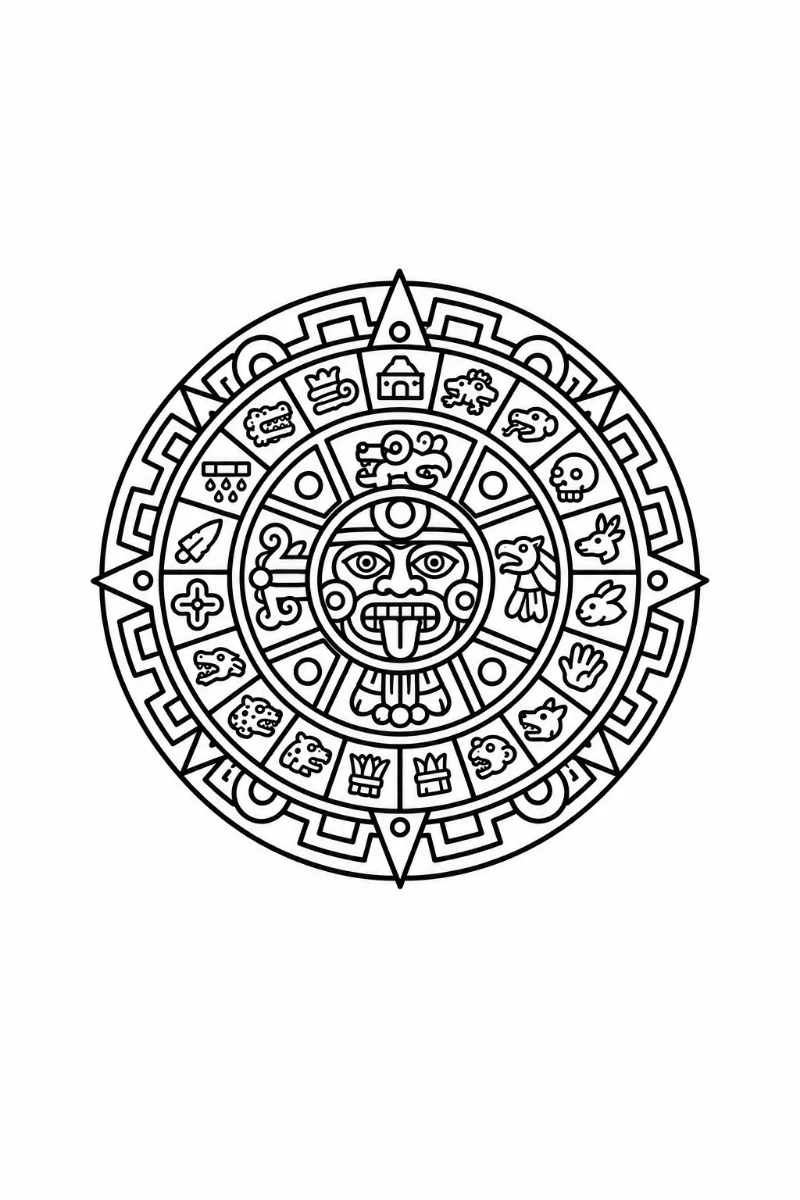
Aztec tattoo designs draw on the art of the Mexica people of central Mexico, from the carved Sun Stone to the flat, bold figures in painted codices. For many clients, especially in Mexican and Mexican-American communities, these images are about heritage. Stencil-wise they are some of the most demanding designs to get right: tight rings of glyphs, true circles and bold outlines that leave no room for drift.
- Sample stencils, Stencify style
- Line work for thermal or hand transfer
- Prints on A4 or US Letter
- Updated Oct 19, 2026
What an Aztec tattoo means
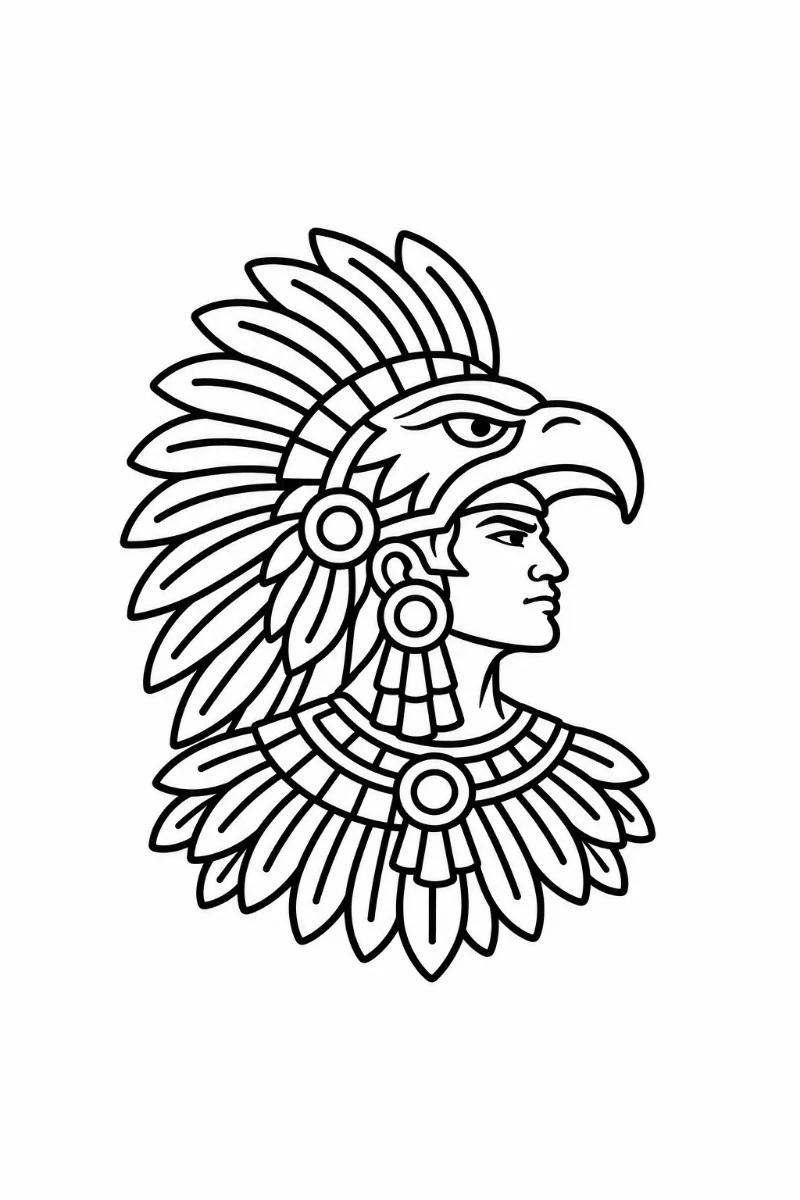
The Mexica, often called the Aztecs, built Tenochtitlan on the site of present-day Mexico City. Their art includes the Sun Stone, a carved basalt monument with a central face, usually identified as Tonatiuh, surrounded by rings that include the twenty day signs of the ritual calendar. Other common tattoo subjects are eagle and jaguar warriors, the feathered serpent Quetzalcoatl, and the eagle on a cactus with a serpent from the founding story of Tenochtitlan, now on the Mexican flag.
Many clients wear these images as heritage. Use accurate references, and avoid mixing in unrelated cultures' motifs just to fill space.
Popular Aztec tattoo styles
Sun Stone and glyph work
Concentric rings, repeated glyphs and a central face. Precision work that depends heavily on the stencil.
Black and grey realism
Warriors, temples and carved stone rendered with depth, often in Chicano-influenced black and grey. The stencil maps edges and value boundaries.
Codex and flat graphic
Bold, even outlines and flat shapes based on painted manuscripts. Converts well from a clean drawing.
Placement and size
- The Sun Stone suits the chest, upper back or shoulder cap, where a large circle can sit flat. Avoid placing it across a joint.
- Warriors and serpents need length: forearm, calf, side or a full sleeve.
- Stepped fret patterns work as bands around the forearm or calf, sized to close evenly.
- A Sun Stone under about four inches loses its glyph rings. Go bigger or simplify to the central face and one ring.
Line weight tips for an Aztec stencil
- Use a straight-on, evenly lit reference of the Sun Stone. Photos taken at an angle turn the circles into ovals.
- Keep ring lines at one consistent weight and make sure each ring is a true circle. If it is off, fix the reference.
- Glyph interiors must stay open. If the converter fills small enclosed shapes, lower the line weight or enlarge the design.
- Codex-style figures take heavier, even outlines. Raise contrast so any paper texture from a manuscript scan drops out.
- Fret and step patterns need exact repeats. Check the corners are square at print size.
Frequently asked questions
Is the Aztec Sun Stone a calendar?
It is often called the Aztec calendar, and it includes the twenty day signs, but scholars describe it as a ceremonial monument rather than a working calendar.
How big should an Aztec Sun Stone tattoo be?
Large enough for the glyph rings to stay open, usually six inches or more. Smaller pieces work better as the central face with one ring.
Can I stencil an Aztec design from a photo of the carving?
Yes, from a straight-on, evenly lit photo. Raise contrast to drop the stone texture and keep the carved edges.
More subjects
Related reading
- Geometric and Mandala Tattoo Stencils - symmetry and size
- How to Turn a Sketch Into a Tattoo Stencil - from paper to print
- Tattoo Placement and Anatomy - why stencils must follow the body
Make your own Aztec stencil
Convert a straight-on photo of a carving, a codex drawing or your own sketch, then check every ring and glyph at real size. Stencify turns a photo, sketch or text into print-ready line work in about 30 seconds on iPhone, iPad or Android. Two free uses, then $4.99 a week or $47.99 a year (US).