Lotus Flower Tattoo Ideas: Meaning, Styles, Placement and Stencil Tips
• by Stencify • 9 min read
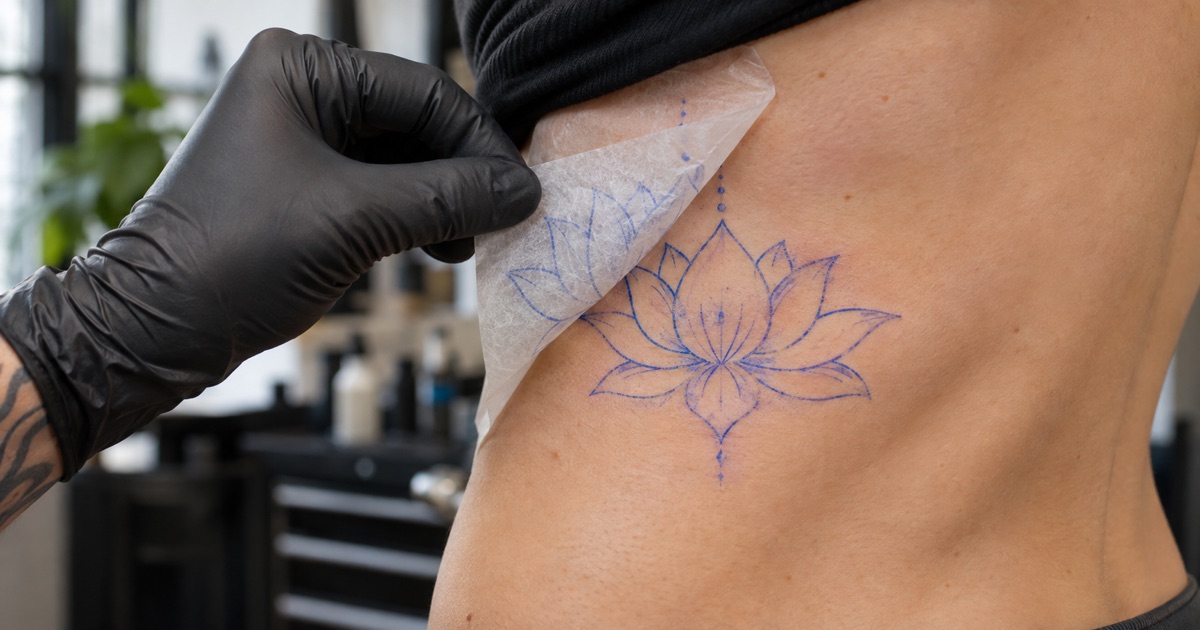
A lotus flower tattoo works at almost any size, from a few petals behind the ear to a wide mandala lotus across the sternum. The flower is symmetrical, so the stencil is mostly about getting the centre line, the petal overlap and the line spacing right. This guide covers what the lotus is widely understood to mean, the main styles, sizes for common placements in cm and inches, and how to build a lotus stencil that stays clean as it heals.
Key takeaways
- The lotus is closely tied to Buddhism and Hinduism, where it is widely associated with purity and spiritual awakening. Treat it with the same respect as any religious symbol.
- Fine line, mandala lotus, dotwork, unalome with lotus and watercolour with a black outline are the most common styles.
- Draw one half of the flower and mirror it, and let front petals cover back petals so no lines cross.
- Small lotuses need fewer petals and wider gaps between lines, not the same drawing shrunk down.
What a lotus flower tattoo means
The lotus roots in mud at the bottom of ponds and opens its flower above the surface of the water. That growth habit is the basis of most of its meaning, and it is why the flower is so often chosen to mark recovery, a new start, or getting through a hard period.
In Buddhism
In Buddhist traditions the lotus is widely used as a symbol of purity and of spiritual awakening: a flower that comes out of mud without being stained by it. The Buddha is very often shown seated on a lotus, and the seated meditation posture with crossed legs is known as the lotus position (padmasana). Some sources link petal colours to particular qualities, but those readings vary between traditions, so it is better not to rely on a single colour chart.
In Hinduism
In Hinduism the lotus is linked with several deities. Lakshmi is commonly depicted seated on or holding a lotus, and the god Brahma is described as emerging from a lotus that grows from the navel of Vishnu. The flower is also widely associated with beauty, purity and prosperity.
A note on respect
Many people wear a lotus as a personal symbol without belonging to either tradition, and that is common. If the design includes clearly religious elements, such as an unalome, a Buddha figure or script, it is worth reading about what they mean first. In parts of Southeast Asia, placing sacred images on the feet or lower body is considered disrespectful, which is worth knowing before choosing an ankle or foot placement for that kind of design. A plain lotus on its own is generally treated as a flower motif.
Lotus tattoo styles
Fine line lotus
A single thin outline, sometimes with a short stem or a water line beneath. It suits small placements and minimal designs. The risk is detail: thin lines placed close together can blur into each other over the years, so fine line lotuses work best with few petals and generous spacing. The stencil technique by style guide explains how line weight changes the stencil.
Mandala lotus
The lotus seen from above, with petals radiating from a centre in rings, often combined with geometric patterns, dots and borders. This is the most demanding version to stencil because any error in spacing shows around the whole circle. The geometric and mandala stencil guide covers radial symmetry and centring in detail.
Dotwork lotus
Outlines in line work, with shading built from dots that are denser near the base of each petal and lighter towards the tips. It reads well at medium and large sizes. On very small pieces the dots need extra space, or they merge into a grey patch.
Unalome with lotus
The unalome is a line design from Buddhist tradition, commonly explained as a path towards enlightenment: the spirals and turns stand for confusion and struggle, and the straight line at the top for clarity. It is often paired with a small lotus, and it is long and narrow, which is why it suits the spine, the forearm and the back of the arm.
Watercolour lotus with an outline
Soft colour washes in pinks, blues or purples, usually around a black outline. Colour without a line tends to soften and spread over time, so a clear outline keeps the flower readable. The stencil carries only the outline; the colour is placed freehand.
Sizes and placements
Lotus designs tend to be wider than they are tall, unless a stem, unalome or mandala ring is added. As a rough guide for adults, measured on the width of the flower:
| Placement | Typical width | Notes |
|---|---|---|
| Behind the ear | 2 to 4 cm (0.8 to 1.6 in) | Five to seven petals, simple outline |
| Wrist | 3 to 5 cm (1.2 to 2 in) | Fits across the inner wrist without wrapping |
| Ankle | 4 to 7 cm (1.6 to 2.8 in) | Place above or beside the bone, not on it |
| Sternum | 8 to 15 cm (3 to 6 in) | Up to 20 to 25 cm (8 to 10 in) wide with mandala or ornamental extensions |
| Spine | 4 to 8 cm (1.6 to 3 in) | With an unalome, the full piece is often 15 to 30 cm (6 to 12 in) tall |
| Forearm or upper arm | 7 to 12 cm (2.8 to 5 in) | Room for dotwork shading |
Treat these as starting points and adjust to the client. The tattoo size chart has general sizing by body part, and behind the ear tattoos covers that small, curved placement in more detail.
Placement notes
- Sternum. A lotus sits naturally on the centre line of the chest, and many sternum pieces extend downward with a hanging ornament or upward with an unalome. The centre of the flower should line up with the centre of the sternum with the client standing upright, not lying back.
- Spine. The spine is rarely perfectly straight, and it changes shape when the client bends. Apply long spine pieces standing, with the shoulders relaxed, and check the line from a few steps back.
- Ankle and wrist. Both are bony and move a lot. Keep the flower off the ankle bone itself and keep wrist pieces small enough that they do not wrap around to the side.
- Behind the ear. The skin is curved and thin, and the space is small. A simple outline with clear gaps ages better here than detailed shading.
If you are deciding between two placements, seeing the design on a photo of your own body helps; see how to try on a tattoo. In Stencify, "Place It Myself" puts the stencil on a photo of the client so you can compare sizes before printing.
How to stencil a lotus
Start from the centre line
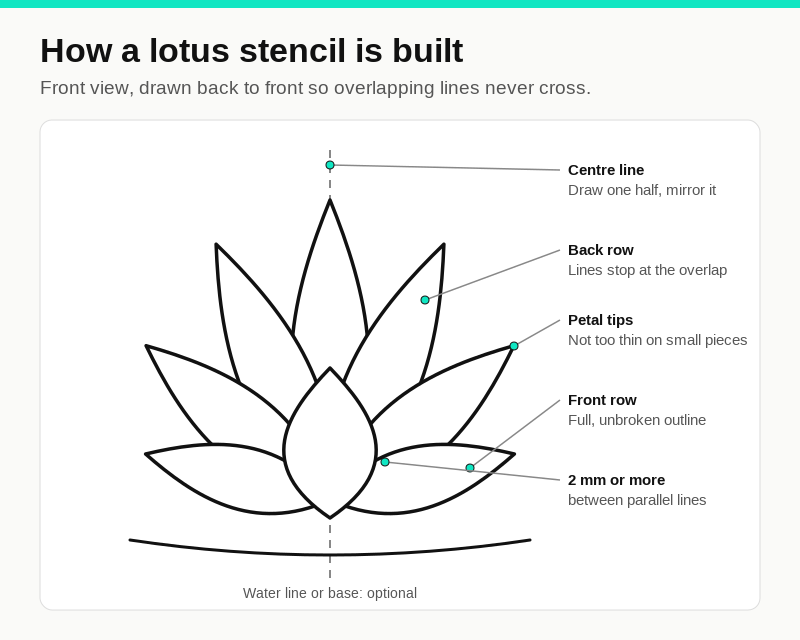
A front view lotus is mirror symmetrical. Draw a vertical centre line, design one half of the flower against it, and mirror that half for the other side. Every petal then has an exact partner, which is hard to achieve by drawing both sides freehand. In Stencify, the "Mirror" option flips a design, which helps when you build one half and need the other. Before applying, mark the same centre line on the skin with a skin marker and line the stencil up to it.
Get the petal overlap right
- Work back to front. Draw the back row first, then the middle row, then the front row. Each front petal covers the base of the petals behind it.
- Stop lines at the overlap. Back petal lines end where they meet a front petal. If both outlines continue, the stencil has crossing lines that confuse the artist during the line work.
- Use an odd number of petals in front view. A centre petal with an equal number on each side reads as a lotus at a glance.
- Keep inner lines optional. Petal veins and centre lines add detail on large pieces. Leave them out under about 5 cm (2 in).
Line spacing and how it ages
Lines spread slightly in the skin over the years, and where petals meet near the base, lines naturally converge. Aim for at least about 2 mm between parallel lines, and simplify the base rather than pack petals into it. Petal tips are another weak point: a very thin, sharp tip on a small lotus can fade or blur, so keep tips simple and avoid tapering the line to nothing.
Dotwork stencils with the Stipple style
For dotwork, the stencil usually carries the outlines and, at most, a guide for where shading goes. Starting from a photo or a drawing with tone, Stencify's Stipple style turns that tone into dots, which gives a dotwork reference showing where density should build. Many artists still place the actual dots by hand and use the stencil only for the outlines, so ask yourself whether the stippled version is a stencil or a reference before you print it.
Print and check the size
Set the size in cm or inches from the client's measurements, print at 100% with any fit to page option turned off, and measure the check ruler before you apply. Large sternum or back pieces can be split across several sheets. The steps are in how to size and print a tattoo stencil.
Before you book
- Bring references for the style, not just the flower. A fine line lotus and a dotwork mandala lotus are very different tattoos. Show the artist examples of the look you want.
- Decide on extras early. A stem, water line, unalome, dots or ornament changes the size and the placement.
- Ask about the smallest workable size. If your artist suggests going a little bigger or removing petals, it is usually so the lines stay separate as the tattoo ages.
- Mention any meaning you want kept. If the lotus marks something specific, tell the artist so the design does not drift from it.
For more flower references, browse the flower stencil designs, and for other compact ideas see small tattoo ideas.
Frequently asked questions
What does a lotus flower tattoo mean?
The lotus grows from mud and opens above the water, so it is widely associated with purity, resilience and new beginnings. In Buddhism it is a common symbol of purity and spiritual awakening, and in Hinduism it is linked with deities such as Lakshmi and Brahma. Many people also choose it as a personal symbol of getting through a difficult time.
What size should a lotus tattoo be?
As a rough guide, about 2 to 4 cm (0.8 to 1.6 in) wide behind the ear, 3 to 5 cm (1.2 to 2 in) on the wrist, 4 to 7 cm (1.6 to 2.8 in) on the ankle and 8 to 15 cm (3 to 6 in) on the sternum. Smaller lotuses need fewer petals and wider gaps between lines.
Where is the best placement for a lotus tattoo?
The sternum and spine suit symmetrical and long designs such as a mandala lotus or an unalome with lotus. The wrist, ankle and behind the ear suit small fine line lotuses. If the design includes religious elements, consider that in some cultures sacred images on the feet or lower body are seen as disrespectful.
How do you keep a lotus stencil symmetrical?
Draw a vertical centre line, design one half of the flower and mirror it for the other side. Mark the same centre line on the skin before applying the stencil and line the two up, with the client standing upright.
Can a lotus tattoo be done in dotwork?
Yes. The stencil usually carries the outlines, and the dot shading is built by hand, denser at the base of each petal and lighter towards the tips. A stippled version of the design can serve as a reference for where the dots should build up. Leave extra space between dots on small pieces so they do not merge.
Related reading
- Flower Stencil Designs - flower references to start from
- Geometric and Mandala Stencils - radial symmetry and centring
- Stencil Technique by Style - fine line, bold and traditional
- Small Tattoo Ideas - designs that work at small sizes
- Koi Fish Tattoo
Symmetrical lotus stencils in seconds
Stencify turns a lotus photo or sketch into a clean stencil in about 30 seconds, with "Mirror", the Stipple style for dotwork and printing at an exact size in cm or inches.