Koi Fish Tattoo Ideas: Meaning, Colours, Direction and How to Stencil Scales
• by Stencify • 9 min read
The koi is one of the central subjects of Japanese tattooing and one of the most requested fish designs anywhere. Its curved body fits arms, legs and backs naturally, and it carries a clear meaning: perseverance. The short answer for planning one: decide which way the fish swims and what surrounds it, give the body a strong S-shaped curve that follows the limb, and draw the scales as ordered rows that shrink toward the tail. This guide covers meanings, colours, popular designs, sizes and how to stencil a koi.
Key takeaways
- Koi stand for perseverance and success after struggle, based on the legend of the carp that climbs a waterfall and becomes a dragon.
- Colour and swimming direction are often given their own meanings, but these are tattoo conventions that vary between artists, not fixed rules.
- A koi needs room for its curve. Forearm, calf, thigh, shoulder and back work best, and detailed scales need about 12 cm (5 in) of body length or more.
- Stencil the outline, the centre line of the back and the rows of scales. Water and background are often drawn on the skin afterwards.
What a koi fish tattoo means
Koi are ornamental carp, bred for colour in Japan since the nineteenth century. Their meaning in tattooing comes mainly from an older Chinese legend: carp swim up the Yellow River against the current, and the one that leaps the waterfall at the Dragon Gate is turned into a dragon.
- Perseverance. The fish that keeps swimming against the current is the core image. Many people choose a koi to mark an illness, a loss or a hard period they have come through or are still working through.
- Ambition and success. The leap over the Dragon Gate is a picture of effort rewarded, which is why koi are linked with study, career and personal goals.
- Courage. In Japan, carp-shaped streamers called koinobori are flown for Children's Day on 5 May, as a wish that children grow up strong and brave.
- Good fortune and long life. Koi are kept in garden ponds as a sign of prosperity and can live for several decades.
- Balance. Two koi circling each other echo the yin and yang symbol and stand for opposites in harmony. The same image is used for the zodiac sign Pisces.
Colour meanings
These readings are common in tattoo culture. They differ from source to source, so treat them as a starting point for a conversation, not as a code.
| Colour | Often read as |
|---|---|
| Red or orange | Love, energy and strength |
| Black | Overcoming a major obstacle or a hard change in life |
| Gold or yellow | Wealth and prosperity |
| Blue | Calm, and in family designs often a son |
| White with red markings | Success in work and a fresh start |
In family designs, each fish sometimes stands for one person: a black koi for the father, a red one for the mother and smaller fish for the children.
Swimming up or down
Direction is the detail people ask about most. A koi swimming upward, against the current, is usually read as someone still in the struggle and determined to get through it. A koi swimming downward is often read as someone who has already overcome the obstacle. Other artists explain it the opposite way, or attach no meaning to it at all. In practice, direction is also a composition question: the fish should follow the flow of the body part and face inward or forward. Decide on the meaning that matters to you, then let the artist fit it to the body.
Popular koi tattoo designs
Traditional Japanese koi
A large koi with bold outlines, set in waves and splashes of water, often with maple leaves or cherry blossoms. The background is part of the design and lets the piece grow into a half or full sleeve. See the sleeve tattoo guide for planning the whole arm.
Two koi
Two fish circling head to tail, often one dark and one light. This works well as a round design on the shoulder, chest or upper back.
Koi and lotus
The lotus rises clean from muddy water, so the pair doubles the idea of growth through difficulty. The lotus flower tattoo guide covers the flower itself.
Dragon koi
A koi shown partway through its change, with a dragon's head, horns and whiskers on a fish body. It refers directly to the Dragon Gate legend. For the dragon's features, see the dragon tattoo guide.
Black and grey realism
A koi seen from above, as in a pond, with soft shading, ripples and reflections instead of outlined waves.
Fine line and minimal
A small outline with a few scales suggested, or a single continuous line. These leave out most of the detail and work at wrist and ankle sizes.
Watercolour
Loose washes of orange, red and blue around a light outline. Ask the artist how the colour is expected to age without strong lines to hold it.
Sizes and placements
| Placement | Typical size | Notes |
|---|---|---|
| Wrist or ankle | 4 to 7 cm (1.5 to 2.75 in) | Outline only, few or no scales |
| Forearm | 12 to 20 cm (5 to 8 in) | The body can curve along the length of the arm |
| Calf | 15 to 25 cm (6 to 10 in) | A broad area that suits a koi with water around it |
| Upper arm or shoulder | 15 to 25 cm (6 to 10 in) | Good for two circling koi or the start of a sleeve |
| Thigh or ribs | 20 to 30 cm (8 to 12 in) | Room for a koi with flowers and background |
| Back | 30 cm (12 in) and up | Full scenes with several fish, waves and a waterfall |
For a koi with individual scales, plan about 12 cm (5 in) of body length or more, so each scale is large enough to stay separate as the tattoo ages. The tattoo size chart gives general ranges for each body part.
How to stencil a koi
1. Start with the curve
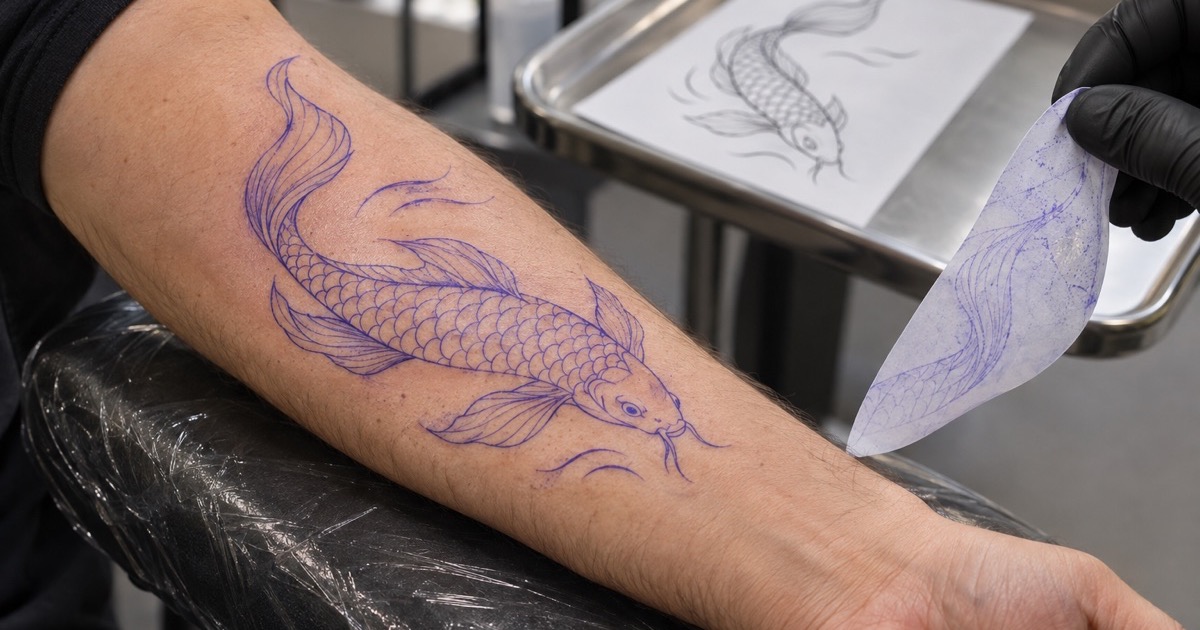
Draw one flowing line from the nose to the base of the tail before anything else. An S-shape or a C-shape gives the fish movement; a straight koi looks stiff. On an arm or leg, let that line follow the limb at a slight diagonal instead of running straight down it.
2. Build the head
The head is smooth and has no scales. Mark the eye, the curved edge of the gill cover, the mouth and the barbels, the two pairs of whiskers at the corners of the mouth that separate a koi from a goldfish. Keep these lines clean, since the head is where the eye goes first.
3. Lay the scales in rows
Scales are what make or break a koi stencil.
- Draw guide lines first. Sketch lines along the body that follow its curve, then place the scales along them in offset rows, like roof tiles.
- Change the size gradually. Scales are largest in the middle of the body and get smaller toward the tail and the belly.
- Follow the twist. Where the body turns, the rows turn with it. Rows that stay flat make the fish look like a cut-out.
- Do not draw every scale on a small piece. A few rows along the back, with the rest left open, read better than a crowded grid.
4. Add fins and tail
Draw the outline of each fin and the tail with a small number of long lines that fan out from the base. They should trail behind the movement of the body. Leave the fine rays inside the fins for the tattooing stage, or mark only a few of them.
5. Clean up a photo or painting conversion
A photo of a koi in water converts into a lot of noise: reflections, ripples and blotches of colour that are not lines. Remove everything that is not the fish. In Stencify, "Simplify tiny details" clears the smallest marks and "Thicken outlines" strengthens the contour of the body and fins. Colour patches can be marked with a thin or dotted border so you know where they start and stop. The snake tattoo guide uses the same approach for scales on a long body.
6. Plan the water separately
Waves, splashes and wind bars are often drawn directly on the skin with markers once the fish is placed, because they need to wrap around the real shape of the limb. If you print them, keep them on a separate stencil from the fish so each part can be positioned on its own.
7. Size, print and place
Preview the design on a photo of the client with "Place It Myself" to check the direction and the curve, then print it at exact size in cm or inches. A calf, thigh or back koi may need several A4 or US Letter sheets taped together; put the joins in the water or the tail, not through the head. Full steps are in how to size and print a tattoo stencil. Apply the stencil with the client standing and the limb relaxed, as described in the placement and body flow guide.
For reference drawings, see the koi stencil designs and the dragon stencil designs.
Frequently asked questions
What does a koi fish tattoo mean?
Most often perseverance and success after struggle. The meaning comes from a legend in which a carp swims upstream, leaps a waterfall at the Dragon Gate and becomes a dragon. Koi are also linked with courage, good fortune and long life.
What does it mean if a koi tattoo swims up or down?
A koi swimming upward is usually read as someone still fighting through a challenge, and a koi swimming downward as someone who has already overcome it. Interpretations vary between artists, and the direction is also chosen to suit the flow of the body part.
What do the colours of a koi tattoo mean?
Common readings are red for love and strength, black for overcoming a major obstacle, gold for prosperity, blue for calm and white with red for success in work. These are tattoo conventions that differ from source to source, not fixed rules.
How big should a koi fish tattoo be?
A simple outline works at 4 to 7 cm (1.5 to 2.75 in). A koi with individual scales needs about 12 cm (5 in) of body length or more, and most forearm, calf and thigh pieces are 12 to 30 cm (5 to 12 in).
What do two koi fish in a tattoo mean?
Two koi circling each other stand for balance between opposites, in the same way as the yin and yang symbol. The image is also used for the zodiac sign Pisces and for two people, such as a couple or siblings.
Related reading
- Koi Stencil Designs - reference drawings and stencil notes
- Dragon Tattoo Ideas - the other half of the Dragon Gate legend
- Lotus Flower Tattoo Ideas - a classic partner for koi
- Sleeve Tattoo Guide - planning a koi as part of a full arm
- Phoenix Tattoo Ideas
Koi stencils with clean scales
Stencify turns a koi reference into clean line work, clears stray marks with "Simplify tiny details" and lets you check the curve of the body on a photo of the client with "Place It Myself".