Phoenix Tattoo Ideas: Meaning, Styles, Placement and How to Stencil Feathers
• by Stencify • 9 min read
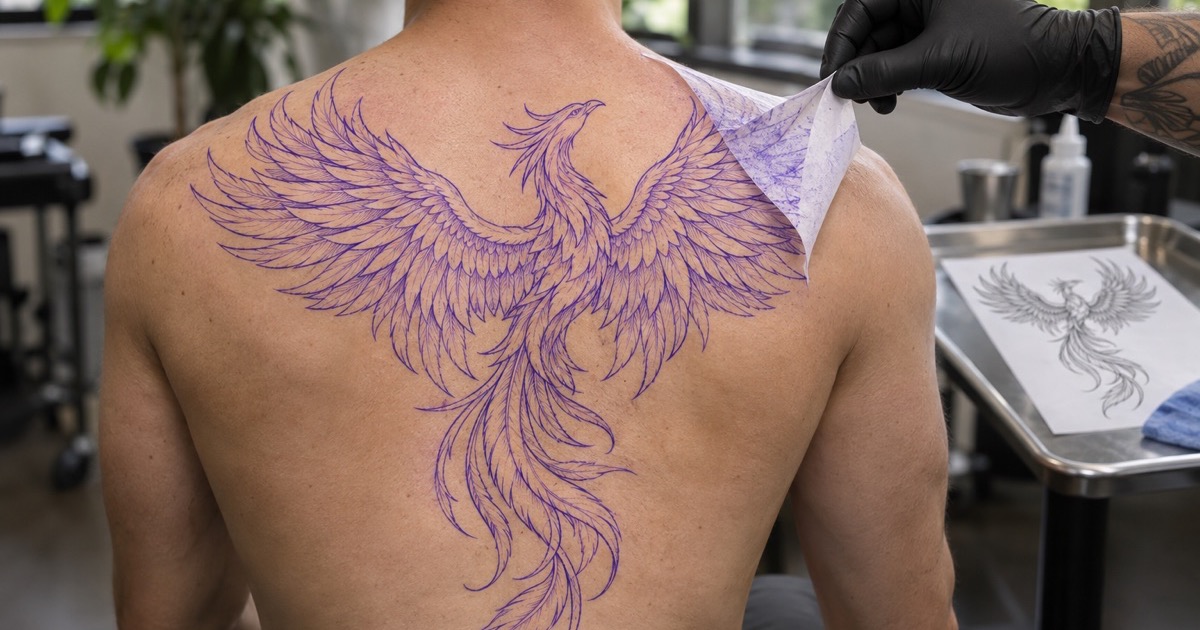
The phoenix is the bird that burns and rises again from its own ashes, and it is one of the most chosen tattoos for marking a new start. It is also one of the most flexible designs to place, because the wings and the long tail can be arranged to fit almost any part of the body. The short answer for planning one: decide what the bird is doing, rising, flying or circling, draw one flowing line from head to tail that follows the body, and build the wings and tail from grouped feathers, not hundreds of single ones. This guide covers meanings, popular designs, sizes and placements, and how to stencil a phoenix.
Key takeaways
- A phoenix stands for rebirth and for coming through a hard time stronger. It is a common choice after illness, loss, recovery or a major change.
- The Greek phoenix and the East Asian phoenix are different birds with different meanings. Know which one a design is based on.
- Spread wings suit the back and chest. A long tail suits the ribs, thigh, arm and leg.
- On the stencil, group the feathers in layers, draw the tail as a few long ribbons, and keep flames clearly separate from feathers.
What a phoenix tattoo means
- Rebirth. In Greek and Roman tradition, the phoenix lives for centuries, dies in fire and is born again from the ashes. The Greek historian Herodotus wrote of a cycle of 500 years. This is the meaning most people have in mind.
- Resilience. The bird does not avoid the fire; it comes out of it. People choose a phoenix to mark recovery from illness or addiction, the end of a difficult relationship, or grief they have lived through.
- Transformation. A phoenix can stand for a deliberate change: a new country, a new career, a new stage of life.
- The sun and renewal. The phoenix is often linked to the Egyptian Bennu, a heron-like bird connected with the sun and with creation. Sun discs and rays appear in many phoenix designs for this reason.
- Virtue and harmony. The East Asian phoenix, called fenghuang in China and hō-ō in Japan, is a separate creature. It does not burn and rise again. It stands for virtue, peace and good fortune, and it is traditionally paired with the dragon.
Phoenix and dragon
In Chinese tradition, the dragon and the phoenix together stand for a balanced couple and are a classic wedding motif. As a tattoo, the pair works as one large composition or as two matching pieces. See the dragon tattoo guide for the other half.
Popular phoenix tattoo designs
Rising phoenix
The bird climbs upward with wings open and the tail trailing below, often out of flames or ashes. This is the clearest picture of rebirth and the most requested version.
Japanese phoenix
A hō-ō with a crested head, layered wings and very long, curling tail feathers, set among clouds, flames or flowers. It is planned as a large piece for the back, the thigh or a sleeve. The sleeve tattoo guide explains how to wrap a long design around the arm.
Black and grey realism
A phoenix drawn like a real bird of prey, with soft shading in the feathers and smoke instead of outlined flames. It needs size for the feather detail to hold.
Colour and watercolour
Reds, oranges and yellows that run from the body into the flames, sometimes with blue or purple in the tail. In loose watercolour versions, ask the artist how the colour will age without strong outlines.
Blackwork and tribal-style
The bird is reduced to bold black shapes and curves. Feathers become solid points, which keeps the design readable at smaller sizes.
Fine line and minimal
A small outline with a simple curved tail, or a single continuous line. These work at wrist, ankle and collarbone sizes and leave out individual feathers.
Phoenix feather
A single long tail feather, often with a flame-like tip. It carries the meaning in a narrow shape that fits the forearm, the spine or behind the ear.
Phoenix over an old tattoo
The dense wings and flames of a phoenix can hide earlier work, and the meaning suits a fresh start. Whether it is possible depends on the old tattoo; see cover-up tattoo stencils.
Sizes and placements
| Placement | Typical size | Notes |
|---|---|---|
| Wrist, ankle or collarbone | 4 to 8 cm (1.5 to 3 in) | Outline or single feather only |
| Forearm | 12 to 20 cm (5 to 8 in) | Upright bird with the tail running toward the wrist |
| Shoulder blade | 12 to 18 cm (5 to 7 in) | One wing can follow the edge of the shoulder |
| Upper arm and shoulder | 15 to 25 cm (6 to 10 in) | Wings wrap the shoulder, tail runs down the arm |
| Ribs or side | 20 to 35 cm (8 to 14 in) | A tall, narrow area that suits a long tail |
| Thigh | 20 to 30 cm (8 to 12 in) | Room for wings and tail together |
| Chest | 20 to 30 cm (8 to 12 in) across | Wings spread from the centre toward the shoulders |
| Full back | 35 cm (14 in) and up | Wings across the shoulders and tail down the spine |
A phoenix with separate feathers in the wings needs about 15 cm (6 in) or more in its longest direction. Below that, simplify the wings into a few large shapes. The tattoo size chart gives general ranges for each body part.
How to stencil a phoenix
1. Draw the line of movement
Start with one curve from the beak through the neck and body to the end of the longest tail feather. An S-shape gives the bird lift. Fit this line to the body part first: along the spine, around the shoulder or down the side of the ribs. Everything else hangs from it.
2. Keep the head small and clear
The head is a small part of the design and the place people look first. Mark the eye, the beak with its hooked tip and the crest feathers with clean, simple lines. Do not let flames or wing feathers cross it.
3. Build the wings in layers
A wing is easier to draw and to read when it is treated as three bands instead of loose feathers.
- Short feathers at the top. Small, rounded and overlapping, close to the leading edge of the wing. Suggest them with a few rows of curves.
- Medium feathers in the middle. One row of longer shapes below the first band.
- Long feathers at the edge. The big flight feathers that fan out from the wing tip. Draw each one with an outline and a centre line, and nothing else.
- Make both wings agree. On a front view, the two wings should match in size and angle. On a side view, the far wing is smaller and partly hidden.
The same layered approach is used in the angel wings stencil guide.
4. Draw the tail as ribbons
Three to seven long tail feathers are enough. Draw each one as a ribbon with a centre line, let them cross and curl, and vary their length. The ends can carry an eye shape like a peacock feather or a curl like a flame. The tail is the part you can bend most freely to fill the space on the body.
5. Separate flames from feathers
Flames and feathers are both pointed, curved shapes, and on a purple stencil they are easy to confuse. Keep the flames in their own areas below or behind the bird, draw them with a different rhythm, taller and more irregular, and mark them with a small note or a dotted outline if you need to. Many artists leave the flames off the stencil and draw them on the skin afterwards, as described in freehand tattooing vs stencils.
6. Clean up the conversion
Phoenix references are usually full paintings with heavy colour and texture. Converted directly, the feathers turn into a mass of short strokes. Remove detail until each feather is one shape. In Stencify, "Simplify tiny details" clears the smallest marks and "Thicken outlines" strengthens the outer contour of the bird and the main feathers.
7. Print and place
Back, rib and thigh pieces are often larger than one A4 or US Letter sheet. Print at exact size across several pages, check the ruler on each page and tape the sheets together, with the joins in the tail or the flames and never through the head. Full steps are in how to size and print a tattoo stencil. Apply the stencil with the client standing, and on the back check that the body of the bird sits on the centre line of the spine. The placement and body flow guide covers this in more detail.
For reference drawings of feathers and wings, see the eagle stencil designs, and the dragon stencil designs for a matching piece.
Frequently asked questions
What does a phoenix tattoo mean?
Most often rebirth and resilience: coming through a hard time and starting again. The meaning comes from the Greek and Roman myth of a bird that dies in fire and rises from its ashes. The East Asian phoenix is a different creature that stands for virtue, harmony and good fortune.
Where is the best place for a phoenix tattoo?
It depends on the pose. Spread wings suit the back and chest. A long, trailing tail suits the ribs, thigh, arm and leg. Small outline versions work on the wrist, ankle and collarbone.
How big should a phoenix tattoo be?
An outline or single feather works at 4 to 8 cm (1.5 to 3 in). A phoenix with separate wing feathers needs about 15 cm (6 in) or more, and most rib, thigh and back pieces are 20 to 35 cm (8 to 14 in) or larger.
What does a phoenix and dragon tattoo mean?
In Chinese tradition the dragon and the phoenix together stand for a balanced, harmonious couple, and the pair is a classic wedding motif. As a tattoo it is often chosen for balance between two opposite forces or by two partners.
Is a phoenix a good cover-up tattoo?
It can be. The dense wings, tail and flames give an artist many dark areas to work with, and the meaning suits a new start. Whether it works depends on the size, colour and darkness of the old tattoo, so the decision belongs to the artist.
Related reading
- Dragon Tattoo Ideas - the traditional partner of the phoenix
- Angel Wings Tattoo Stencil - drawing wings in feather layers
- Koi Fish Tattoo - another symbol of perseverance
- How to Size and Print a Stencil - exact size and multi-page printing
Phoenix stencils with readable feathers
Stencify turns a phoenix reference into clean line work, clears stray marks with "Simplify tiny details" and prints large pieces at exact size across several sheets.