Snake Tattoo Ideas: Meaning, Styles, Placement and Wrap Stencils
• by Stencify • 9 min read
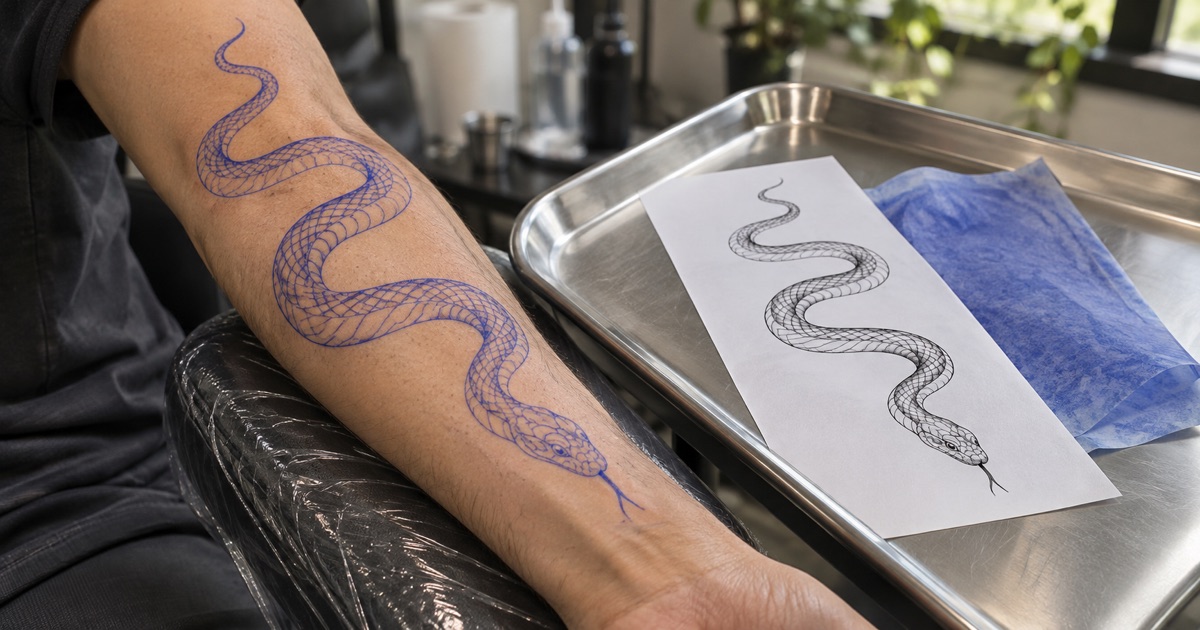
A snake can run down a spine, curl around an ankle or wrap a forearm, and it works in almost every style, from bold traditional flash to fine line. The short answer for planning one: pick the style first, let the placement decide the length and curve, and size the snake to the actual limb, because a snake that wraps an arm needs a much longer body than it looks on paper. This guide covers common meanings, styles, sizes and placements, and how to stencil a snake that wraps a limb.
Key takeaways
- Snakes are most often linked with renewal, through the shedding of skin, and with healing, through the Rod of Asclepius. Many people choose one simply for the shape.
- Style changes the stencil: traditional needs bold outlines and few scales, fine line needs almost none, realism and Japanese need a planned scale pattern.
- A wrapping snake is longer than it looks. Measure the circumference of the limb and size the body to it.
- Mark front and back at every crossing, print at exact size, and split long pieces across sheets at a straight run of body, never through the head.
What a snake tattoo means
Snake symbolism differs between cultures. These are the widely recognised readings.
- Renewal and change. Snakes shed their skin as they grow, and this is the most common reason given for a snake tattoo: a new start, recovery, or leaving something behind.
- Healing and medicine. The Rod of Asclepius, a single snake around a staff, is the traditional symbol of medicine. It is often confused with the caduceus, which has two snakes and wings and belongs to Hermes. If a client wants a medical symbol, check which one they mean.
- Cycles and eternity. The ouroboros, a snake eating its own tail, is an ancient symbol of endless cycles.
- Temptation and danger. In the Genesis story the serpent tempts Eve, which is part of why snakes are often paired with apples or roses as a contrast between beauty and risk.
Meanings attached to combinations such as the snake and dagger vary from person to person, and many clients choose a snake simply for the look.
Snake tattoo styles
The style decides how much the stencil carries and how much is left to freehand shading.
Traditional snake and dagger
A staple of American traditional flash: a snake coiled around or through a dagger, mouth open, with bold outlines and a limited palette. The stencil needs strong, even outlines, a clear overlap wherever the body crosses the blade, and only a few rows of diamond scales along the back. Leave space inside the shapes for solid colour, since packed scales fight the bold style. Roses and skulls are classic companions.
Japanese
In Japanese tattooing the snake is usually large and stylised, with a heavy outline, a patterned body and often flowers or waves around it. The scales are drawn as a repeating pattern, and the composition is planned to the whole arm, leg or back. The stencil carries the body, the scale grid and the main background shapes.
Fine line
A single thin outline, usually with no scales. Fine line snakes are popular along the collarbone, down the spine and around the ankle or finger. Keep the curves smooth and avoid tight hairpin bends where lines sit close and can blur over time. The stencil technique by style guide covers line weight in more detail.
Blackwork
Solid black bodies or bold negative-space scales. The stencil outlines every black area and every shape left as skin; mark which areas are filled before printing.
Realism
Usually from a photo of a real species. The stencil carries the outline, the head, the eye and the main scale bands as a shading guide. A direct photo conversion produces far more scale lines than skin can hold, so reduce them to the bands that show the form.
Snake with rose or skull
The snake weaving through a skull, or coiled around a rose stem, is one of the most requested combinations across styles. The key decision is which element sits in front at each crossing. Draw the second element at final size first so the coils fit around it. For flower details, see the rose tattoo guide.
Sizes and placements
A snake has no fixed proportions, so size it to the body part. These adult ranges are a starting point, not a rule.
| Placement | Typical size | Notes |
|---|---|---|
| Finger or wrist | 4 to 8 cm (1.5 to 3 in) | Fine line, no scales, simple head |
| Ankle coil | 6 to 10 cm (2.5 to 4 in) across | One loop around the ankle bone |
| Forearm, straight | 15 to 25 cm (6 to 10 in) long | Head toward the wrist or the elbow |
| Forearm wrap | Body 30 to 45 cm (12 to 18 in) long | One turn, sized to circumference |
| Spine | 20 to 40 cm (8 to 16 in) long | Vertical S-curve along the spine |
| Thigh or calf | 20 to 35 cm (8 to 14 in) tall | Room for a coiled snake with a rose or dagger |
| Around the upper arm or leg | Body 50 cm (20 in) or more | One to two full turns |
For general size ranges by body part, see the tattoo size chart.
Forearm wrap
The most popular large snake placement. The body usually turns once around the arm, with the head ending on the top of the wrist or the outer forearm where it is easy to see. The inner forearm and wrist are usually reported as more sensitive than the outer forearm; the tattoo pain chart covers what to expect.
Spine
A vertical snake in a gentle S-curve. Keep the curve centred on the spine and check it with the client standing straight, since the spine line shifts as soon as they lean or twist.
Leg
The thigh, shin and calf take larger snakes with more detail. A snake down the shin or wrapping the calf once follows the long line of the leg.
Around the arm
A snake coiling around the upper arm, often starting at the shoulder, is a common anchor for a sleeve. Plan it together with the rest of the sleeve, since the coils create gaps that other elements or filler will need to fill.
Curves that follow the muscle
A snake looks right when its curves follow the forms underneath. On a forearm, run the body with the long muscles rather than across them at random angles. On the upper arm, a coil that rises along the outer arm and dips under on the inside reads more naturally than a flat spiral.
Bend the limb while you check the placement, and keep the head and tight curls out of the inner elbow and the back of the knee. The body flow and placement guide explains how to read these lines.
How to stencil a snake that wraps a limb
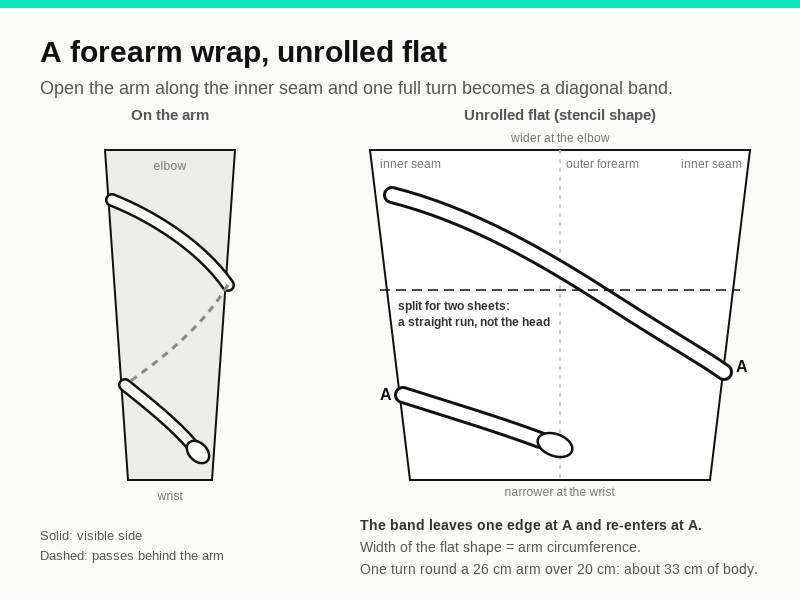
A wrap is the hardest snake to stencil because a flat sheet has to go around a tapered, curved surface. Unrolled flat, the turn becomes a diagonal band that leaves one side of the paper and continues from the other.
1. Measure the limb
Measure the circumference at the top and bottom of the area with a soft tape, and the length the snake should cover. Forearms are wider at the elbow than at the wrist, so the flat shape is a tapered strip, not a rectangle. For one full turn, the body length is about the square root of circumference squared plus length squared. One turn around a 26 cm (10 in) forearm over 20 cm (8 in) of arm needs about 33 cm (13 in) of body, much longer than it would be straight.
2. Decide the scale pattern
On real snakes, the back scales run in diagonal rows and the belly has one row of wide, flat scales. On a tattoo, decide early how much of this goes into the stencil:
- Outline only for fine line and most small pieces.
- Scale bands for traditional and realism: a few rows along the back that show which way the body turns, with the belly drawn as simple stripes.
- Full pattern for Japanese and blackwork, drawn as a regular grid that bends with the body rather than traced from a photo.
Keep scales at least about 2 to 3 mm (around 0.1 in) across on the finished tattoo. Smaller than that and the lines tend to merge into a grey mass as the tattoo ages. If your reference produces too many marks, the "Simplify tiny details" fix in Stencify removes the smallest ones, and "Thicken outlines" brings the body edge up to a weight that holds.
3. Mark every crossing
Wherever the body passes behind itself or behind a dagger, rose or skull, the line behind must stop at the edge of what is in front. Converted references often get this wrong, so check each crossing before printing.
4. Choose the direction of the wrap
A snake can spiral either way around the arm, which changes where the head ends up. To reverse the direction, use "Mirror" to flip the design rather than redrawing it.
5. Print at exact size, across several pages if needed
Set the stencil to its measured size in cm or inches and print at 100%. A forearm wrap is often wider than one A4 or US Letter sheet allows, so print it across two or more pages with multi-page printing, check the ruler on each page, and tape the sheets together. Put the split across a straight run of body, never through the head or a crossing. Full steps are in how to size and print a tattoo stencil.
6. Apply in sections
A single sheet rarely sits flat all the way around a limb. Many artists apply a wrap in two or more pieces, starting with the section that holds the head on the most visible side, then lining up the next piece to it. Keep the arm relaxed while you apply, and close small gaps at the joins with a skin marker.
Line weight and how it ages
Long, smooth curves are forgiving. Tight coils where two lines run close can merge as lines spread over the years, so leave a few millimetres between parallel lines. Make the tongue, fangs and tail tip slightly bolder than looks necessary on paper.
Before you book
- Try the size on. A wrap is hard to judge on a screen. Seeing the design on a photo of your own arm helps; see how to try on a tattoo. With "Place It Myself" in Stencify, artists can place the design on a photo of the client before printing.
- Ask about sessions. A full wrap with scales or a Japanese snake often needs more than one sitting.
For more snake references and a real stencil example, see the snake stencil designs.
Frequently asked questions
What does a snake tattoo mean?
The most common reading is renewal or change, because snakes shed their skin. A single snake on a staff, the Rod of Asclepius, stands for medicine and healing, and a snake eating its own tail, the ouroboros, stands for endless cycles. Meanings vary between cultures and people, and many choose a snake simply for its shape.
How big should a snake tattoo be?
It depends on the placement. As a rough guide, a fine line snake on a finger or wrist is 4 to 8 cm (1.5 to 3 in), a straight forearm snake 15 to 25 cm (6 to 10 in), a spine snake 20 to 40 cm (8 to 16 in), and a snake wrapping once around a forearm needs a body about 30 to 45 cm (12 to 18 in) long.
Where is the best place for a snake tattoo?
The forearm, spine, calf, thigh and upper arm all suit a snake because they give the long body room to curve. A wrap around the forearm is the most common large placement. For small pieces, the ankle, wrist and finger work well in fine line.
How do you make a stencil for a snake that wraps around the arm?
Measure the circumference and the length the snake should cover, then size the body to fit, since a wrap is much longer than it looks. Unrolled, the snake becomes a diagonal band as wide as the arm is round. Print it at exact size across as many sheets as needed, split at a straight part of the body, and apply it in sections.
Should a snake stencil include every scale?
Usually not. Fine line snakes rarely need scales, traditional and realism snakes need a few bands that show the direction of the body, and Japanese or blackwork snakes need a regular pattern drawn to fit. Keep scales at least about 2 to 3 mm across so they do not merge as the tattoo ages.
Related reading
- Snake Stencil Designs - a real snake stencil and what makes one work
- How to Size and Print a Stencil - exact size, printer settings and checks
- Placement and Body Flow - working with muscles and bones
- Tattoo Size Chart - common sizes by placement
- Skull Tattoo Ideas
Snake stencils sized to the limb
Stencify turns a snake reference into a clean stencil, prints it at exact size across several sheets for long wraps, and flips the direction with "Mirror".