Rose Tattoo Ideas and Meaning: Styles, Placement and Stencil Tips
• by Stencify • 10 min read
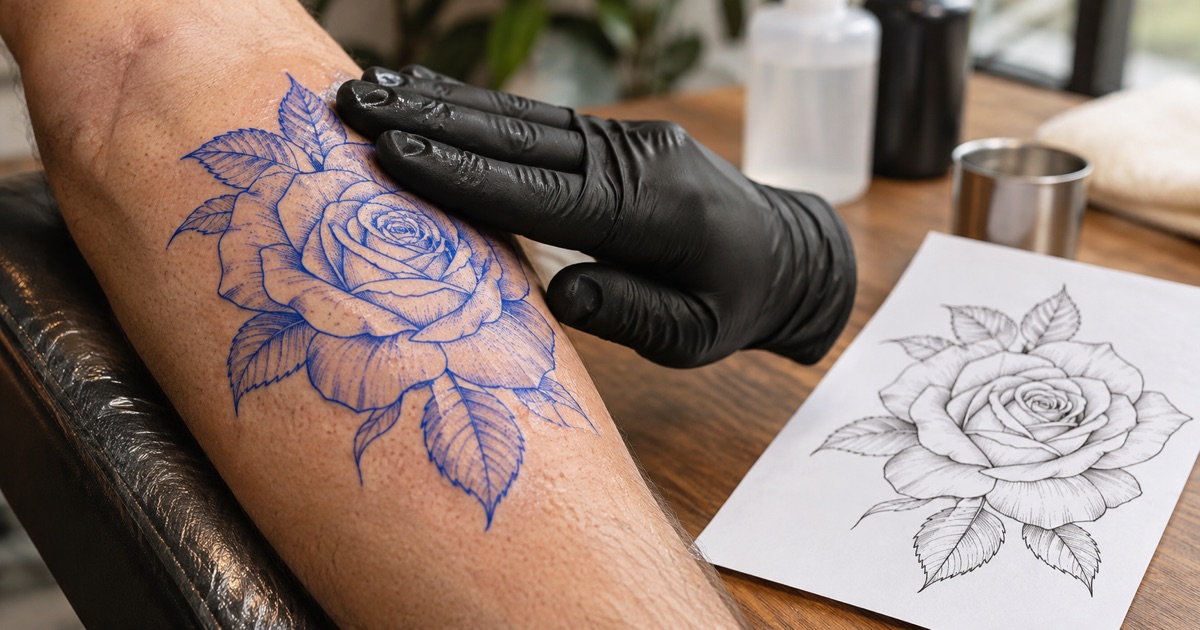
A rose tattoo usually stands for love, but it can also mark a loss, a birth month, a person named Rose, or the idea that beauty comes with thorns. Most of the meaning comes from three choices: the colour, what the rose is paired with, and the style. For a tattoo that stays clean, choose the style first, give the petals enough room (about 3 to 6 cm, or 1.2 to 2.4 in, for a small bloom and 10 to 18 cm, or 4 to 7 in, for a detailed rose on the forearm), and keep the stencil to petal edges so the shading is left to the artist.
Key takeaways
- Colour meanings come mostly from the Victorian language of flowers and were never fixed, so treat them as conventions rather than rules.
- Style decides size: fine line roses can be small, while black and grey realism needs room for its gradients.
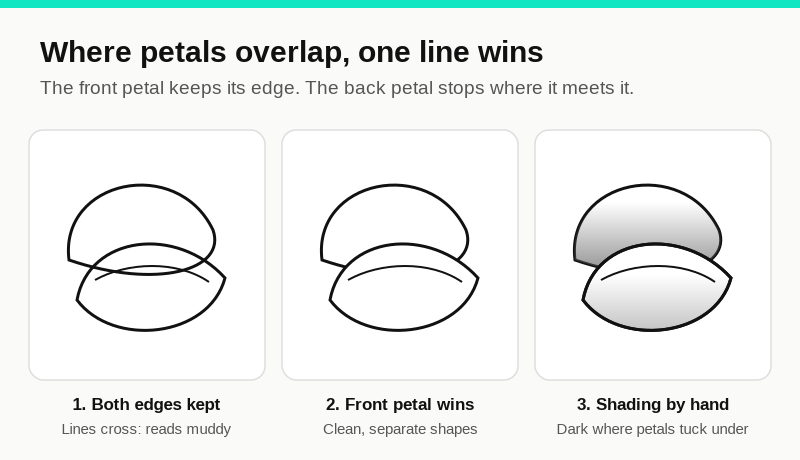
- Where two petals overlap, keep only the front petal's edge. Double lines are what make rose stencils look muddy.
- Put petal outlines, the centre spiral, leaves and stem in the stencil, and leave shading to the artist's hand.
What a rose tattoo means
The rose has stood for love in European art and poetry for centuries. In the 19th century, the Victorian "language of flowers" (floriography) gave individual flower colours specific messages, and most of today's colour meanings trace back to it. Even then, different flower dictionaries disagreed, so no single list is the correct one. The readings below are the ones most commonly cited:
- Red: love and romance. The most common reading, and the default colour for traditional roses.
- White: purity, innocence and new beginnings. White roses are also used in remembrance.
- Yellow: friendship and joy. Some older flower dictionaries linked yellow to jealousy, which is worth knowing if the tattoo is meant for a friend.
- Pink: gratitude, admiration and gentleness.
- Black: there are no truly black roses in nature; the darkest varieties are a very deep red. In tattoos a black rose usually means loss, mourning or the end of something.
Colour meaning matters mostly in colour work. A rose done in black and grey is not read as a "black rose"; it is simply a rose in that style. Thorns are often read as beauty that comes with pain, or as protection. The rose is also the birth flower for June, which makes it a common choice for a birthday or a child's birth month; the birth flower tattoo guide covers the other months.
Rose tattoo ideas: what to pair it with
Single stem or full bloom
A single stem is long and narrow, which suits the forearm, the side of the ribs or the spine, and works well in fine line. A full bloom is a rounded, open flower with two or three leaves; it sits well on the shoulder cap or outer thigh and is the classic shape in traditional and realism work. A half-open bud is a good middle ground for small pieces, because it has fewer petals to fit in.
Rose with a name or date
Roses are a common frame for a name or a date, often in memory of someone. The lettering can run along the stem, sit on a banner, or curve under the bloom. Plan it from the start so the stem can bend to make room. As a common rule of thumb, keep letters at least about 5 to 6 mm (1/4 in) tall so they stay readable as the lines settle. For other ways to include a personal detail, see memorial tattoo ideas.
Rose and dagger
The dagger through a rose is a staple of American traditional flash. It is usually read as love and pain together, or as loss, betrayal or a hard lesson. The vertical layout fits the forearm, upper arm or calf. In the stencil, decide where the blade passes behind a petal and where it comes out in front, and keep only the top lines at each crossing.
Rose and clock
A rose with a clock or pocket watch is usually about time: a birth, a loss, or time passing. If the hands show a specific time, a dial of at least about 5 cm (2 in) keeps the numerals clear, which usually puts the whole piece at 15 cm (6 in) or more.
Skulls, snakes and butterflies are other common pairings. Each extra element adds lines, so a combination needs more space than a rose alone.
Rose tattoo styles
American traditional
Bold black outlines, solid colour, a limited palette, and a simplified flower with only a handful of petal shapes. The rose is one of the most common motifs in traditional flash. Because the lines are thick and the shapes are open, traditional roses hold up well over time and can be read from across a room.
Fine line
Thin, often single-needle outlines with little or no shading. Fine line roses can be small and delicate, which makes them popular on the wrist, ankle and behind the ear. The trade-off is that thin lines soften over the years, so very small fine line roses should keep fewer petals and wider gaps between lines.
Black and grey realism
Soft gradients, realistic petal curls and deep shadows where petals tuck under each other. Realism needs room for the shading to work, so it is rarely done smaller than about 10 cm (4 in). The stencil for a realistic rose is a map of where light and shadow change rather than a drawing to follow line by line; the realism stencil guide explains how to build one.
Neo-traditional and illustrative
Bold outlines with more petals, richer colour and decorative details, so they need more space than a classic traditional rose. How the outline changes by style is covered in stencil technique by style.
Rose tattoo sizes and placements
The right size depends on the style and how many petals the design has. The ranges below measure the longest side of the design and are starting points for adults:
| Placement | Good fit | Typical size |
|---|---|---|
| Finger, behind the ear | Fine line bud or small bloom | 1.5 to 3 cm (0.6 to 1.2 in) |
| Wrist, ankle | Small bloom or short stem | 3 to 6 cm (1.2 to 2.4 in) |
| Upper arm, shoulder cap | Traditional bloom, rose and dagger | 8 to 15 cm (3 to 6 in) |
| Forearm | Long stem or bloom with leaves | 10 to 18 cm (4 to 7 in) |
| Sternum, ribs | Stem or bloom following the ribs | 10 to 20 cm (4 to 8 in) |
| Thigh, calf, back | Realism or larger compositions | 15 to 25 cm (6 to 10 in) or more |
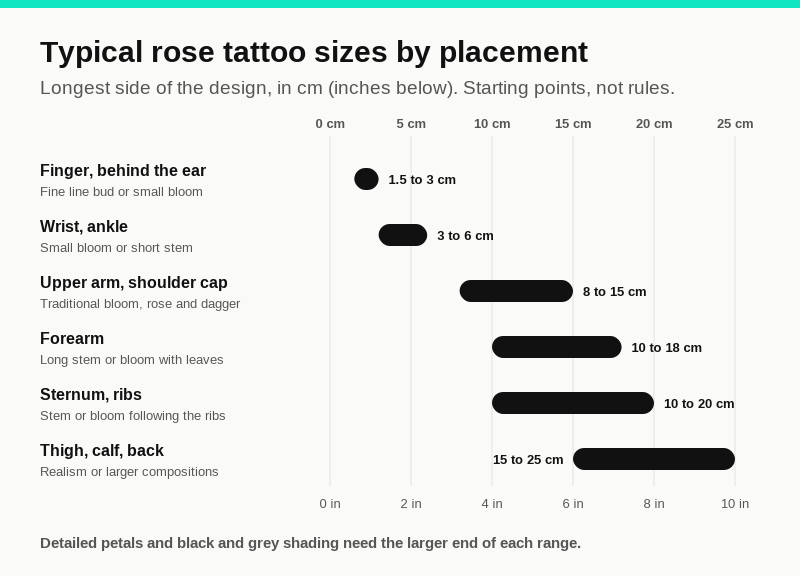
Run a stem along the long axis of the limb, and put a full bloom on a flatter area away from joints. Fingers and hands only suit the simplest fine line roses, because detail there tends to blur. For sizing by body part in general, see the tattoo size chart. The ribs, sternum, ankle and fingers are commonly reported as more painful than the outer arm or thigh; the tattoo pain chart compares placements.
How to stencil a rose
A rose is a stack of overlapping, curling petals with almost no straight edges, so a direct trace of a photo produces dozens of crossing lines that print as a grey blur. A good rose stencil is a clear plan of which petal sits on top of which.
Map the petals in layers
Work from the centre out. Most roses have three zones: a tight spiral of petals at the centre, a cup of inner petals around it, and outer petals that open and roll back at the edges. Draw each zone as its own layer, and decide for every overlap which petal is in front.
Which lines to keep
- Outer petal edges: keep, with the heaviest line.
- Overlaps: keep only the front petal's edge. Two lines crossing at an overlap is a common reason a rose looks muddy on skin.
- Rolled petal lips: keep the line where a petal turns back as one short curve. Do not outline both sides of the curl at small sizes.
- The centre spiral: keep it, but simplify. Three to five turns are usually enough on a small rose; more than that fills in over time.
- Leaves: keep the outline and the central vein. Add side veins only on larger pieces.
- Thorns: place a few deliberately; thorns copied from a photo read as noise.
- Shadows and texture: leave them out, or mark the edge of a dark area with a light broken line. The artist builds the shading by hand.
As a rough count, traditional roses use five to nine petal shapes and fine line roses usually keep twelve to twenty. Keep at least about 1.5 to 2 mm between neighbouring lines in the finished size. The rose stencil designs page shows a sample rose stencil with these decisions already made.
Match the stencil to the shading style
Traditional roses, whip shading and dotwork need clean outlines only, with shading done by hand. Realism also needs soft petal edges marked lightly so they do not become hard outlines. When converting a reference in Stencify, the four shading styles (Classic, Stipple, Crosshatch and Broken Lines) give different ways to mark those areas, Broken Lines suits soft realistic edges, and "Simplify tiny details" removes the small veins and texture a photo picks up. "Thicken outlines" helps when a traditional rose needs a bolder outer edge.
Size, print and apply
Print the stencil at the planned size and check it with a ruler before it touches the skin; a rose that looks clean on a screen can be too dense at 3 cm. Stencify prints at an exact size in cm or inches with a check ruler on the page. Apply a stem with the limb in its relaxed position, and check from a distance that it runs straight along the arm or leg. For two matching roses, such as one on each side of the chest, flip the second with "Mirror" so the pair faces each other.
Line weight and how a rose ages
Tattoo lines spread a little over the years and the gaps between them shrink. On a rose this shows first in the centre spiral, which has the most lines in the least space. A rose slightly larger and simpler than seems necessary usually looks better in ten years than one packed with petals. Lighter colours such as yellow, pale pink and white generally fade sooner than black, and sun speeds this up, so use sunscreen on a colour rose.
Before you book
- Choose the style first. Bring photos of healed rose tattoos in the style you like.
- Decide on colour or black and grey. It affects both meaning and size.
- Try the placement. A rose on a photo of your own arm shows whether a stem or a bloom fits better. With "Place It Myself" in Stencify, the artist can place the design on a photo of the body before printing; see how to try on a tattoo for other ways.
- Plan any lettering, dagger or clock now. Extra elements are hard to add well later.
Frequently asked questions
What does a rose tattoo mean?
Most often love, especially a red rose. Other common readings come from the Victorian language of flowers: white for purity or remembrance, yellow for friendship, pink for gratitude, and a black rose for loss or an ending. Thorns are often read as beauty that comes with pain.
What size should a rose tattoo be?
It depends on the style and placement. As a rough guide, a fine line bud on a finger or behind the ear is about 1.5 to 3 cm (0.6 to 1.2 in), a small bloom on the wrist or ankle 3 to 6 cm (1.2 to 2.4 in), a forearm rose 10 to 18 cm (4 to 7 in), and a black and grey realism rose usually 10 cm (4 in) or more.
Where is the best place for a rose tattoo?
A long stem suits long placements such as the forearm, ribs, calf or spine. A full bloom suits rounder, flatter areas such as the shoulder cap, upper arm or outer thigh. Fingers and hands only suit very simple fine line roses, because detail there tends to blur.
Do fine line rose tattoos last?
They can, if they are not too small or too detailed. Thin lines soften over the years and the gaps between them shrink, so a fine line rose ages best with fewer petals, a simple centre spiral and at least about 1.5 to 2 mm between lines.
How many petals should a rose stencil have?
Fewer than the reference photo. Traditional roses usually use five to nine petal shapes and fine line roses about twelve to twenty. At overlaps, keep only the front petal's edge.
Related reading
- Rose Stencil Designs - sample rose stencil and line notes
- Birth Flower Tattoos - flowers for every month
- Stencil Technique by Style - fine line, bold and traditional
- Tattoo Size Chart - sizes by body part
- Skull Tattoo Ideas
Rose stencils from your own reference
Turn a rose photo or sketch into clean line work in about 30 seconds, choose a shading style, and print at the exact size with a check ruler.