Skull Tattoo Ideas: Meaning, Styles, Placement and a Stencil That Reads
• by Stencify • 9 min read
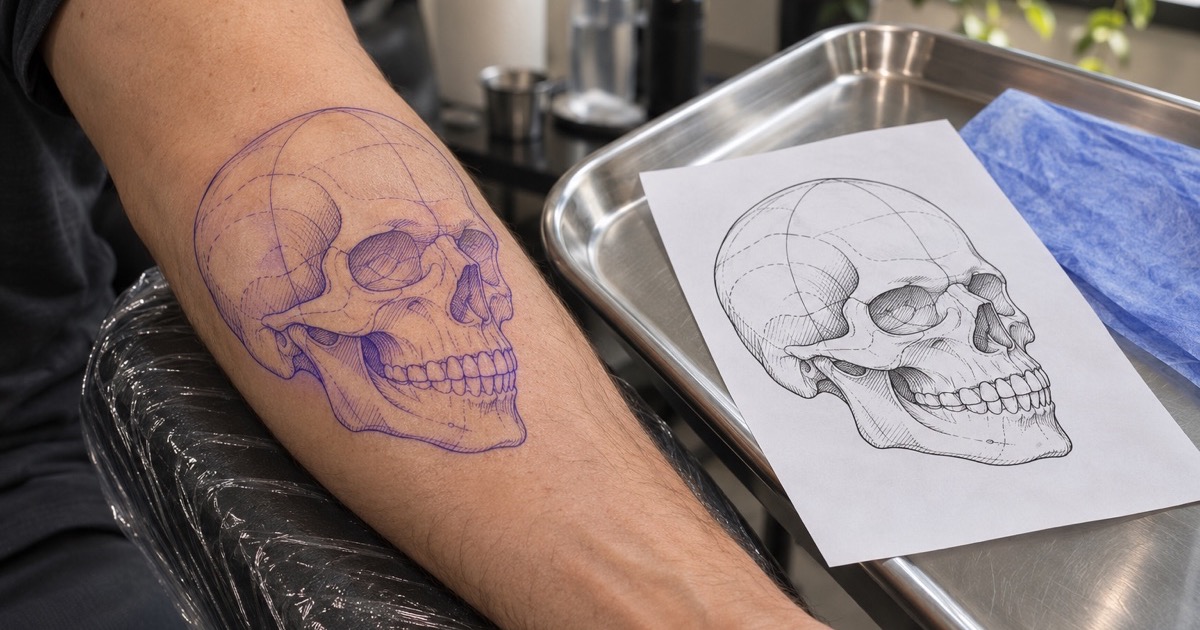
The skull is one of the oldest tattoo subjects and one of the most flexible. It works alone or with roses, snakes and daggers, at 4 cm on a hand or across a whole back. The short answer for planning one: choose the style first, because it decides how much anatomy the drawing needs, then size the skull so the teeth and eye sockets stay clear at the placement you want. This guide covers meanings, styles, sizes, the anatomy that makes a skull convincing, and how to build the stencil.
Key takeaways
- The most common meaning is mortality, a reminder to live fully. In the Mexican Day of the Dead tradition the skull is about remembrance and celebration, not fear.
- Style sets the stencil: traditional needs a few bold shapes, realism needs mapped shadow edges, a sugar skull needs clean symmetry.
- Teeth are where small skulls fail. Under about 5 cm (2 in), simplify them into a few shapes instead of drawing each tooth.
- The eye sockets sit about halfway down the skull. Placing them too high is the most common drawing mistake.
What a skull tattoo means
A skull means different things in different traditions, and the wearer's own reason matters most. These are the readings you will meet most often.
- Mortality. In European art the skull is the classic memento mori, Latin for "remember that you must die". In still-life painting it appears next to candles, hourglasses and flowers as a reminder that time is limited. Many people wear it as a prompt to live fully, not as something grim.
- Remembrance. In Mexico, decorated skulls called calaveras are part of the Day of the Dead on 1 and 2 November, when families remember relatives who have died. The tone is warm and celebratory.
- Danger and defiance. The skull and crossbones marked pirate flags and still marks poison. In tattooing this side of the symbol stands for toughness or for having faced something and survived.
- Change. Paired with a butterfly, a flower or a snake, a skull is often read as an ending and a beginning in the same image.
For designs made in memory of a person, the memorial tattoo ideas guide covers dates, handwriting and portraits.
Skull tattoo styles
Traditional
A simplified skull with a heavy outline, solid black eye sockets and a short row of blocky teeth, often with a dagger, a rose or a snake. The stencil is a small number of confident shapes. Leave the inside of the cranium open so there is room for shading and colour.
Black and grey realism
Drawn from a photo or a cast of a real skull, with soft shading and no hard outline in the finished tattoo. The stencil has to carry more information: the outer contour, the sockets, the nasal opening, the cheekbone, the teeth, and the edges of the main shadows marked as thin or dotted lines. The realism stencil guide explains how to map shadows.
Sugar skull
Based on the Mexican calavera: a front-facing skull decorated with flowers, often marigolds, plus dots, scrolls and a heart-shaped nose. The design depends on left and right matching, so symmetry is the main stencil task. Because it comes from a living tradition, it is worth knowing the Day of the Dead background before choosing one.
Neo-traditional
Bold outlines like traditional, but with more depth, varied line weight and decorative extras such as jewels, crowns, leaves and filigree. Mark the two or three line weights on the stencil so they stay consistent during the session.
Blackwork and geometric
Skulls built from solid black, dotwork or straight facets. Outline every filled area and mark which areas are filled. For faceted skulls, draw the lines with a ruler and check them at final size.
Fine line and micro
A single thin outline with minimal interior detail. This style needs the most editing: two socket shapes, a nose, a jaw line and a suggestion of teeth are enough.
Animal skulls
Ram, deer, bull and bird skulls are popular in blackwork and realism. Horns and antlers make the design much wider or taller than the skull itself, so measure the full outline before choosing a placement.
Common combinations
- Skull and rose. Life next to death. Decide which sits in front where they overlap. See the rose tattoo guide for petal structure.
- Skull and snake. The snake usually passes through an eye socket or the jaw. Mark every crossing clearly; the snake tattoo guide covers coils and scales.
- Skull and dagger. A traditional staple. The blade needs straight, even edges, so check it with a ruler on the stencil.
- Skull with a clock or hourglass. A direct reference to time. Clock faces carry numerals, so check the minimum size of the smallest one.
- Skeleton hand. Often tattooed over the wearer's own hand. The skeleton hand stencil designs show how the bones line up.
Sizes and placements
Adult ranges as a starting point. The right size is the one where the smallest detail in your chosen style is still clear.
| Placement | Typical size | Notes |
|---|---|---|
| Finger or behind the ear | 1.5 to 3 cm (0.6 to 1.2 in) | Outline only, no individual teeth |
| Wrist or ankle | 3 to 5 cm (1.2 to 2 in) | Fine line or simple traditional |
| Back of the hand | 6 to 9 cm (2.5 to 3.5 in) | Fits the shape of the hand; expect more fading than on the arm |
| Forearm | 8 to 15 cm (3 to 6 in) | Room for a skull with a rose or dagger |
| Upper arm or shoulder | 10 to 18 cm (4 to 7 in) | Good for realism and neo-traditional |
| Chest or thigh | 15 to 25 cm (6 to 10 in) | Space for full shading and several elements |
| Back | 25 cm (10 in) and up | Large compositions, printed across several sheets |
The tattoo size chart gives general ranges by body part. A front-facing skull suits flat, centred areas such as the chest, the back of the hand and the kneecap. A three-quarter view fits the curve of an arm or calf better and shows more depth.
The anatomy that makes a skull convincing
Even a stylised skull looks wrong when the proportions are off. Four checks cover most problems.
- Sockets at the halfway line. Seen from the front, the eye sockets sit about halfway between the top of the cranium and the bottom of the chin. Beginners put them too high and the cranium ends up too small.
- Sockets are not circles. They are rounded squares that slope down slightly toward the outside, with a heavier brow edge on top.
- The nose is an upside-down heart. The nasal opening is narrow at the top and wider at the bottom, with a thin dividing wall in the middle.
- The jaw is a separate bone. The lower jaw hinges just in front of the ear opening, and the cheekbone runs back toward that point. An open jaw should pivot from there, not from the chin.
Teeth
An adult has up to 32 teeth, 16 in each jaw, but only the front ones are fully visible from the front. The row curves around the jaw, so teeth get narrower toward the sides and then turn out of view. Drawing every tooth as the same rectangle makes the skull look flat. Front teeth are longer than they look in a living face, because the roots and the bone around them are exposed.
How to stencil a skull
1. Decide what the stencil carries
Solid lines for edges that will be tattooed as lines. Thin or dotted lines for the borders of shadows. Nothing for soft gradients, which are shaded freehand inside the map. Deciding this before you draw keeps the stencil readable.
2. Reduce texture
Photos of real skulls are full of cracks, pits and suture lines. A direct conversion turns all of them into marks, and most of them do not help. Keep the two or three cracks that describe the form and drop the rest. In Stencify, "Simplify tiny details" removes the smallest marks, and "Thicken outlines" strengthens the outer contour so it survives wiping.
3. Size the teeth first
Find the smallest gap between two teeth at final size. If it is under about 1 mm, the lines will tend to merge as the tattoo ages. As a rule, under about 5 cm (2 in) of skull height, draw the teeth as one band with a few dividing marks, or leave them as a simple line.
4. Check symmetry on front views
Fold the print down the centre line and hold it to the light, or flip the design with "Mirror" and compare. Small differences between the sockets are easy to miss on screen and easy to see on skin. For sugar skulls, check each decorative element against its partner on the other side.
5. Print at exact size and place it
Print at 100% at the size you measured, as described in how to size and print a tattoo stencil. On hands, knees and elbows, apply the stencil in the position where the skin is smoothest, then check it with the joint both bent and straight.
For reference drawings and more notes on what makes one work, see the skull stencil designs.
Frequently asked questions
What does a skull tattoo mean?
Most often mortality: a reminder that life is short and should be lived fully, from the memento mori tradition in European art. In the Mexican Day of the Dead tradition, decorated skulls stand for remembering and celebrating relatives who have died. A skull can also stand for danger, toughness or change, and the wearer's own reason matters most.
What is the difference between a skull and a sugar skull tattoo?
A sugar skull is based on the Mexican calavera used during the Day of the Dead. It is front-facing, symmetrical and decorated with flowers, dots and scrolls, and it is about remembrance. A plain skull follows real anatomy more closely and is usually read as a symbol of mortality.
How big should a skull tattoo be?
It depends on the style. A fine line outline works at 3 to 5 cm (1.2 to 2 in). A skull with individual teeth needs about 6 cm (2.5 in) or more, and black and grey realism usually needs 10 cm (4 in) or more so that the shading has room.
Where is the best place for a skull tattoo?
Front-facing skulls suit flat, centred areas such as the chest, the back of the hand and the kneecap. Three-quarter views fit the forearm, upper arm, thigh and calf. Hands show the design well but usually fade faster than arms or legs.
How do you stencil the teeth on a small skull?
Simplify them. If the gap between two teeth is under about 1 mm at final size, the lines tend to merge over time. Under about 5 cm (2 in) of skull height, draw the teeth as a single band with a few dividing marks instead of separate teeth.
Related reading
- Skull Stencil Designs - reference drawings and stencil notes
- Realism Tattoo Stencils - mapping shadows from a photo
- Rose Tattoo Ideas - the most common partner for a skull
- Tattoo Size Chart - common sizes by placement
Skull stencils with clean structure
Stencify turns a skull reference into clean line work, removes excess texture with "Simplify tiny details" and prints the stencil at the exact size you measured.