Cyber Sigilism Tattoo Stencils: Style, Placement and Line Weight
• by Stencify • 9 min read
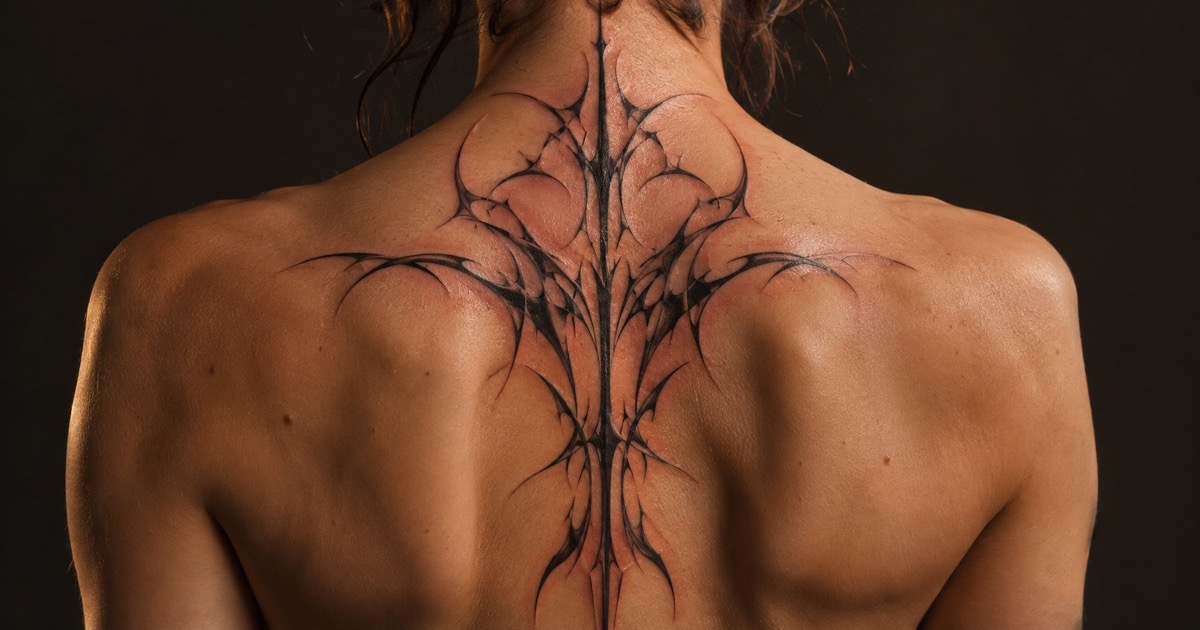
Cyber sigilism is a tattoo style built from thin, sharp lines that flow into spikes, hooks and thorn-like points, often arranged symmetrically around a center line. It looks a little like modern tribal drawn with a fine pen. Because the whole style depends on fine lines and narrow gaps, it works best at generous sizes on long, fairly flat areas such as the spine, sternum, forearm and ribs. The stencil matters more than usual: it has to follow the body's center line and muscle direction, and leave enough room between points for the ink to settle as the tattoo ages.
Key takeaways
- Cyber sigilism uses thin, sharp, flowing lines with tapering spikes, often mirrored around a center line.
- Give it length. Spine pieces are often 20 to 45 cm (8 to 18 in) long; squeezing the same design into a small space makes the points merge.
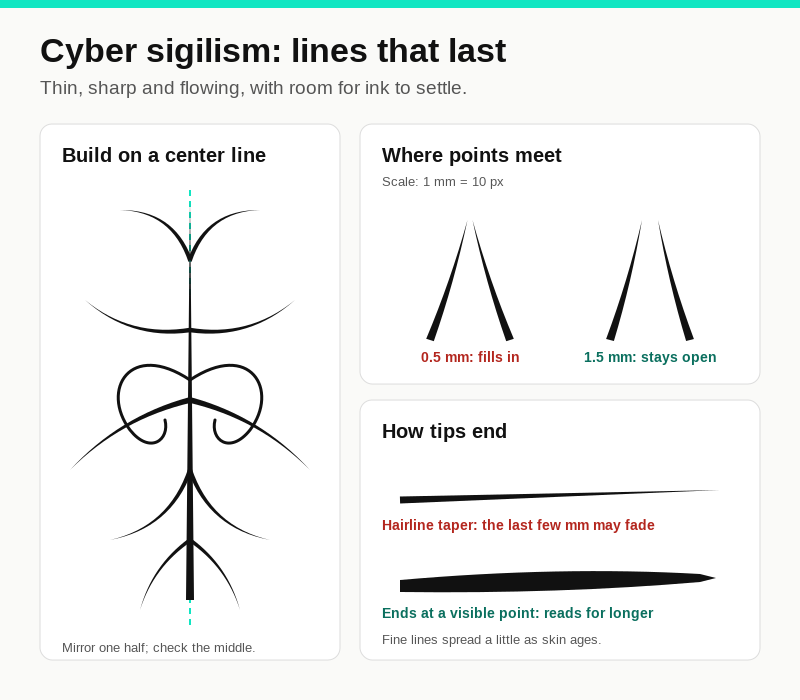
- Keep at least about 1 to 1.5 mm between lines where points meet, and end tapers at a visible point rather than a hairline.
- Mark the body's center line on the client while they stand, then apply the stencil from the middle out.
What cyber sigilism is
The name joins two ideas. "Cyber" refers to the sharp, slightly digital feel of the lines, which echo early-2000s graphic design. A "sigil" is a symbol drawn for a personal or symbolic purpose. In practice, most cyber sigilism tattoos are abstract and decorative rather than encoded symbols: the appeal is the shape, the movement and the way the lines sit on the body.
The style became widely popular in the early 2020s, largely through social media, and it overlaps with what is often called neo-tribal. Typical features:
- Thin, even main lines that taper to sharp points at the ends.
- Spikes, hooks and thorns branching off curves, sometimes with a barbed or wire-like rhythm.
- Symmetry around a center line, especially on the spine, sternum and back of the neck.
- Flow that follows the body, wrapping a forearm or curving along the ribs.
- Integrated motifs such as small hearts, stars, crosses, butterfly shapes or barbed wire worked into the linework.
How it differs from bold tribal
Classic blackwork tribal relies on wide, solid black shapes. Cyber sigilism keeps the sharp, sweeping silhouettes but draws them with fine lines and lots of open skin. That difference shapes everything about planning it: line weight, size, and how the tattoo will look in ten years. Traditional tribal designs from specific cultures, such as Polynesian work, carry their own meanings and conventions; cyber sigilism is a modern decorative style and does not borrow those meanings.
Where it sits on the body
Cyber sigilism suits long, fairly flat areas where lines can run without crossing a joint. Common placements and typical sizes:
| Placement | Typical size | Flow notes |
|---|---|---|
| Spine | 20 to 45 cm (8 to 18 in) long | Symmetrical on the center line; the most popular placement |
| Sternum and under the chest | 10 to 20 cm (4 to 8 in) wide | Symmetrical; follows the curve under the chest |
| Back of the neck | 5 to 10 cm (2 to 4 in) tall | Often continues down the spine |
| Forearm | 12 to 20 cm (5 to 8 in) long | Runs with the length of the arm or wraps around it |
| Ribs and side | 15 to 30 cm (6 to 12 in) long | Follows the angle of the ribs, not a straight vertical |
| Collarbone | 10 to 18 cm (4 to 7 in) wide | Follows the bone; can be mirrored on both sides |
| Hip and lower back | 10 to 25 cm (4 to 10 in) wide | Sweeps along the hip bone or across the lower back |
Hands and fingers are sometimes used too, but fine lines there fade quickly. The spine, sternum and ribs are among the more painful placements, so long pieces there may need more than one session; see the tattoo pain chart. For size ranges across all placements, see the tattoo size chart.
Line weight and how fine lines age
All tattoo lines spread slightly under the skin over time. With bold work, this barely shows. With cyber sigilism, it decides whether the design still looks sharp in ten years. Three things matter most:
Gaps where points meet
Cyber sigilism is full of places where two lines run toward each other: spikes branching from a curve, hooks folding back, thorns meeting in a V. Where the gap is under about 1 mm, the lines tend to merge into a dark wedge as the tattoo ages. Keep at least about 1 to 1.5 mm of clear skin at those points, and more on areas that see a lot of sun or movement.
Tapers
The sharp ends are the signature of the style, but a taper that thins to nothing can lose its last few millimetres as it heals. Ending each point with a short, visible tip keeps the sharp look for longer. The artist pulls the actual taper by hand; the stencil only needs to show where each point ends.
Main line weight
A design drawn entirely in the finest possible line looks crisp in fresh photos and soft a few years later. Many artists give the main structural curves a slightly heavier line and keep the finest lines for accents. If the client wants a very delicate look, go larger rather than finer: the same design at 30 cm instead of 20 cm gives every gap more room. Our stencil technique by style guide covers fine line work in more depth.
Designing for the body
Cyber sigilism looks best when it seems to grow out of the body rather than sit on top of it.
- Use the real center line. Bodies are not perfectly symmetrical. On the spine, follow the vertebrae; on the sternum, find the midpoint between the collarbones and the bottom of the breastbone. A symmetrical design placed on a guessed center looks crooked straight away.
- Follow the muscles. On the forearm, lines that run with the length of the arm or spiral gently around it look natural. On the ribs, angle the design with the ribs rather than straight up and down.
- Plan for movement. Check how the design looks with arms raised and lowered, and with the back straight and bent. Spikes that cross a joint distort as it moves.
- Draw one half, then mirror it. For symmetrical pieces, draw one side in a drawing app and duplicate it as a flipped copy, then adjust the middle so the two halves join cleanly.
Our guide to placement and body flow goes further into reading the body's lines.
Making the stencil
Most cyber sigilism starts as a drawing: on paper, on a tablet, or as a custom design built from references. The stencil step turns that drawing into lines that transfer cleanly and fit the measured placement.
- Clean single lines. Sketch lines are often doubled or broken. The stencil needs one clear line per stroke, so the artist knows exactly where to go.
- Lines that transfer. Very thin lines in the drawing can transfer faintly or break up on the skin. Thicken the stencil lines a little if needed; the needle choice, not the stencil, sets the final line weight.
- Room between points. Check every place where spikes converge before printing. If they are closer than about 1 mm at final size, open them up in the drawing or make the design larger.
- Measure along the body. Measure the placement with a flexible tape following the curve of the back or arm, not as a straight line. Print at that exact size.
- Split long pieces carefully. A spine piece longer than a sheet of paper needs to print across several pages. Mark the center line on every section so the pieces line up on the body.
Stencify handles most of this in one place. Photograph a sketch and it becomes stencil lines in about 30 seconds; "Thicken outlines" strengthens fine lines so they transfer, "Simplify tiny details" opens up crowded spikes, and "Remove background clutter" clears pencil marks and paper texture. "Place It Myself" lets you place the design on a photo of the client's back or arm to judge length and flow. Print at the exact size in cm or inches, confirm it with the check ruler, and use multi-page printing for a full spine or back piece. It runs on iPhone, iPad and Android: get Stencify on the App Store or on Google Play.
Placing a stencil that flows with the body
- Have the client stand naturally. Arms relaxed at the sides, weight on both feet, looking straight ahead. Posture changes the line of the spine and the shape of the ribs.
- Mark the center line. With a skin marker, mark a few points along the spine or sternum. A long ruler or a plumb line helps on the back.
- Apply from the middle out. Line up the stencil's center line with the marks and press from the middle toward the edges, so the paper does not drift as it meets the curve.
- Check in the mirror. Let the client see it in a full-length mirror, front and back, standing and with arms raised. A symmetrical design that is off by a few millimetres at the top can be off by a centimetre at the bottom.
- Reapply rather than adjust. If it is off, wipe it and reapply. With long, thin designs, freehand corrections drift quickly from the original.
Long pieces also need the stencil to last through a long session. Our guide on getting the stencil to stick covers skin prep and transfer products.
Consultation and booking tips
- Bring references, but expect a custom drawing. Because the style is so personal to each body, most artists redraw the design to fit the client's placement.
- Talk about aging. Ask how the artist balances fine lines with longevity, and look at healed photos of their fine line work, not just fresh ones.
- Plan sessions. A full spine piece may be split into more than one appointment, especially on sensitive areas.
- Try it on first. A preview on a photo of the body helps settle size and direction before the stencil day. See our tattoo try-on guide.
Frequently asked questions
What is a cyber sigilism tattoo?
A modern tattoo style built from thin, sharp, flowing lines with tapering spikes, hooks and thorn-like points, often arranged symmetrically around a center line. It became widely popular in the early 2020s and overlaps with neo-tribal work.
Where does cyber sigilism look best on the body?
On long, fairly flat areas where the lines can flow without crossing a joint: the spine, sternum, back of the neck, forearm, ribs, collarbone and hip. The spine is the most popular placement for symmetrical designs.
Do cyber sigilism tattoos age well?
They can, if the design leaves room for ink to spread slightly over time. Keep at least about 1 to 1.5 mm between lines where points meet, end tapers at a visible point, and choose a larger size rather than finer lines.
How big should a cyber sigilism spine tattoo be?
Spine pieces are often 20 to 45 cm (8 to 18 in) long. The more spikes and details the design has, the more length it needs so the gaps between lines stay open.
Is cyber sigilism the same as tribal?
No. It borrows the sharp, sweeping silhouettes of modern tribal, but draws them in fine lines with lots of open skin instead of wide solid black shapes. It is a decorative style and does not carry the meanings of traditional tribal designs from specific cultures.
Related reading
- Tattoo Placement and Body Flow - fitting a stencil to the body
- Stencil Technique by Style - fine line, bold and traditional
- How to Size and Print a Stencil - exact size and multi-page prints
- Snake Stencils - flowing designs that follow the body
Fit sharp linework to the body
Stencify turns a sketch into clean stencil lines, lets you place it on a photo of the client, and prints long pieces at exact size across several pages.