Lion Tattoo Ideas: Meaning, Styles, Placement and How to Stencil a Mane
• by Stencify • 9 min read
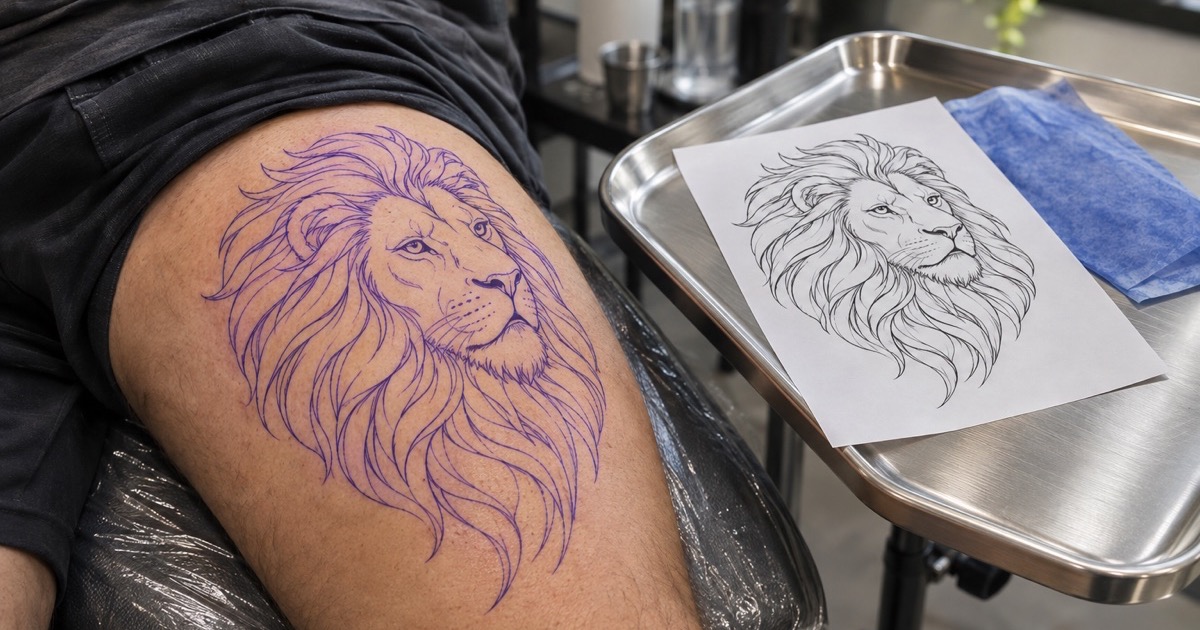
The lion is one of the most requested animal tattoos, usually as a head-on portrait with a full mane. The mane is also what makes it difficult: it takes up more than half of the design, and if it is stencilled as loose hair it swallows the face. The short answer for planning one: decide what the lion should express, give the face enough size to hold the eyes and nose, and build the mane from a small number of large, flowing locks. This guide covers meanings, popular designs, sizes and placements, and how to stencil the mane.
Key takeaways
- Lions stand for courage and leadership in many cultures, and for family, since lions are the only big cats that live in groups.
- A male lion's head with mane is roughly as wide as it is tall, so it suits broad areas: chest, shoulder, thigh and back.
- For realism, plan about 12 cm (5 in) or more across the whole head, so the face inside the mane is large enough.
- Stencil the mane as big locks that flow away from the face, with the heaviest lines at the outer edge and the lightest next to the face.
What a lion tattoo means
- Courage and strength. The oldest and most common reading. English still uses "lionhearted" for a brave person.
- Leadership and royalty. The lion has been called the king of beasts for centuries and appears on royal arms across Europe, including the three lions of England. A crown on a lion tattoo makes this meaning explicit.
- Family. Lions are the only big cats that live in social groups, called prides, made up mostly of related lionesses and their cubs. A lion with a lioness, or a lioness with cubs, is a common family tattoo.
- Protection. Stone guardian lions stand in pairs at the entrances of temples and palaces in China, and similar guardian figures appear in Japan. A lion placed on the chest or shoulder is often chosen with this in mind.
- Faith. The Lion of Judah is a symbol in Judaism and Christianity and is central to Rastafari. The lion lying down with the lamb is a popular image of peace.
- Leo. The zodiac sign for birthdays from about 23 July to 22 August. Some people choose the lion itself, others the Leo glyph or constellation.
Lion or lioness
The two read differently. A male with a mane is the image of authority and protection. A lioness is leaner, has no mane, and does most of a pride's hunting, so she is often chosen for strength, independence and motherhood. Without a mane, a lioness tattoo depends entirely on the structure of the face, which makes a good reference even more important.
Popular lion tattoo designs
Realistic portrait
A front or three-quarter view in black and grey, drawn from a photo. The eyes and nose are the focus and the mane frames them. This is the design that most needs size. The realism stencil guide explains how to map the shadows.
Lion with a crown
A crown sits on or above the head. Check that it follows the tilt of the head, and keep the band and points simple; small jewels and filigree are the first details to blur.
Roaring lion
An open mouth adds teeth, a tongue and deep shadow, and changes the outline of the head. Mark the inside of the mouth clearly on the stencil so the teeth stay separate from the dark area behind them.
Geometric and half-and-half
One half realistic, the other built from straight lines, triangles or mandala patterns. The split line has to run exactly through the centre of the face. See the geometric stencil guide for exact lines.
Traditional and neo-traditional
A stylised head with bold outlines and a mane drawn as a ring of pointed or curled tufts. Neo-traditional versions add roses, daggers, clocks or ornamental frames.
Fine line and minimal
A single-line profile, a small outline or the Leo constellation. These leave out the fur and work at wrist and ankle sizes.
Lion and cubs, or lion and lioness
Family designs with two or more heads. Overlap them and let one be clearly larger, so the group reads as one shape instead of a row.
Guardian lions
The stylised lions of Chinese and Japanese art, with curled manes and a broad, fierce face. They follow their own drawing rules and are usually planned as large pieces with background.
Sizes and placements
| Placement | Typical size | Notes |
|---|---|---|
| Wrist, ankle or behind the ear | 2 to 5 cm (0.8 to 2 in) | Outline, profile or Leo symbol only |
| Back of the hand | 7 to 9 cm (2.75 to 3.5 in) | Front-facing head, simplified mane; expect faster fading |
| Forearm | 10 to 16 cm (4 to 6.5 in) | Works best with a three-quarter view or a tall design with a crown |
| Upper arm or shoulder | 12 to 20 cm (5 to 8 in) | The mane can follow the curve of the shoulder |
| Chest | 15 to 25 cm (6 to 10 in) | One side, or centred on the breastbone for a front view |
| Thigh | 18 to 28 cm (7 to 11 in) | A broad, even area that suits a full realistic head |
| Back | 25 cm (10 in) and up | Full scenes, prides and guardian lions |
Because the mane spreads in every direction, a lion's head is close to a circle. Narrow areas such as the forearm force the mane to be cropped or the whole head to be small. If the forearm is the goal, a three-quarter view, a profile, or a design that extends downward with a crown above and a chest ruff below makes better use of the space. The tattoo size chart gives general ranges for each body part.
For realism, about 12 cm (5 in) across the head is a practical minimum. The face is only the central part of that, and the eyes need to be large enough to hold a highlight.
How to stencil a lion
1. Build the face first
A lion's face is broad. The eyes are small and set wide apart, the nose is a wide, flat triangle, and the muzzle is heavy and squared off with a clear split under the nose. On the stencil, mark the outline of each eye with its pupil and highlight, the top and bottom of the nose, the muzzle pads, the mouth line and the chin. Get these in place before any mane is drawn.
2. Draw the mane as locks
Think of the mane as thick, overlapping locks, not hair. Each lock starts near the face and flows outward and down, and the locks get longer under the chin and on the chest.
- Draw the edge of each lock with one or two long, tapered lines. Fifteen to thirty locks are enough for most portraits.
- Vary the size. A few large locks with smaller ones between them look natural. Equal locks look like a sunflower.
- Keep the area next to the face quiet. Shorter, lighter marks around the face and heavier lines at the outer edge keep attention on the eyes.
- Mark the darkest zones with a thin or dotted border: under the chin, behind the ears and between the deepest locks.
3. Clean up a photo conversion
A lion photo converted directly gives a mass of fine strokes in the mane and very little in the face, the opposite of what is needed. Remove strokes until the locks read as shapes. In Stencify, "Simplify tiny details" clears the smallest marks and "Thicken outlines" strengthens the contour of the head and the main locks. The same approach to fur is used in the wolf tattoo guide.
4. Check the centre line
On a front view, draw a line from the top of the head through the middle of the nose to the chin. The eyes should sit level and the nose should be centred. Flip the design with "Mirror" to spot a tilt you have stopped seeing. The mane does not have to be symmetrical, and usually looks better when it is not.
5. Print large pieces across several sheets
A chest, thigh or back lion is often larger than one A4 or US Letter sheet. Print it at exact size across several pages, check the ruler on each page and tape the sheets together. Put the joins in the mane, never through the eyes or nose. Full steps are in how to size and print a tattoo stencil.
6. Place it on the body
Apply the stencil with the client standing in a relaxed posture. On the chest and shoulder, the face should sit on the flattest part and the mane can run over the curve, since a little distortion in the mane is invisible while the same distortion in the face is not. The placement and body flow guide covers this in more detail.
For reference drawings, see the lion stencil designs, and the tiger stencil designs for another big cat.
Frequently asked questions
What does a lion tattoo mean?
Most often courage, strength and leadership. Lions are also the only big cats that live in family groups, so they are a common symbol of family and protection. For some people the meaning is religious, as with the Lion of Judah, or tied to the zodiac sign Leo.
What does a lion with a crown tattoo mean?
It underlines the idea of the lion as king: leadership, self-respect and authority over your own life. Some people choose it for religious reasons, and couples sometimes pair a crowned lion with a crowned lioness.
How big should a lion tattoo be?
An outline or Leo symbol works at 2 to 5 cm (0.8 to 2 in). A realistic head with a mane needs about 12 cm (5 in) or more across, and most chest, thigh and shoulder pieces are 15 to 28 cm (6 to 11 in).
Where is the best place for a lion tattoo?
Broad areas suit the round shape of a maned head: chest, shoulder, upper arm, thigh and back. On the narrower forearm, a three-quarter view, a profile or a tall design with a crown fits better than a full front view.
How do you stencil a lion's mane?
Draw it as fifteen to thirty large, overlapping locks that flow away from the face, not as individual hairs. Vary the size of the locks, keep the marks next to the face light, put the heaviest lines at the outer edge and mark the darkest shadows with a thin or dotted border.
Related reading
- Lion Stencil Designs - reference drawings and stencil notes
- Wolf Tattoo Ideas - another animal portrait, with fur stencil tips
- Realism Tattoo Stencils - mapping shadows from a photo
- How to Size and Print a Stencil - exact size and multi-page printing
Lion stencils with a readable mane
Stencify turns a lion reference into clean line work, clears stray marks with "Simplify tiny details" and prints large pieces at exact size across several sheets.